By Joseph Lallo
Writer’s block is the ever-present spector that hangs over the head of every writer. It is so notorious that it is the one pitfall of the writing profession that non-writers seem to know about. You can talk to someone about the trouble you’re having developing realistic character flaws that last for an entire six book series without getting tedious, but you’ll get nothing but blank stares. One mention of writer’s block will get knowing nods from anyone regardless of their relationship with literature. It is “that thing that happens to writers.” And, like most job-specific maladies, writer’s block has as many folk cures as the hiccups, with about the same success rate.
I’m not going to claim I have the silver bullet solution, with all of the confidence of someone telling you to hold your breath, look up, and count to fifteen. But I am going to talk a bit about what writer’s block is (for me) and what can get you on the road to getting unstuck.
What Kind of Rut?
The first problem with writer’s block that makes its cure so elusive is the simple fact that writer’s block isn’t just one thing. In its rawest form, writer’s block is a blanket term for any issue that keeps the words from flowing, but isn’t actively keeping you from writing. If there is a grizzly bear between you and your keyboard, that’s not writer’s block, and you should probably call animal control. If you have a cat sleeping on your lap and you can’t reach the keyboard, that’s not writer’s block, that’s just cat ownership. (Though it can be just about as insurmountable an obstacle as the grizzly bear.) If you don’t have time to write, that’s just life. But if you find yourself sitting at the pad or word processor with the time and intention to write and nothing comes out? Congratulations, you’ve got a case of writer’s block.
Simple?
In these cases, writer’s block is usually either a lack of motivation, a lack of inspiration, or a lack of resolution for some sort of riddle you need to solve before moving on. Each of these has a myriad of potential treatments. Inspiration can be refilled with something as simple as reading a book, watching a movie, or listening to music. Motivation can be restored with something as simple as a pep talk. Plot riddles are often untied by talking them through out loud, either to a friend/family member or to yourself. But if you’ve found your way to this article, chances are the simple, obvious solutions haven’t done the job.
To over-simplify a complex problem, writer’s block is often a case of you merrily puttering along a well-worn rut in the road, only to realize that you need to make a turn. People talk about being stuck in a rut as if it is a bad thing, but it’s only bad if that rut isn’t leading you where you need to go. “Flow State” or “being in the groove” is just “finding the right rut.” Writer’s block is the state of being in the wrong rut. And if there’s one thing that’s certain to fail at hauling yourself out of a rut, it’s trying the same thing again and again. (That is, in fact, how ruts are MADE.) What you need, even if it’s just for a moment, is something new.
Would You Repeat That?
How about we take a brief, hopefully illustrative tangent? Have you ever said something to someone and had them ask you to repeat it? The instinct for many is to say it again in precisely the same way. Almost without fail, you end up having to repeat it again. And if you say it in the same way again, you’ll need to repeat it yet again. Eventually, often out of frustration, you’ll change it up, speaking louder or slower or more distinctly or more angrily. Then they get it. That’s often because their brain had already grappled with the sequence of sounds and rejected it as unintelligible. Giving them the same sequence of sound is just going to get the whole mess instantly labeled as “that thing I just tossed in the trash” rather than something new to try to process. As often as not, you’ll be understood when you change things up not simply because you’d corrected the faults in your prior comment, but because you’d actually presented something properly new that the listener will thus need to process anew.
A change doesn’t always need to make things better, sometimes it just needs to make things different.
Enough with the Preamble! Make with the Solutions
What I have always found to work for me, and what I suggest you try, is a little bit of novelty. You can’t spell “novelty” without “novel,” right? So try doing what you’ve been doing, but do it in a new way.
Switch Gears
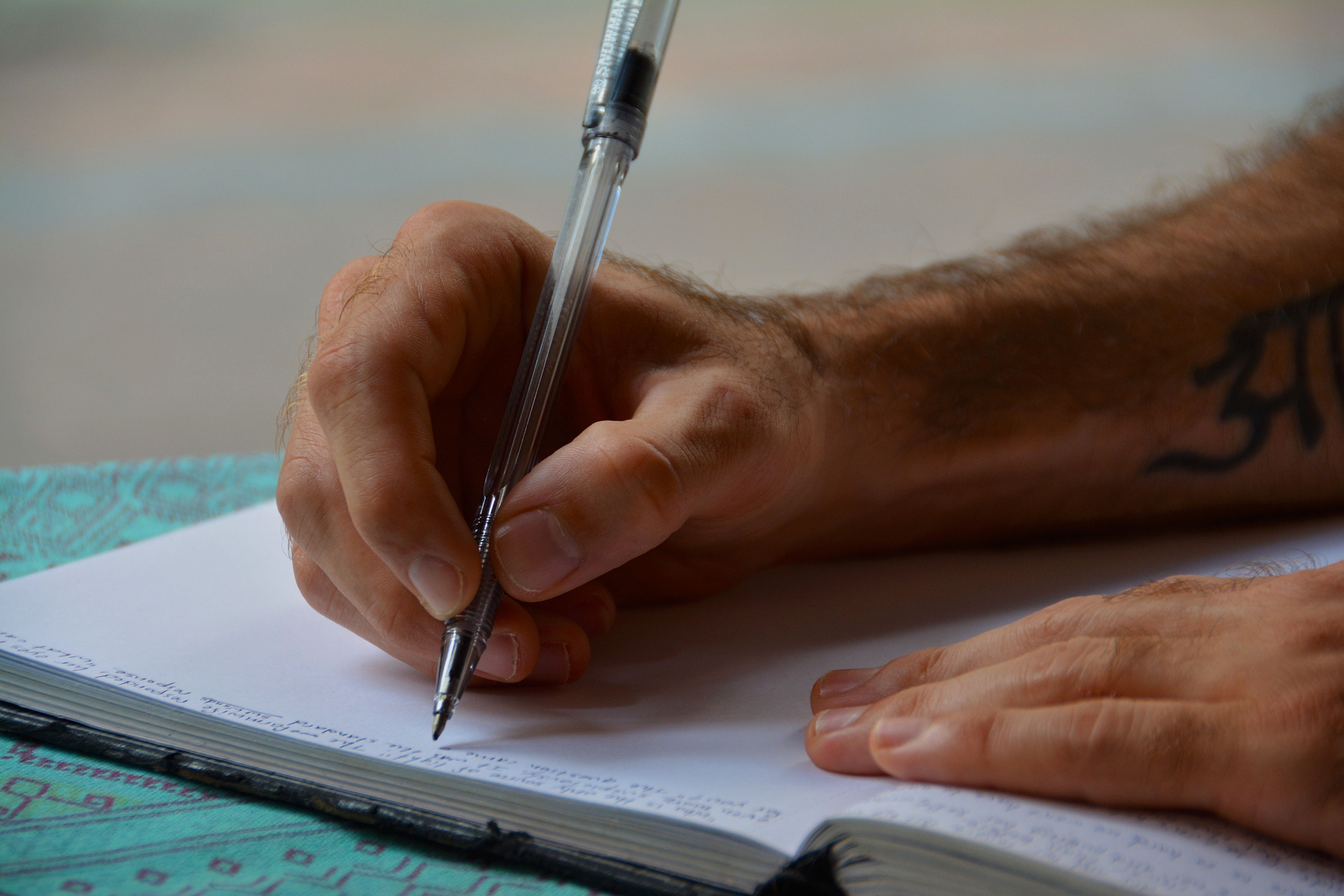
We’ll start with the absolute most basic. Pen and paper. If you are finding the word processor page stays empty, grab a pen and paper and just start writing. It doesn’t have to be plot or dialogue. It could be an outline, or some bullet points that encapsulate what you want to do, what you plan to do, what you need to do, or what you just can’t seem to do. Heck, you could even simply write down precisely what you’re thinking. A stream of consciousness rant could be all it takes. It might seem pointless at first, but all of this will be tracing its way along a different route through your gray matter. You will, by definition, not be rolling along in that same rut. It’ll increase the odds that you will find something new along the way. And if you need to change direction, it’ll be that much easier, once you’ve thrust yourself into unfamiliar territory.
What’s that, you say? You already do your writing in pen and paper, or you’ve tried pen and paper and it didn’t work? Well, you could skip ahead to the software section, or you could open the door to the harder stuff. Try a different pen, try a different paper. And if you’re ready for the truly arcane… ink up a fountain pen.
Old is New
If the goal is novelty, there is always another new thing to try in the ancient world of fountain pens. I am writing the first draft of this article with a fine nib, TWSBI Eco-T, inked with Diamine Oxblood ink. The experience is entirely different from the old pilot rollerball I usually use. Ever since I got a fountain pen for Christmas, I have been filling notebooks. It’s just interesting and new! And when the novelty wears off? There is always another ink color, another nib size, another pen. It’s the gift that keeps on giving. Just, you know, don’t get carried away. Budget is a factor. A fountain pen that costs more than your car is probably not going to do any better getting you unstuck than the $4 one from the drugstore.
But What about Software?
Software is the second half of the equation, and easily runs the same risk of breaking the bank, so I’m going to suggest you tread with caution. Throwing money at a problem seldom reliably solves anything beyond the rare issue of having too much cash. So we’ll focus on some free options. Whatever word processor you use? Check if it has a focus mode or a dark mode.

Anything that radically changes the visual nature of your writing environment will get those novelty juices flowing. You might even get a little jolt out of the rut just from changing the font or color. (Side tip: Changing the font and/or the font size is actually a really good idea when doing a second revision. It’ll move the line breaks around and help reveal those problems that were masked by straddling two lines.)
Budget Friendly
While there are plenty of people who already use them, I would be remiss if I didn’t mention LibreOffice/OpenOffice. These are free alternatives to Microsoft Office and the like that are every bit as capable. This matching level of capability actually makes them a poor choice for this particular technique, as switching to them won’t feel like much of a shakeup, and thus might lack that rut-dislodging jolt. For that, I’d recommend going the other direction. Use something less capable, like Notepad, or something differently capable, like Notepad++. These things will drastically change your writing experience. Not necessarily for the better, but more than enough to force you out of your calcified writing habit.
Transportable
Another excellent thing to try, for potentially non-obvious reasons, is Google Docs. While the different appearance/nature of the program might be enough to get the novelty-juices flowing, the real value here is portability. Google Docs will run on just about anything with a web browser, and will seamlessly deliver the same document to each device. This means, not only can you try typing on your phone or tablet for a change of pace, you can type on the bus, at the park, at the library, in the basement, etc. This is a method that offers a change of scenery. (Which is, by the way, a change also made possible with pen and paper. You would never believe the battery life on a spiral notebook.) Moving to an entirely new space can really get the brain moving in new directions.
Industry Standard
If you want to invest some money in your software solution, Scrivener is the industry standard for a reason. It is worlds away from using something like Docs or Word. You may find that the ability to thumbnail scenes and drag and drop them to change their order will force your brain out of its box enough to get the new ideas blooming once more.
Going Nuclear

Everything I’ve listed thus far has been recognizably “writing.” Either typing or handwriting. If you really want to start working different chunks of your brain, consider dictation. For the same reason that talking your way out of a plot knot can work, talking the plot itself onto the page is a huge departure from writing it down.
At its simplest, you could just be talking into a phone or pocket recorder with the intention to transcribe it later. (This, it should be noted, is yet another thing that can be done portably, and thus another thing that can be paired with a change of scenery or multitasking.) A higher tech option that also streamlines the drafting process is the use of voice typing or automatic transcription. Most phones and word processors, including Word and Docs, have this available in some form.
Making a change this drastic may not appeal to you. You may try it for 20 seconds and decide it isn’t for you. But even in this there is value. Back when I first started resorting to longhand to get unstuck, I typically found myself getting frustrated and retreating back to the old ways, but almost invariably I rushed back and did something. It was like a splash of ice water to my brain. Likewise with dictation. “If that’s the alternative, I’d rather do the other thing.”
In Conclusion
As I hope I’ve hammered home by this point, nothing is a surefire solution to curing writer’s block. And even though the old adage “The definition of insanity is doing the same thing over and over and expecting different results” is false–that’s called practice and it’s how you get the results you’re after–it’s true that trying the same solution to a problem is probably not the most efficient way to solve it.
Your brain has gotten you this far. It’s full of all sorts of inventive solutions. The problem is, if you’ve been picking all of the low hanging fruit, eventually the really tasty stuff will be out of reach. So get yourself a ladder. Maybe grab a long stick and start swinging it. And if all else fails, bang your head against the tree a few times. If nothing else, it’ll give you a change of pace, and who knows, maybe you’ll knock down a couple more fruits.
Have you ever been stuck in your writing? What solutions did you try and what worked for you?
About Joseph

Joseph R. Lallo took a crooked path to authordom. He was educated at NJIT, where he earned a master’s degree in Computer Engineering, and paid his bills in the world of Information Technology until Sept of 2014, when he finally became a full-time storyteller. The international bestseller The Book of Deacon defined his early career, and he has since written dozens of novels, short stories, and novellas. These include the critically acclaimed Steampunk series Free-Wrench and the thrilling sci-fi adventure saga, Big Sigma.
Outside of writing, he has co-hosted multiple self-publishing podcasts over the years, including the Six Figure Authors podcast with Lindsay Buroker and Andrea Pearson and the Science Fiction and Fantasy Marketing podcast.
First and last images in this post were purchased from DepositPhotos.
Second image by Dean Moriarty from Pixabay
Third image is a screen shot by Lynette M. Burrows