
Writers in the Storm

A blog about writing

storm moving across a field
10 Common Bedroom Objects to Use As Weapons

by Piper Bayard
of Bayard & Holmes

Everyone loves a good fight, and a good fight scene is arguably the lifeblood of every thriller. Since my writing partner, Jay Holmes, is a forty-five-year veteran of the military and intelligence communities, we are often asked what weapons we prefer for fights.

In truth, Holmes and I both advocate firearms training for the best self-defense, but shooting too many people in books tends to make for boring books. So we’re going to explore a bit more about how common objects can be used in a fight scene.

10 handy weapons in a bedroom.

Two weapons right there. Three if you count the flowers and water.

1. Nightstand Lamp

A nightstand lamp can be one of your character’s most handy weapons. They can grab it by the pole and smash the base into someone’s face. Even better, if the lamp has a long enough cord, the character can jerk off the lampshade and shove the bulb straight into the attacker’s face.

The broken glass of the bulb will cause bleeding, and if it is still plugged in, your character gets the added bonus of delivering an electrical shock.

2. Glass Vase

Your character can grab it by the narrow end or, if it’s a pitcher, by the handle and smash the vase into the opponent’s face. If the vase breaks off, that’s okay. Then it will be like a broken bottle that can be used to slice the face or shove into the neck or groin.

3. Jewelry

Your character can throw jewelry in someone’s face to distract them for the next blow. Also, if a necklace is long and sturdy enough, your character can use it to choke their target.

Pendants can be especially useful in that they can be used to smuggle poison. Also, if your character is like Piper, they have a long, needle-like fashion metal pendant on a sturdy chain that can be worn to the office, on a plane, or into any building. That long, sharp needle can do some damage to the eyes, throat, groin, or ear. A nice cloak pin or an old-fashioned hat pin can serve the same purpose.

Note that if your character shoves a needle-like pendant or anything else into an ear, they have to go more than a couple inches in to do serious damage or even kill. It is not a move for the uncommitted.

4. A Desk

Small desk drawers that come out quickly can be thrown at an opponent to distract them and give your character a chance to run or use follow-up blows.

A wide drawer can be used as a shield. If a character is very strong and a desk rather light, they might be able to flip the desk over in a sudden move to startle someone. It’s not a first-choice move in real life, but it could be fun in a book.

What a desk is not especially good for, though, is a hiding place. Not only is it entirely too obvious, but if your character is hiding under a desk, they are as good as painted into a corner when their stalker finds them.

It’s difficult to fight effectively when squatting on the ground, surrounded on all sides. If one of our characters is hiding under a desk, we’re going to make sure they have a loaded firearm at the ready.

5. Wall Picture

Your character can grab a sturdy picture off the wall and drive the frame into their target’s face to stun them for follow up blows to the groin or instep.

Something commonly seen in fiction that is a bad idea is breaking the glass over the target’s head. It’s not likely to disable them, and it is just as likely to cut your character.

6. Candle

Your character can grab a candlestick and shove it in their target’s face. If the candle is in a jar and has been burning a while, your character can flick the hot melted wax into the face of the opponent and follow up by smashing the glass candle into their face or temple.

Be sure to follow up with some debilitating blows, though. If the opponent already wanted to kill your character, they will certainly want to kill them even more after they get wax to the face.

A lit candle can also be used to start a fire, but keep in mind that, unlike in Hollywood, most real-life fires take a few moments to actually catch and be helpful.

7. Curtains

We don’t recommend that your character hide behind curtains if there are other viable alternatives for the same reason we don’t recommend them hiding underneath a desk. It’s too obvious, and it leaves your character pinned down when they are found.

However, if they have time, your character can tie curtains to something solid and use them to escape out of a window. Also, if your character knows someone is coming into a room, they can light the curtains on fire and hide behind a door. When the person comes into the room, they will be immediately riveted to the fire, giving the character the opportunity to smash the stalker with the door and follow up with blows as the target enters the room.

If your character is attacking, they can twist the curtains into a cord to use to choke their target.

One person's curtain rod is another person's stabby tool.

8. Curtain Rod

A good, heavy curtain rod can be wielded like a staff to poke, jab, smash, or block. Some curtain rods have fashion points at the end for stabbing at the face, groin, or ribs. If your character stabs into the ribs and hits a bone, don’t worry. The weapon will usually slide off the bone and into the body.

9. Blanket

Your character can throw a blanket over an opponent like a net and then either run or follow up with blows.

There is also always the tried-and-true method of lighting a blanket on fire while someone is sleeping in the bed. It generally takes the sleeper a few moments to realize what is happening, giving your character either time to escape or time to follow up.

Like all arson methods, we recommend that your character does not do this in their own home.

10. Cell Phone

Holmes’s favorite method of using a cell phone in a fight is to call in an air strike. However, if your character does not have an Air Force in their bedroom, they can use the light on their phone to flash in someone’s eyes. They can also use the phone to emit a distracting noise, or they can throw it at the opponent’s face.

If they have time, the character can use the phone to call 911, but that is not especially effective in an active fight. As the saying goes, “When seconds count, the police are only minutes away.”

A bed can also be used as a weapon, but we’ll leave that one to the romance writers.

On a general note, notice the frequent suggestions of targeting the face. Face wounds tend to stun and slow people. If someone is stabbed in the eye or through the cheek, they will have to mentally reset. Also, face wounds bleed. A lot. That and the fact that it’s lots of blood coming from a wound they can’t see tends to freak people out.

This gives your character time to follow up with a knee in the groin, a good stomp on the instep, or another stab or jab. Also, the target might feel compelled to put one hand over the wound, especially if it is an eye, leaving them to fight one-handed.

Always remember that with any fight, the greatest weapon your character has is their mind. Your character must be in a mindset to do what it takes to survive, or all the weapons in the world won’t help them.

What bedroom objects would your characters choose to incorporate into a fight? What questions do you have for us?

About Bayard and Holmes
Piper Bayard and Jay Holmes of Bayard & Holmes are the authors of espionage fiction and nonfiction. Please visit Piper and Jay at their site, BayardandHolmes.com. For notices of their upcoming releases, subscribe to the Bayard & Holmes Covert Briefing. You can also contact Bayard & Holmes at their Contact page, on Twitter at @piperbayard, or at their email, BayardandHolmes(at)protonmail.com.

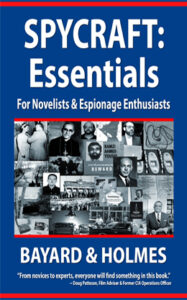
SPYCRAFT: Essentials takes the fiction out of spy fiction, covering the functions and jurisdictions of the main US intelligence organizations, the espionage personality and character, recruitment, tradecraft techniques, surveillance, firearms, the most common foibles of spy fiction, and much more. Available in digital format and print. See Bayard & Holmes Nonfiction for links to your preferred bookseller.


Top Image by Pexels from Pixabay.

Read More
What Doomscrolling is Doing to Your Writing Creativity

by Colleen M. Story

Is “doomscrolling” hurting your writing creativity?

If you haven’t heard of the term, it describes the act of consuming a lot of negative information at once, typically online.

It’s become more popular over the past year, but it could ruin your writing sessions. Here’s how and what you can do to protect yourself.

What is Doomscrolling?

With the onset of the COVID-19 pandemic, doomscrolling gained steam as people began scrolling their news and social media feeds for information on how to protect themselves. Things got worse during the George Floyd protests and later, during the 2020 election, as we all compulsively scoured the Internet in search of ever more terrible information.

Strangely enough, we feel productive while doing it. We’re gaining information about current events and informing ourselves about issues we have a reason to be concerned about.

The problem is that we often keep going even after we’ve gathered the basic information we need. Like witnesses to a train wreck, we simply can’t pull our attention from the constant stream of disasters.

Why Do We Doomscroll?

Experts point to several possible reasons. For one, most of us felt disconnected during the pandemic, with our only remaining connections to the world coming from our devices. Even amidst all the bad news we could share it with our online friends and thereby reclaim a little of the connection we were missing.

We were also feeling confused and frightened, so we turned to the news for more information as a way to protect ourselves. The hope was that the more informed we were, the better we’d be able to handle whatever might come our way.

Strangely, doomscrolling can also help us feel safe. The riots are occurring in another city, not ours, we think. The death rates are higher in another state than in ours. It’s not that we don’t have compassion for others. We’re just scared and looking for ways to reassure ourselves.

Unfortunately, whatever the reasons for doomscrolling, it can become a bad habit that can easily derail your writing practice.

How Doomscrolling Messes with Your Writing Practice

1. Doomscrolling increases stress, which destroys creativity.

Exposing yourself to negative news on a regular basis increases your stress levels. According to a 2017 study, watching the news triggered persistent negative psychological feelings, including stress and anxiety. In a recent survey by the American Psychological Association (APA), more than half of Americans said the news caused them stress, as well as anxiety and insomnia.

Stress, in turn, is terrible for creativity. In a 2002 study, researchers analyzed more than 9,000 daily diary entries from people who were working on projects that required high levels of creativity. They found that stress, in the form of time pressure, resulted in less creative results.

If you’re regularly doomscrolling, you're hampering your creative muse.

2. Doomscrolling negatively affects your mood, which inhibits creativity.

It’s true that positive thoughts encourage creativity, while negative thoughts discourage it.

In one experiment, scientists found that a positive mood facilitated work on a project while a negative mood inhibited it. A later study found similar results—those in a positive mood produced higher creativity ratings than those in a neutral or negative mood.

Doomscrolling typically increases negative thoughts and feelings, worsening your mood and making you less creative.

3. Doomscrolling can create sleeping problems, robbing you of creative energy.

When you spend significant time scrolling on your gadgets, you expose yourself to blue light, which in turn, can mess with the sleep hormone melatonin. In 2018, researchers found that greater screen time was associated with insomnia and shorter sleep periods. Negative news, on top of that, can leave your mind reeling with worries and anxieties that can be hard to quiet down.

All of this causes next-day fatigue, which is definitely not conducive to writing. You know how it goes when you’re staring at the blank page with heavy eyelids—not good.

4. Doomscrolling creates a vicious negative cycle that increases anxiety.

“The more time we spend scrolling,” clinical psychologist Amelia Aldao explained to NPR, “the more we find those dangers, the more we get sucked into them, the more anxious we get. Now you look around yourself and everything feels gloomy, everything makes you anxious. So you go back to look for more information.”

Not only can this habit cut into your writing time, but it can also leave you in a state of mind that discourages creativity. Who wants to sit and write a story when it feels like the world is going up in flames?

“When uncertainty is high, it drives our brains to seek as much information as possible to feel in control,” says Jacqueline Bullis, Ph.D., a clinical psychologist in McLean Hospital's Center of Excellence in Depression and Anxiety Disorders. This can make us feel slightly better in the short term but ultimately has the opposite effect.

“In the long term, these behaviors are increasing our anxiety by feeding into this belief that if we have enough information, we can control what happens,” Bullis said. “The more we seek certainty over what will happen in the future, the more anxious we will feel.”

5 Ways to Stop Doomscrolling and Boost Writing Productivity

Nothing good comes from doomscrolling, so the only thing to do is to stop. Here are some tips to help you do that:

1. Limit your exposure to negative news.

Set aside a certain amount of time to check the news each day, and then refuse to go over that time. As to how much is too much? Go by how you feel after you’ve finished scrolling. If you notice an uptick in anxiety or negativity, you need to cut back more.

2. Choose to get your information only from trusted sources.

Be selective about your media. Rather than falling down negative rabbit holes online, watch and read the news only from your trusted sources, then let it go. Bookmark your trusted sites and vow to check them only once a day.

3. Remove anxiety-provoking leads from your social media.

If you follow people who are constantly posting negative news, it may be time to unfollow them or to at least hide them from your main feed. Feel free to explain that you're taking a break from negative news if you like, but don't worry too much about what others think. Your health and ability to write is what matters most.

4. Soak yourself in inspiring news.

As a writer, it is your responsibility to take care of your creativity. That means inspiring yourself as often as you can with music, art, walks in nature, photography, workshops, books, and more.

Rather than immersing yourself in negative news, make a point to surround yourself with inspiring resources of information and inspiration. Do so for just a week and you're likely to see an increase in writing creativity.

5. Unplug at least once a week.

Choose one day a week to avoid social media, the internet, and the news completely. Use that day to allow your mind to rest and recuperate. Take a notebook and head to the park for some quiet time. Make an afternoon trip to the library and see what you can find that might inspire you. Spend some quality time with your family, or take your dog for a walk.

Reconnect to the other things in your life that you love and watch your mood and your energy soar.

How do you avoid doomscrolling? Did you do this more than usual during the pandemic?

For more help managing your time and increasing productivity, see Colleen’s award-winning book, Overwhelmed Writer Rescue.Get your free chapters here!


Sources

  1. Amabile TM, et al., “Creativity under the gun,” Harvard Business Review, 2002; 80(8):52-61, 147.
  2. Garcia-Navarro, L. (2020, July 19). Your 'Doomscrolling' breeds anxiety. Here's how to stop the cycle. NPR.org.
  3. Heid, M. (2020, May 19). You asked: Is it bad for you to read the news constantly? Time.
  4. How much news is too much news for good mental health? (2020, October 31). McLean Hospital | Mental Health Treatment, Research, and Education (Belmont, MA).
  5. Mastria, S., Agnoli, S., & Corazza, G. E. (2019). How does emotion influence the creativity evaluation of exogenous alternative ideas? PLOS ONE, 14(7), e0219298.
  6. Study links screen time to insomnia symptoms and depressive symptoms in adolescents: Regulating screen times may improve sleep health and reduce depression. (2021, January 12). ScienceDaily.
  7. Szabo, A., & Hopkinson, K. L. (2007). Negative psychological effects of watching the news in the television: Relaxation or another intervention may be needed to buffer them! International Journal of Behavioral Medicine, 14(2), 57-62.
  8. Vosburg, S. K. (1998). The effects of positive and negative mood on divergent-thinking performance. Creativity Research Journal, 11(2), 165-172.

About Colleen

Colleen M. Story inspires writers to overcome modern-day challenges and find creative fulfillment in their work. Her latest release, Writer Get Noticed!, was a gold-medal winner in the 2019 Reader’s Favorite Book Awards, a 1st-place winner in the Reader Views Literary Awards, and Book By Book Publicity’s best writing/publishing book of 2019.

Colleen frequently serves as a workshop leader and motivational speaker, where she helps attendees remove mental and emotional blocks and tap into their unique creative powers. Find more at her motivational site, Writing and Wellness, and on her author website, or connect with her on Twitter.

Read More
5 Dialogue Quick Tips for Page-Turning Fiction

by Kris Maze 

Editing a manuscript can be a daunting task, but it becomes easier when using time-tested dialogue suggestions. While I tip-toed through my first chapters, I discovered how to use this handy writers’ multipurpose tool. Slogging through stalled and unproductive scenes, the simple act of allowing my characters to speak had many purposes, and solved my writerly problems. 

With proper use of dialog, I could:

  • Keep an active plot moving during slower scenes
  • Break up sticky sentences
  • Tackle info-dumps
  • Intensify the tension
  • Incite reader curiosity

Dialogue is an essential part of a well-crafted story, but what does an author include and avoid?

Adding dialogue can move the plot forward and develop the characters, but too many words can bog down your tale. By sprinkling in dialogue, I improved the readability of my manuscript and built confidence in the work I will send to beta readers and editors.

But what are the basic rules to follow? Here are a few resources for editing this important part of fiction.

Keep the Plot Moving

 Sprinkling in dialogue is a spark plug to keeping a reader engaged. The long chunks of backstory and scene description can use the vehicle of dialogue to take the reader along on your literary ride.

Consider whether your story with description (in bold) of a bucolic countryside, complete with rolling hills and picturesque farmsteads, could be enhanced by the characters bringing these details to the reader instead:

              “We’ve been driving for like, forever!” Sam put her foot against the side window as she glanced at fields of spotted cows. “When are going to get there?”

              “You’re being dramatic, Sammie. Someday you’ll appreciate going to Grammie’s farm.” Her dad feathered the brakes when he spotted a deer and its fawn grazing too near the road’s graveled shoulder. “She’s not getting any younger.”

              “Me neither.” Sam slurped the dregs of a Biggie Drink purchased at the last tiny town’s gas station. “I had plans.”

              “I know it’s hard on you, but it’s my weekend with you and I didn’t have to work.” The pickup crossed a one-lane wooden bridge over a babbling brook, bouncing them around the cab. “I’m sorry you’re missing the big gig of your friend’s band. I’m going to make it up to you.”

              “I’ll believe it when I see it.”

He dialed the radio to one of two available stations. “See? I’ll let you choose. Classic rock or country.”

              “No, thanks. Listen to what you want, I brought my own.” Sam placed the headphones over her ears and opened her sketchbook. She started to replicate a circled design painted on a faded red barn.

Break up Info-Dumps

For the clunky parts in my chapters, I focused on the long paragraphs that would slow down the reader. These sections of backstory could be delivered better through the voices of my characters.

In the example above, we not only see that we are driving on a country road to Grammie’s house, but we get information about Sam and her dad, too.

We can tell that Dad has part-time custody, and he tries to use their time together in meaningful ways. Sam is a teen and acts with typical indignant behavior, as kids do when they lack control over where they are going and with whom. She likes a certain band and is being forced to skip their concert to visit her relatives. Dad has a sense of humor and jokes about the radio station, which Sam shuts out with her headphones and snarky comments.

We set the stage for a relationship reconciliation for Dad, and a potential coming of age experience for Sam. All through dialogue.

Show Don’t Tell

The writer’s mantra we all love to hate when we see segments of lengthy exposition all over our work. (Just me? Okay. We all start somewhere!)

I found that my areas without conversation were filled with showing the reader what was happening instead of letting the characters' conversation weave the drama.

Showing the reader how the characters feel and revealing their motivations is the most effective use for dialogue. Consider it a shovel when unearthing a tough, rocky passage in your work. 

In the example above, we see how the father is excited about spending time with his daughter and is exercising patience despite her angst. Sam is angry for potentially many reasons: not seeing her friend’s band, having to spend the weekend on a boring farm, her drink is empty, her music choices are limited, and her parents are divorced.

Dialogue can roll down the window and let the reader peek into the world you are creating.

Tags? We don’t need no stinking tags!

I’m pretty sure I ripped that one off from a cheesy comedy, but editors often recommend that writers use their tags sparingly, or *gasp* not at all.

Tags are used to help the reader understand who is speaking, but there are other ways to show this and draw a reader into your story. Try to eliminate the following tempting tags problems common to many writers.

  • He said. She said.  - According to online editing software, ProWritingAid, published authors use “said” as a dialog tag 60%, with “asked” at a distant second at 10%. These authors use nonstandard dialogue tags only occasionally. For these reasons, they recommend not using tags other than “said” and “asked” over 20% of the time.
  • Adverbs with Dialogue tags - Writers may want to describe how a character says something, but it distracts the reader and takes away from the words they say. Try not to upstage your characters. Using actions instead allows readers to make inferences and imagine more fully developed characters. ProWritingAid suggests that authors keep adverbs to under 12% of their total in one work.
  • Use the right words -If you still want to use unique dialog tags and you have over 12%, consider taking a hard look at the content of your conversation. Can you strengthen the wording to convey the emotion instead?
  • No laughing matter - According to Writer’s Digest, some common dialog tags shouldn’t be used because they don’t make sense. Words cannot be “smiled, giggled, laughed, or sighed.” Use “said” and save these actions for use as intended.
  • Hemming and Hawing - In real life, we pause and add filler to conversation. Eliminate those fillers when writing to keep the reader engaged. Try to avoid phrases such as “um, so, well” that slow down the dialog.

Using fewer tags takes a little practice and critical reading to find examples to model. I am thrilled to say my example above contains exactly zero tags in it. *air high fives for everyone*

Don’t be intimidated by the minutia of punctuation that typically gives me hives, try using dialogue to fix sticky parts of a manuscript.

5 Dialogue Constructions

Here are 5 constructions of dialogue to use in your writing. Experience the following benefits to your dialogue:

  • Use these to increase the variety in your writing.
  • Write with confidence! Let those curly or straight quotes take a seat to your clever character’s words instead.
  • Improve the readability of your work.

I’m using American English Rules to compile this list, but punctuation standards may differ by region and country. Always check with the editor or submission guidelines to see what style, or dictionary they prefer.

My examples below come from The Catcher in the Rye, by J.D. Salinger, in a scene where Holden is arguing with his roommate:

Dialogue Formatting Demystified:

  1. Single Line Quote - These have a line of dialogue within quotation marks and no tag. The sentence punctuation occurs within the quotes.
  2. Single Line Quote with Tag - A quotation with a tag, either before or after the quote. Note the punctuation differences for each location.
  3. Dialogue Tags within a Quote - add a natural pause with this strategic tag placement.
  4. Quotes with body language or actions within the dialogue - adding body language and small actions can control pacing and add depth to the words spoken.

Then, when he was taking off his tie, he asked me if I’d written his goddam composition for him. I told him it was over on his goddam bed. […]

              All of the sudden, he said, “For Chrissake, Holden. This is about a goddam baseball glove.”

              “So what?” I said. Cold as hell.

              “Wuddaya mean so what? I told ya it had to be about a goddam room or a house or something.”

              “You said it had to be descriptive. What the hell’s the difference if it’s about a baseball glove?”

              “God damn it.” He was sore as hell.  He was really furious. “You always do everything backasswards.” He looked at me. “No wonder you’re flunking the hell out of here,” he said. “You don’t do one damn thing the way you’re supposed to.  I mean it. Not one damn thing.”

If you want more of a deep-dive into the mechanics of using quotations, this article explains why we place punctuation in specific parts of the sentence. It also explains more scenarios than I dig into here, with several simple examples to clarify these guidelines.

Hopefully, these writing tips will help to nail down the details of your newly renovated dialogue and help pick up the pace of your story.

What tools do you recommend we add to the writing dialogue toolbelt? Is there a grammar point you struggle with as a writer? Add some writer encouragement for better editing and share your thoughts with us today!

About Kris

Kris Maze author pic

Kris Maze is an author, freelance writer, and teacher. She enjoys writing twisty, speculative fiction with character-driven plots. After years of reading classic literature, mysteries, and thrillers, she began to write and publish her own books. She also writes for various publications including a regular post at the award-winning Writers in the  Storm Blog. 

When she isn’t spending time with her favorite people and pets, Kris Maze is taking pictures, hiking, or pondering the wisdom of Bob Ross. You can follow her author journey at her website at KrisMazeAuthor.com

Read More

Subscribe to WITS

Recent Posts

Search

WITS Team

Categories

Archives

Copyright © 2026 Writers In The Storm - All Rights Reserved