Writers in the Storm

A blog about writing

storm moving across a field
Writing Deep Point of View Like A Pro: A Checklist

Lisa Hall-Wilson


You don’t know what you don’t know, right? That’s part of what makes writing in deep point of view so hard. I have spent years studying this technique and continue to learn more about it. But if you had a place to start maybe you could get started on your own.

But what if you had a checklist?

I’ve been teaching deep point of view for six years online, and my students have repeatedly requested this resource, so I thought I would first post it here with the good readers of WITS.

The Basics

The basics of deep point of view is often where a lot of books and writers start and stop learning about deep point of view. Without these bits, the more advanced techniques are going to fall flat, but there’s so much more than these bits to build on to really make deep pov work for your story.

Immediacy

The power of deep point of view is creating a sense for readers that they’re IN the story AS IT’S HAPPENING with your characters. This isn’t a question of using past or present tense, instead write as though the action is happening in real time for readers.

Avoid Naming Emotions

Deep point of view takes telling more seriously than any other writing style, I’ve found. If you write an emotion word (to describe how your protagonist feels) that’s probably telling in deep point of view. Instead, show what that emotion feels like. Don’t tell me they’re happy, show readers what happy looks like to them. What happy feels like to them. Deep point of view is IMMEDIATE and PERSONAL.

Limit Distance

If story is a car and your protagonist is the driver, deep point of view puts the reader in the driver’s lap. They want to see what the protagonist sees, feel the vibrations in the wheel, the pressure under the feet from the brake, the lurch as the car shifts gears—all of it AS IT’S HAPPENING.

Some words that raise red flags because they automatically create distance for readers include:

watched, saw, felt/feel, wished, heard, thought, made, caused, hoped, knew, wondered, wanted, believed, regarded, noticed, looked, smelled, realized, decided.

When these words are used to ‘tell’ the reader something you could ‘show’ them you force the reader into the theatre seat and out of the story.

Incorporating Senses

We want to provide readers with an immersive fictive dream with Deep POV so using as many of the senses as possible is important (but maybe not all at once).

Choose one sense, the most prominent detail, to help bring an individual scene to life. The most prominent sense to show/provide insight into your character based on their fears, past experiences and associations, level of tension, etc.

Advanced Deep Point Of View Techniques

Subtext

Subtext can happen in dialogue between two characters, between a character’s thoughts and their outward actions, in internal dialogue, and in the setting.

Beats

In deep point of view, we want to avoid using dialogue tags (he said, she said) because it builds distance and instead use beats, which is bits of action to attribute speech. Take this idea an extra step and strive to use beats but avoid stage directions. Make each beat move the story ahead in some way rather than just attribute speech.

Literary Devices

Many literary devices give readers information about our characters, but it’s subtle. The reader will say what they know, but may not know why they know that detail. Look into devices like foreshadow, personification, pathetic fallacy, simile, metaphors, metonymy, etc.

Character Voice

This is tricky because it’s often confused with author voice. In deep point of view, you (the writer) are not telling the story the protagonist is. How would they describe things? What would they be sure to notice or overlook? Each character will tell the story using their own truth.

Emotional Arc

Emotional arc is another level of intensity for readers. How does the character change throughout the story? Think of a movie like The Greatest Showman. Hugh Jackman’s character starts out pushing against what seem like impossible odds, but when he gains the success he’s always dreamed of that changed him. In order to reach his personal goals, he had to change his priorities, goals, and personality. He didn’t just go back to the way he was before he was successful, there was an arc not a circle.

Layering Emotions

This goes along with the emotional arc. By using emotional layers, you learn to work backwards from the emotion you want portrayed to find the primary emotions fueling that behavior. This adds nuance and authenticity.

Internal Dialogue

Many of these advanced techniques are evidenced in a character’s internal dialogue. There’s so much to learn here. I strive to learn one or two new things about internal dialogue with each manuscript. Each step forward helps you get closer to where you want to be.

Body Language

Become a student of how people communicate. We say so many things to others with facial expressions, posture, tone of voice, gestures, etc. This really goes hand in hand with emotional layering.

Backstory

Backstory should answer one question and leave the reader with two more. Keep it relevant to the scene at hand. Backstory is one of the advanced bits that bleeds into many of the others such as internal dialogue, character voice, and emotional arc.

Write Tight

With deep point of view, very likely your wordcount will increase. This doesn’t have to be a bad thing as long as every word you use moves the story ahead. It’s very easy to have a character catalogue the furniture in a room without any purpose to it, or recount the physical details of someone they meet when that description could be used to give readers insight into your protagonist.

Intimate Point Of View

Your protagonist can only share with readers what they know, see, hear, feel, taste, touch, assume, etc. If your protagonist doesn’t know something, the reader can’t either. This restriction means this writing technique will serve certain genres better than others. However, you don’t have to use deep point of view for your entire novel. You could use deep point of view to create a specific effect in key scenes to ratchet up the tension or create emotional punch for readers.

Gah! I’m out of space. Listen, I’m just skimming the surface here, but this is a list that will get you started. I am doing a free 5 Day Deep Point Of View Challenge on Facebook in October. It’ll be in a closed Facebook group. You can sign up for the waiting list here so you don’t miss out when I have all the details put together.

What aspect of writing in deep point of view do you struggle with the most?

Get your copy of Method Acting for Writers: Learn Deep Point of View Using Emotional Layers on Amazon or Kobo.

*  *  *  *  *  *

About Lisa

Lisa Hall-Wilson

Lisa Hall-Wilson was a national award-winning freelance journalist and author who loves mentoring writers. Fascinated by history, fantasy, romance, and faith, Lisa blends those passions into historical and historical-fantasy novels.

Find Lisa’s blog, Beyond Basics for intermediate writers,  at www.lisahallwilson.com.
Read More
Why Learning Writing Takes So Long

I'm taking a break from first page critiques this month, because something is bugging me and I have to get it out.

Continue to send your pages, though, I'll be back next month with a crit!


I traveled to speak at a writer's group last weekend (I do that, you know. Contact me if you're interested). I was talking to a writer there, and she bemoaned the fact that she didn't have this down yet.  She was still making mistakes. I've heard this many times. I'll bet you've said it to yourself, too (God knows, I have). So I thought a reminder of what 'writing' entails, might help you give yourself a break already!

First the science: (and thank you to Roger Manning for explaining this to me).

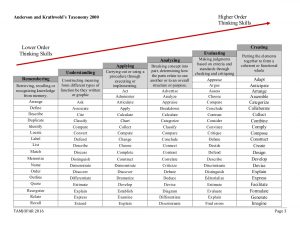
Higher-order thinking, known as higher order thinking skills (HOTS), is a concept of education reform based on learning taxonomies .The idea is that some types of learning require more cognitive processing than others, but also have more generalized benefits. You can read more about it HERE, but I think a chart is easier to understand:

Trust me, there are a lot more items in the lists, but I didn't want to bore you. But take a look at the items here - any look familiar? Yeah. Most of them are used in creative writing! YIKES!

"The reason typos get through isn't because we're stupid or careless, it's because what we're doing is actually very smart, explains psychologist Tom Stafford, who studies typos of the University of Sheffield in the UK. "When you're writing, you're trying to convey meaning. It's a very high level task," he said.

As with all high level tasks, your brain generalizes simple, component parts (like turning letters into words and words into sentences) so it can focus on more complex tasks (like combining sentences into complex ideas). "We don't catch every detail, we're not like computers or NSA databases," said Stafford. "Rather, we take in sensory information and combine it with what we expect, and we extract meaning." 

When we're reading other peoples' work, this helps us arrive at meaning faster by using less brain power. When we're proof reading our own work, we know the meaning we want to convey. Because we expect that meaning to be there, it's easier for us to miss when parts (or all) of it are absent. The reason we don't see our own typos is because what we see on the screen is competing with the version that exists in our heads.

This can be something as trivial as transposing the letters in "the" to "hte," or something as significant as omitting the core explanation of your article. In fact, I made both of these mistakes when I wrote this story. The first was a misspelling in a sentence that my editor had to read aloud for me before I saw it for myself. The second mistake was leaving out the entire preceding paragraph that explains why we miss our own typos."

You can read the whole article HERE.

See? We're trying to complete low level tasks and very high level tasks at the same time! Can you imagine how complex your brain is to be able to do that?

Then there's the mechanics:

SPELLING

Yes, we have way more tools than they did years ago (Thanks, Word, for telling me when I'm wrong-most of the time), but this is the nit-picky, in the mud, the blood and the beer editing that make my eye twitch. Even when we're careful, we tend to read what we meant to write, not what's on the page.

Suggestion: Have Word, or another program, read it back to you. You'll hear things you won't see: missing words, clunky sentences, change in tense, etc.  OR, pay someone to do it. It's worth it to me not to have to go over that ms one more time (and you know I'm cheap).

GRAMMAR

Sentence structure, punctuation, adverbs, pronouns, dangling participles! There is SO much to know here, and finding out you're doing something wrong after your book is published is uber-embarrasing. Word can suggest, and Margie Lawson is the queen of rhetorical devices, but when it comes right down to it, you have to know this stuff to earn your chops as a writer. Personally, I'll never get Lay vs Lie (had a college professor try) and I'll admit to comma-drama.

GETTING THE STORY OUT OF YOUR HEAD, AND ON THE PAGE IN A COMPELLING WAY

It seems so easy when you're reading a good book, but anyone who's tried to write can tell you, it's like the Olympics; Those little girls make gymnastics look easy because they learned it right after walking, and then practiced for years.

The only thing that works here is sweat-equity. Sorry, but if I knew a faster way, I'd be using it. Keep writing - you'll get better.

STORYTELLING

This is probably the highest thinking of all. We all know a story needs a beginning, middle and an ending. Sounds simple. It isn't.

ALL THE REST

  • Writing fresh
  • What tense to use?
  • What genre?
  • Jump-off-the-page characters
  • which POV to choose?
  • Where to begin
  • Backstory

And you wonder why you keep putting e after I? Why you mix tenses?  Sheesh people, you're doing the equivalent of riding a unicycle and learning to swing a golf club, all at the same time!

It takes YEARS to master all of the above, and I haven't even mentioned voice! So give yourself a break. Give yourself time. Adopt a child's view of mistakes: they're just ways that didn't work.

Be gentle with yourself, people, keep going, and you'll get there. I guarantee it.

Do you scold yourself for mistakes? Friends who do? What's your worst offender?

 *     *     *     *     *

Like Laura's books/posts? There are two ways to get more!  Sign up for her quarterly newsletter, or her Write Stuff short podcasts on the craft of writing, and have them delivered to your inbox. What's easier than that? Want her to come speak or teach online to your group? You can do that here.  Oh and did she mention she has a December release?

Read More
Involving the Reader in Character Building

Eldred Bird

Good stories are built around great characters. If readers don’t identify or sympathize with your protagonist, they’re not going to care enough to come on your character’s journey.

We writers generally have a picture in mind when it comes to the characters in our books. We know what our heroes and villains look and sound like. Height, build, hair, eyes, accents—it’s all etched inside our brains. As we write, we want the readers to see exactly what we see . . . or do we?

Les Edgerton stated, in an earlier post here at WITS, that giving too much description can actually keep the reader from investing in a character. His theory is that by giving only information essential to the story and letting the readers fill in the blanks with familiar images, the characters become more personal and recognizable.

What happens if we remove all character description?

We bring our own biases and perceptions into the characters we create, often pulling in elements of ourselves and people we know. I was curious to see what readers would do when my own vision was removed from the equation (to the extent that it’s possible), so I did an experiment.

My hypothesis:

In the absence of physical description, the readers would paint their own picture and reveal their own biases.

To test my theory I wrote a short story, Treble in Paradise: A Tale of Sax and Violins. I left out any physical descriptions or details that might influence how readers would picture the protagonist: gender, religion, physical attributes, ethnicity. I included only a vague idea of age. I kept the language gender-neutral as well.

The story was written in first person POV in a journal entry style, as we have a tendency not to describe ourselves physically in that format. That choice made leaving out those details feel more natural.

At the end of the story, I asked readers to close their eyes and without referring back to the text, picture the protagonist and describe that person to me. I wanted to know who they would see without my words guiding them to build the image.

Results:

Though a couple of readers came close to my own vision of the protagonist, no one described the character I’d seen when I wrote the story. Only one person mentioned noticing the lack of description, but indicated that it was not an issue for them.

An equal number of men and women took the time to respond to the question. All but one respondent pictured a male protagonist. To my surprise, the lone respondent who saw a female was a man. This might say more about societal expectations and bias rather than that of the individual readers.

What did the readers tell me?

Beyond the near unanimous agreement on gender, the descriptions covered a wide spectrum.

  • People guessed the age of the musician as anywhere from mid 30s to late 50s.
  • Body types varied from thin to chunky, but most everyone saw pale skin and dark hair with at least a tinge of gray.
  • A couple of people admitted to seeing themselves, and a few even scoured the internet and provided images matching their vision.

Though I had only asked for a physical description, many people responded with emotional descriptions as well. Two readers even built a back-story for the protagonist. I don’t think I could ask for a closer reader connection than that.

What have I learned from this experience?

  1. My first take away is that sometimes less really is more. Trying to force my image of the character into the mind of the reader may push them away rather than bring them closer.
  2. Removing all description is extremely difficult, and not always practical. There may be certain physical details that are required for the story to work.
  3. The big lesson is to TRUST THE READER.I have a tendency to over-describe or over-explain because I fear people won’t get the idea. Believe me, they get it.

While the physical descriptions from the readers often differed from my own vision, the emotions described didn’t, and emotions are what our stories are all about.

This experiment had a profound effect on me as a writer.

Telling a story is about taking the reader on a journey, not just getting them to a destination. Never again will I attempt to spoon-feed the readers information. Instead, I’ll leave more to their imagination so they can fill in the blanks with familiar images. I want them to have a personal experience with the characters I’ve created. Building in too much detail can create a brick wall that blocks their view of the story.

*  *  *  *  *  *

About Eldred

Eldred Bird writes contemporary fiction, short stories, and personal essays. He has spent a great deal of time exploring the deserts, forests, and deep canyons inside his home state of Arizona. His James McCarthy adventures, Killing Karma and Catching Karma, reflect this love of the Grand Canyon State even as his character solves mysteries amidst danger. Eldred explores the boundaries of short fiction in his stories, The Waking Room and Treble in Paradise: A tale of Sax and Violins (Treble is free on Amazon for the next few days).

When he’s not writing, Eldred spends time cycling, hiking and juggling (yes, juggling…bowling balls and 21 inch knives). His passion for photography allows him to record his travels. He can be found on Twitter or Facebook, or at his website: http://www.eldredbird.com/.

Read More

Subscribe to WITS

Recent Posts

Search

WITS Team

Categories

Archives

Copyright © 2026 Writers In The Storm - All Rights Reserved