“Don’t judge a book by its cover.” That is good advice for life, but it doesn’t work for actual books. Readers DO, and always will, judge a book by its cover, and there is nothing you can do about it. No, wait, I lied. There is something you can do about it. You can understand that your cover is a very important marketing tool for your book and act accordingly.
Usually when I come to WITS I talk about branding, and today is different in that instead of discussing your author brand, I’m going to get more specific and discuss your book’s brand by answering a few of the book cover questions I’m frequently asked.
First, remember your author brand represents you as a writer and all your books, regardless of genre. It should not be book or book series specific. Your book brand, on the other hand, applies only to that specific book, though series are branded as well. Your book brand consists of:
The title
The cover
The description/blurb
For this post I want to focus primarily on the cover, but the advice I’m giving you should help you in all three areas.
How do I decide how my cover should look?
That is both difficult and simple. Authors tend to be literal people and want their covers to depict a specific scene, or tell the whole story in an image. But that is both not possible, and not wise. The cover's job is to catch the readers eye and pull them in to read the blurb. It should speak to the genre and general spirit of the story. This can be done in so many different ways. The key is choosing the way that will most catch the reader of your genre. To do that, you must know what else is out there and what sells the best.
I highly recommend that before you choose a title, cover, or even finalize your blurb, you go online and visit Amazon, Barnes & Noble, and iBooks. (Sure, you can go in to a B&N store, but you will get a larger sampling online.) Go straight to the best sellers, in your genre and subgenre. Amazon is best for this.
Look at the covers for the top 25-50 in your subgenre. What do they have in common? Take close, analyzing looks. How many have people on the cover versus just objects or text? What are common base colors? Are there couples, or just women or men? Now narrow it down to the top ten. How many of those traits do each of those have? Remember to compare the traits in the titles and blurbs separately.
Once you determine the qualities all or most of the covers have in common, you should include those in your own cover.
If you already have a cover, look at it in comparison to the top covers in your subgenre. How does it stand up to them? Does it have any of the common traits they all share? Does it look as professional as the others? If the answer is no, then you may want to re-brand your book.
*TIP: When working with your designer, whether you are starting from scratch with a brand-new book or getting a new cover for an already released book, I recommend having a minimum of 3-5 covers in your genre (good selling preferred) that you like to show your designer. NOT so they can copy them, but to give them a strong idea of what you like and what is working in the genre. Some designers will ask for it, some won’t. But I recommend sending them over regardless. It cuts down on miscommunication and can end in a better cover for you, faster.
But what if I don’t want to be like everyone else?
By all means, be unique. Do you and your cover how you want. But don’t be surprised if your book doesn’t sell. Am I saying that there is nothing unique in the world and you shouldn’t try? No. What I am saying is, just like writing to formula, people do it because it works. Tropes exist because people buy them. Readers read them. Period. The same goes for book covers. So all of the best selling covers in your genre have shirtless men on the cover, but that just irks you and you don’t want yours to be like that. Fine, but if the top 100 have shirtless men, don’t be irked if you don’t make the list.
The cover's job is to snare the readers attention. Then it’s the blurbs job to reel them in and make them click that buy button. If a shirtless man is what it takes to snag the attention of readers in your genre, then it should be worth serious consideration for you.
You shouldn’t have to decide between being “true to your art” and selling books, but you know what? You often do. So, the best advice I can give you is to make a thorough assessment of your motives for writing and your career goals, and make your decision based on that.
My book isn’t selling should I re-brand it?
There are a lot of reasons a book doesn’t sell such as:
Little to no market for the book/genre
Poor reviews.
Little (or ineffective) advertising/marketing.
The cover and/or brand isn’t appropriate for the genre.
99 million other reasons.
Some of the reasons are harder to control than others. One thing you should always do for a book that isn’t selling is check how it’s brand lives up to the others in the genre. Use the tips above to evaluate your books brand effectiveness. If it does not fit will with the other books, then yes, you should absolutely re-brand. Of course there are other considerations, such as cost and time commitment. Also, if you have it published as an audio book you may not be able to change that cover.
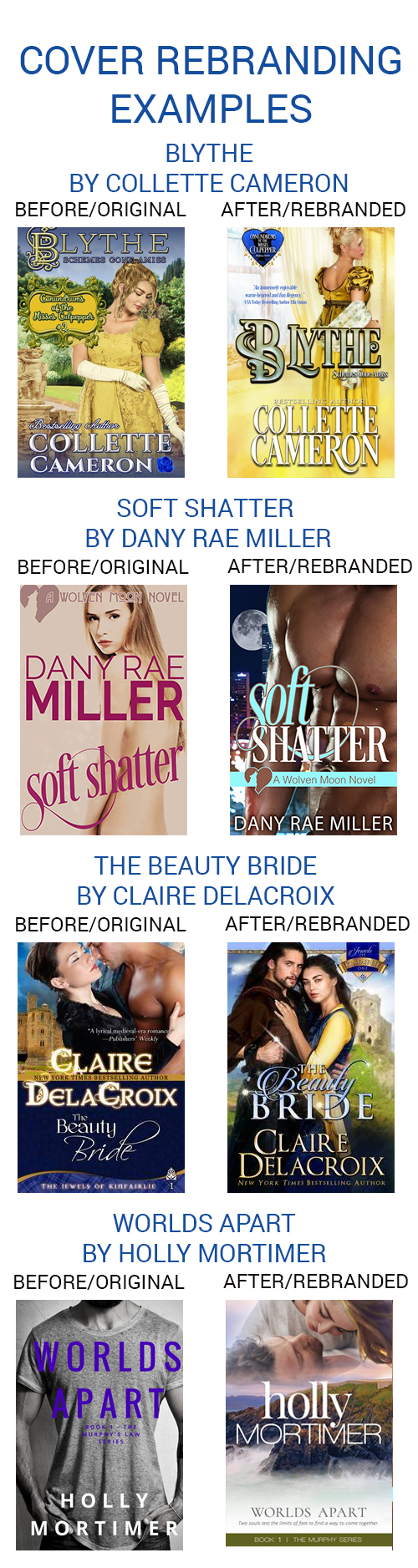
But on the whole, I am a fan of re-branding if you can afford it and have done the research to make sure that your changes will work better. But don’t take my word for it. Before writing this post I talked to many other authors who have, for one reason or another, re-branded their books or series. Though some had different reasons for changing their covers, the common main reason was that their cover was not right for their genre. They all reported positive results once they changed their covers to something more genre appropriate.
As you can see in these examples from those authors, some of them had wonderful, professional looking covers to start with. Yet they didn’t fit the genre. All of these cover before & after examples are from authors who said that once they re-branded their sales increased. Here are the links to these author's websites: Colette Cameron, Dany Rae Miller,Claire Delacroix, Holly Mortimer.
Do you have questions for June? If you've done something "outside the box" that worked, we'd love to hear about it!
ABOUT JUNE
June Stevens Westerfield is author of romantic fiction. She has been in the publishing field one way or another for over decade. She has helped launch several small publishing houses, worked in acquisitions, editing, cover art, web design, as a blogger, radio host, and assisted many authors in their self-publishing journeys. Her particular expertise is in design and branding.
On a personal note, when not writing or working for ABE, she designs greeting cards. She has a wonderful husband, a brilliant stepson, 6 fur-children, purple hair, and a chronically filthy house.
* * * * * *
ABOUT ABE
Author Branding Essentials is dedicated to offering comprehensive author centric branding and design services at competitive prices. As an Author, your name is your brand. Building your Author Brand is key to success. Many agents encourage authors to begin building that brand long before they are published. At Author Branding Essentials we understand the unique criteria it takes to build an author brand, versus another type of business. We can help you decide on the best options for your author brand and help you implement them.
The publication of my debut novel, Perfectly Undone (shameless plug), is only a couple of months away now and because of that, I've been getting asked often if I'm stressed out about it. There's certainly a lot to prepare for, with marketing strategies, guest blogs, book signings, etc. And maybe more importantly, there's the anticipation of how the book will be received. There's simply no preparing for that. No checklist to mark off there.
The truth is, though, I'm not actually stressing out about it. Maybe I'm naive, never having done this before, but over the last year, as the date has grown closer and the "published author" expectations have become a part of my daily life, I've made it a priority to find ways to keep stress from overcoming me. With everything there is to do in the pursuit of building a successful writing career, it can be too easy to get caught up in taskmastering and forget to enjoy the ride. It can be too easy to forget to enjoy life.
If you've followed my journey to publication at all, you know it has been a long, sometimes tough, road for me. It's been 3 1/2 years since I signed with my agent, and 5 1/2 years of full-time writing, blogging, and platform building before that. This gig is a heck of a lot of work without any guarantee of ever succeeding and I sure would hate to miss the moment I've been doing all this work for. What a disappointment it would be if I forgot to honor myself and everything I've done to get here at the time it matters most.
It's not easy to let go of the idea of being stressed. We forget that stress is a choice--it seems like an inherent part of releasing a book, or anything else we want to accomplish. I fall into moments of panic when I get too caught up in my head, but then I remind myself of the kind of life I want to live--published author or not--and words like fulfilled, healthy, joyful, and adventurous are at the top of my list. It's hard to feel that kind of success if I allow stress to take the wheel. But the mindset we carry with us in any situation is absolutely our choice.
As the quote by Charles R. Swindon says, "Life is 10% of what happens to me, and 90% of how I react to it."
Here are some things I'm doing to protect my sanity as life gets busier, that you might try if stress has become your main operator:
1) I have come to accept and love that I have my own approach.
There are a million lists out there of what writers "should" be doing to prepare for a launch, or build their platform, or write their book, or raise their darn children. And I've stopped reading all of them. In fact, just like with raising children, we all know in our hearts what is best for our own unique approach, if we listen to it. If we get all the noise out of our heads.
2) I am being diligent about questioning my own thoughts and expectations.
Where do they come from? Is this really my own voice speaking or is it my parents, my past experiences, or my community? I have found, through much soul searching and honest conversations with my friends, my agent, and my publisher, that much of the seemingly outside expectations we carry around are actually our own expectations. (Hint: Most of them aren't as expected as we believe, if at all.)
In our desire to be perfect, we feel like we have to do all the things we've been taught are necessary to be accepted by our peers. I know that's some heavy stuff that you might not be prepared to dig into, but for now, ask questions--of yourself and of the people you're working with. What are the true expectations, and what are you willing to release in order to enjoy the process, in each moment and for many years to come?
3) I am honoring my process.
Over the years, I have been an eager examiner of what works and what does not work for me when it comes to writing and my business. For instance, I know I don't do well when I'm up against a deadline, and release day is pretty much the most looming and immovable deadline of all. To account for that, I requested the promo list from my publicist months ahead of time so I could work through it in my own way, in my own time. No matter where you are in your career, or what you might be working on, don't be afraid to ask for what you need in order to create the time and space to honor your own process. Boundaries, with other people and with yourself, are the essence of a stress-free life.
I've recently fallen in love with the quote by Fritz Perls that says, "Fear is excitement without the breath." Fear and excitement originate in the same place in our bodies (the adrenal glands, if you're curious)--we choose which one we experience by whether or not we take the time to breathe. So we choose whether or not we experience the joy of our accomplishments by how high we prioritize or own happiness.
Stress has become such an accepted part of everyday life that the struggle to overcome it is a long, arduous road, but I do believe it's a goal we can accomplish with patience, forgiveness, and fierce determination. And I feel a lot closer to achieving it on the days I let my heart guide me.
Jamie is on a wonderful vacation, but we can still talk about how you deal with every day—and writer—stress.
ABOUT JAMIE
Jamie Raintree is an author and a writing business teacher. She is also a mother of two girls, a wife, a businesswoman, a nature-lover, and a wannabe yogi. Her debut novel, PERFECTLY UNDONE, will be released on October 3, 2017 by Graydon House. Subscribe to her newsletter for more writing tips, workshops, and book news. To find out more, visit her website.
acronym: a word, such as NATO, radar, or laser, formed from the initial letter or letters of each of the successive parts or major parts of a compound term; also, an abbreviation, such as FBI, formed from initial letters.
Acronyms are a type of abbreviation. Chances are, your characters see, understand and use acronyms. And that can be very useful to you, the writer.
How can you use an acronym?
Give a context to the world your characters inhabit: You'll use acronyms that everyone will recognize, like AMEX, TSA, IRS. You don't have to spell out the meanings of common acronyms; in fact, omitting the cumbersome definitions is exactly why you use this type of acronym.
Succinctly enhance setting: If you read AI in a blurb, you're probably going to be reading a science fiction or contemporary/near future work involving computers and artificial intelligence. Think HAL in 2001: A Space Odyssey or Bladerunner. I write science fiction military adventure romance (how's that for a sub-genre?) so SOL, SNAFU, and FUBAR and other acronyms that originated in the military let you know you've entered my world.
To convey mood: If you're an actor, when the cast hears the play is SRO, the mood backstage is energized, happy, expectant. Standing Room Only means your job is guaranteed past tonight. It means big names in the business will take notice, and maybe that break you've been hoping for will materialize after the next performance.
Give readers "in the know" an "Easter egg": If you're in a hospital and you overhear a nurse say that your roommate is going to get a 3H, you can be glad you're not in line for that procedure. 3H is a medical slang acronym for an enema that is "high, hot, and a Hell of a lot" that is given to troublesome patients. You don't need to define all your acronyms, but you can show their meanings through context. When you don't define an acronym that's been used in dialogue, it probably won't impact your story, but a reader who knows what those letters mean can smile, knowing they've found that secret surprise you left for them.
Reveal unknown information: You can make up your own acronyms and reveal the definition when it will make the most impact. In my debut YA book, PRISM, the name of the planet matches the landscape of a world where government and military leaders were exiled to twenty-five years ago. Instead of plants, crystals and crystalline forms grow. The reader sees the sunlight streaming through prisms of different shapes and colors. It's a harsh, but beautiful, planet. Late in the book, the hero sees a top secret folder stamped P.R.I.S.M. The cover page reads Prisoner Relocation Internment Security Management. This information changes the mindset of the hero—and, hopefully, the reader. Because this prison world was never meant as a place for a thousand people to survive and thrive.
Avoid overused acronyms. ROTFL was fun when it first became widely used. Now, it's not so fresh, which means description, either visceral or using the senses will have much more of an impact.
Add humor: What if my character uses acronyms but can't spell? What if she changes the meaning of the acronym with one letter. Say she types ROTFS for rolling on the floor screaming. She thinks its hilarious, but no one knows what she means. If I wrote anything funny, I could see this used as a running gag to reveal her character. Imagine she texts, "HM, I had my first VT at lunch today." HM: holey moley, VT: vampire taco Warning--PSA (Personal Story Ahead): I guess it's been a long time since I've been out to eat, because today, I saw a "vampire taco" on a menu. I asked what it was and the server described it. It sounded innocuous, and who doesn't want to brag they've eaten a vampire taco? So I ordered it. Let's just say the server needs to talk to the cook. But I have eaten a vampire taco.
Have you used acronyms in your writing? How might you add them to your WIP?
* * * * * *
ABOUT FAE:
Fae Rowen discovered the romance genre after years as a science fiction freak. Writing futuristics and medieval paranormals, she jokes that she can live anywhere but the present. As a mathematician, she knows life’s a lot more fun when you get to define your world and its rules.
Punished, oh-no, that’s published as a co-author of a math textbook, she yearns to hear personal stories about finding love from those who read her books, rather than the horrors of calculus lessons gone wrong. She is grateful for good friends who remind her to do the practical things in life like grocery shop, show up at the airport for a flight and pay bills.
A “hard” scientist who avoided writing classes like the plague, she now shares her brain with characters who demand that their stories be told. Amazing, gifted critique partners keep her on the straight and narrow. Feedback from readers keeps her fingers on the keyboard.
P.R.I.S.M., a young adult science fiction story of survival, betrayal, deceit, lies, and love, available for pre-order October 2, 2017.