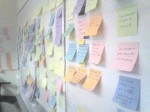
Okay Orly, you say you're a pantser, and for the first draft, I agree you are. But then you happily flip into complete, committed plotter. All those post-its? Nope, I'd say you're a "hybrid-pantser."
Me, I'm pantser through and through. The idea of an outline, post-it notes on charts, even Laura's famous chapter spreadsheet, all make me want to get in the Athenamobile and drive away. Fast.
So how does my writing process work?
My characters present themselves. There are plenty, riding around in the carousel of my mind. Usually one will step forward and demand her story be told next. I spend some time with her, piecing together backstory, what she really wants–it's never what she tells me up front–and look at the potential for conflicts. Sometimes the hero appears first, or they present themselves together. If they're both interesting in their own right and seem screaming-wrong for each other, I'm interested.
I start running movie scenes through my head, about how they meet, what draws them together, how they see the good, and the bad, in each other, and how they fall in love. If I like the way those scenes come together, I start writing. (Aw, who am I kidding? If by this time I've fallen in love with my hero, I start writing.)
I'm typically a nighttime writer, which works great for my process. When I go to bed, I rerun the pages I just finished and play director, changing little, and big, things to make it better, adding snappier dialogue, modifying staging, bumping up the conflict. Then I just let the movie continue and fall asleep. That preps my brain to work on the plot while I sleep, and usually the next morning I have some revisions and ideas for the next scene or two.
Now, don't get me wrong. When I start writing a new book I know most of the pivotal emotional difficulties–er, blow-ups, arguments, inner conflicts– and the technology malfunctions and battle scenes (I write science fiction, give me a break!)-but not exactly how and where these plot points and pinch points will take place. I'm sorry, but if I knew how everything was going to play out, it would be boring to sit and type it all out. I love a good puzzle and fitting the plot, the emotions, and the conflicts together make writing exciting for me.
As for the actual, fingers-on-keyboard writing, I typically keep writing until the end of a scene or the end of a chapter, but I usually always know how the next scene will begin. I'm going to be digging my characters out of the hook where I stopped.
When I sit down again, I re-read what I wrote during my last session, add details and emotion and "dress the set." This process gets me back into the story so I'm connected when I begin putting new words on the page. After more chapters I start to think about adding a phrase or a scene in previous chapters to foreshadow or provide backstory. I'll write the idea on a post-it and stick it to the edge of my computer. Yes, by the time I'm ready to start the first whole-book-revision there are post-its all around my monitor, sometimes three deep. They've been in my peripheral vision and thought, and I begin layering in those ideas during the first revision. I'm a coward; I always start with the simplest revisions.
Then I usually end up taking some paper and pencil notes about timelines and chapter major events so I can find where to add my ideas. I have to admit that on more than one occasion I've let blue words flow while looking for half-an-hour or more for a specific scene. Those times I swear I should have kept track on Laura's spreadsheet and I vow to use it on the next book.
I used to hate revising, but on the last book I could see the story getting better and better through the revision process. I think that examining my revision process is actually improving my initial draft. I'm aware that I tend to be all about the facts in the first draft, ("But what is she feeling?" is a common comment) so I'm trying to layer in more emotions on those "morning after" re-writes.
Final revisions are all about evaluating and using comments from critiques and judges.
Before I send a manuscript off, I read it out loud. Yes, all four hundred plus pages. I catch weird sounding dialogue that looked great on the page, echoes, and always a cliche or two that made it past several pairs of eyes.
My process works for me, an untrained-creative-writer hard-science nerd who managed to get my college degrees without ever taking a writing class. Of course, once I began writing, I've taken a lot of classes to learn the tricks behind the magic. But everyone's process is different.
How do you create your magic on the page? What is the strangest component of your process?
About Fae

Fae Rowen discovered the romance genre after years as a science fiction freak. Writing futuristics and medieval paranormals, she jokes that she can live anywhere but the present. As a mathematician, she knows life’s a lot more fun when you get to define your world and its rules.
Punished, oh-no, that’s published as a co-author of a math textbook, she yearns to hear personal stories about finding love from those who read her books, rather than the horrors of algebra lessons gone wrong. She is grateful for good friends who remind her to do the practical things in life like grocery shop, show up at the airport for a flight and pay bills.
A “hard” scientist who avoided writing classes like the plague, she now enjoys sharing her brain with characters who demand that their stories be told. Amazing, gifted critique partners keep her on the straight and narrow. Feedback from readers keeps her fingers on the keyboard.
When she’s not hanging out at Writers in the Storm, you can visit Fae at http://faerowen.com or www.facebook.com/fae.rowen