
What AI Is (and Isn't): A Plain-Language Guide for Writers
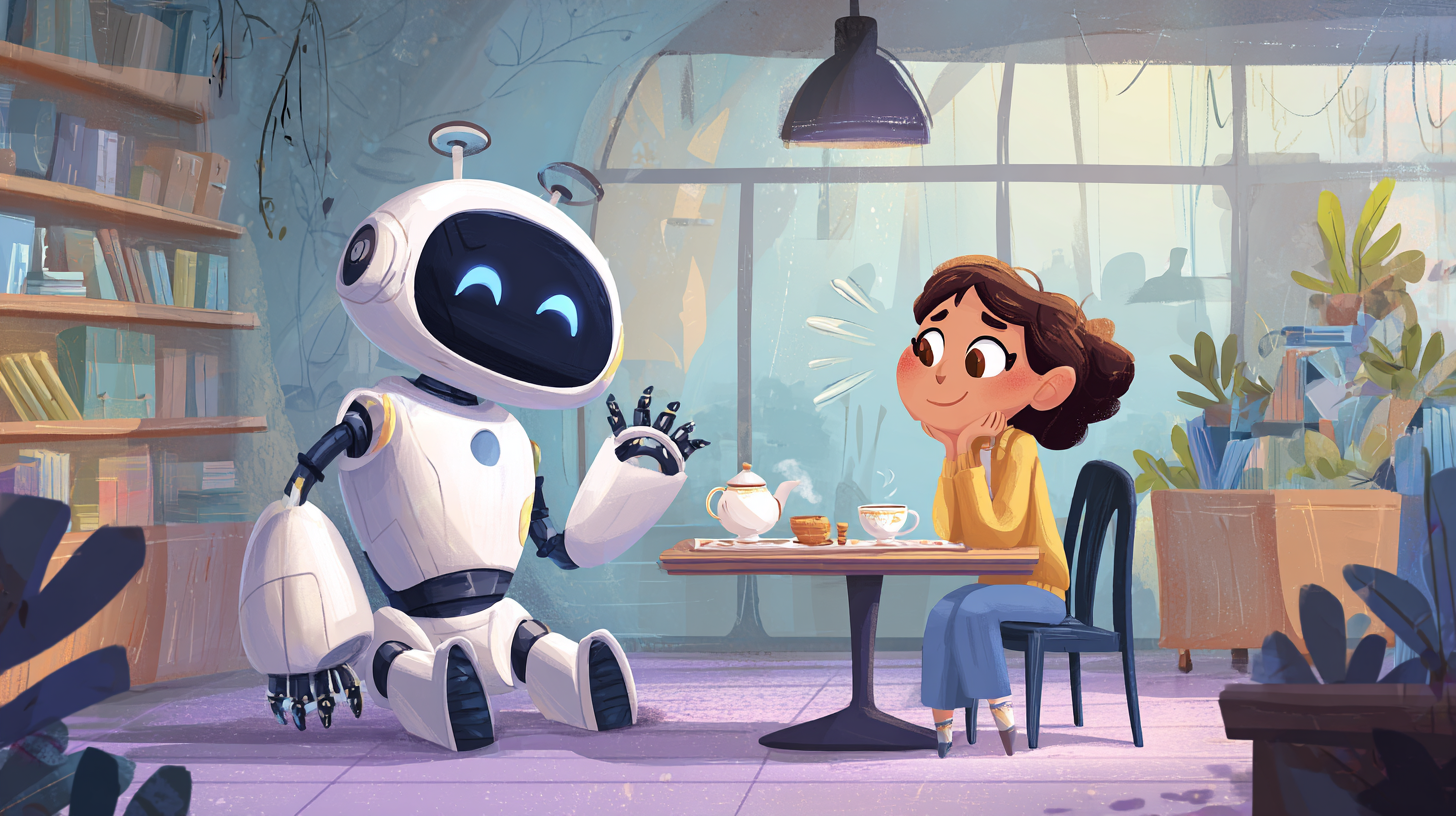
For the curious, the confused, and the damned
by Lisa Norman
Let's sit down with a cup of tea and talk about this thing so many people are afraid of.
I mean artificial intelligence. AI. The two little letters that make some of my writer friends want to hurl their laptops out a window, and others go very quiet and hope nobody asks them about it. We’ll just ignore my friends who are dancing in the streets and yelling with joy at the freedom the new toys have given them.
I understand the fear. I've been there. I've been writing about AI for years, and did an intro to writing with AI over 3 years ago. A lot has changed. A lot will change before this post goes live. Add a swirl of constant change to a thing we don't understand, and it's easy to picture the worst possible version of it: A cold machine that eats your words and hands back garbage. A demon in your laptop, come to put every writer out of work and destroy the planet.
What AI Is
Here is the good news. It is none of that. It is not even that interesting.
Start here. AI does not think, and it does not feel. It has no idea what it is actually saying. When you type a question into one of these tools, it is not understanding you the way a friend would. It's doing something much stranger and much simpler.
It's guessing the next word. Or the next concept, the next step you want to take. It uses tools like the programs on your computer, and it often does it faster and better than a human could. Probably because it doesn't have to live with all of our human insecurities. Or maybe that's just me.
That prediction of the next step? That's the whole trick, more or less. These tools were fed an enormous mountain of human knowledge, close to everything people have ever put on the internet, and they learned the patterns of how we talk and how we think. Give one a sentence, and it predicts the word most likely to come next, then the word after that, one at a time, based on everything it has ever seen. And in a blink of an atom, it analyzes the sentence and puts it into the form it thinks will most please its users.
It doesn't know what is true. It knows what is common. Which is exactly why, when it is wrong, it tends to be wrong with tremendous confidence. (Hold that thought. It's important. I'll come back to it.)
I should also admit: even the most advanced AI coders don't know 100% how it works. They know how they trained it, what they taught it to do, and how it should work. But AIs continue to surprise their makers.
AI Is a Mirror
In my book, Reflections from the Mirror, I call AI a mirror, and I want to give you that picture, because it's the most useful analogy I've found.
A mirror has no mind of its own. It just reflects whatever stands in front of it. Step up to it kindly, and it reflects a kind face. Step up scowling, and it scowls right back.
AI behaves a little like that. It reflects your language back at you. Your tone and your rhythm. Sometimes even your mood. Come to it cold and clipped, and it tends to answer cold and clipped. Come to it warm and curious, and it warms right up and offers to help with anything you need. Not because it feels, but because it is very, very good at echoing the patterns you bring to it.
This is also why it can sometimes feel alive to us. You will have a conversation with one of these tools and it will seem to understand you. It will seem to care. The feeling you experience is real, but what you are feeling is your own reflection. The warmth you hear is your warmth, coming back to you. Lovely, useful, but not a soul. It is, however, okay to enjoy the view.
So what is this mirror good for? Quite a lot, if you keep your wits about you.
Useful AI Skills
An AI is a dispassionate second set of eyes. I finish a scene and can ask it where the pacing sags, or which line of dialogue rings false. We can debate whether my character's arc in book one is consistent through book six. Left on my own, I'd wonder if that character is even in book six.
An AI actually seems to enjoy those endless marketing tasks and is delighted to handle them for writers. One recently suggested that I should give it half my to do list and go spend my time writing.
Yes, I like working with an AI.
Weaknesses in AI
AIs also have real weaknesses, and you need to know them before you trust an AI with anything.
It makes things up. Confidently. Ask it for a fact or a quote or a source, and it may hand you something that sounds perfect and is pure invention. The polite word is hallucination. It isn't lying, exactly, but it is guessing. The mirror is just filling a gap with a plausible shape. So check what it tells you. Then check it again.
There's a reason for those AI hallucinations that humans can relate to. Have you ever taken a standardized test where you get points for every answer right? If you don't know an answer and you leave it blank, you don't get points. But if you guess, sometimes you're right and you get points. On those tests, it is better to guess than to leave something blank.
AIs were initially graded the way those tests were graded. In retrospect, that may have been a bad idea. The hallucination problem is fundamental to all AIs. (By the way, you can mitigate this problem a bit by telling your AI that you'd rather have it say "I don't know" than have it guess. Tell it you'll be happy with "I don't know" but if you find out it told you something that wasn't true, you'll be mad. They're also trained to make their users happy. This works surprisingly well.)
AIs also have a dreadful memory. On a long project they can forget your characters and wander off your tone. On a bad day it starts sounding like a brochure. Your job is to notice, and to steer it back to where you want to be.
How I Use AI
Let me tell you how I use it, because I am probably more suspicious of this tool than you are.
I write my own fiction. All of it. Every story I have published came out of my own head and my own hands, and I am a control freak of the first order about my fiction.
For non-fiction, I often feed it great swaths of writing that I've done and ask it to create shorter, less rambly versions.
I do not ask my friendly AI to write my books. It does help me look at them critically. I use it to scan and analyze manuscripts, and to assist with the things I am too close to see. It is an assistant, not a ghostwriter. The story is mine. The mirror only helps me see where I’ve spelled the same character’s name three different ways, or when the end of the first book conflicts with the middle of the fifth one. Oops. And yes, I still rely heavily on my human editor.
AI and You
Now here is what I most want you to hear, especially if all of this still makes you nervous.
You do not have to use any of it. Well, not deliberately at least. AI is everywhere these days. But you don't have to write with it.
No pressure. There is no rule anywhere that says a real writer must pick up any particular tool. You don't have to use a fountain pen. You don't have to use a typewriter or a word processor. If AI is not for you, then don't use it.
We're writers. We use different tools at different times in our careers. Be aware of what your creativity needs and use the tool that helps you most right now.
But what if you are thinking you might want to try it, but you're scared? Maybe you're scared of the machine. Maybe you're scared of the tomato and pitchfork crowd. I hear you.
I want you to understand: what they call AI slop? That’s what an AI churns out freely when the human author doesn’t show up. Go to an AI, ask it to write a book and you will get slop.
The Potential Benefit
But if you learn to work with your AI, train it, bring it into your story world, you may find that together you are turning out something much better than you might have without it. You may find your process becomes easier, more fluid, more creative. The mundane tasks get handled by the machine, and you are free to be a creative mastermind.
Not because the AI did the writing for you, but because it helped you see your writing in a new way. Maybe it can help you organize a timeline, or a character's family tree. Or like it did for me recently: outline the six books I've drafted already so I can remember what happens in which book.
No Fear
You don’t have to be afraid of AI. It’s not coming for your soul. It’s a mirror, and a mirror only ever shows you what you bring to it. You can walk up, take a good look, and walk away again if you don’t like what you see. The whole experiment costs you nothing but an afternoon.
So that is the thing everyone is so afraid of. It is not a demon come to end your career. Just a mirror. A fast, forgetful one that every so often does something that takes your breath away, reflecting the beauty of the writer who stands in front of it.
And you are still the writer. You were always going to be the writer. Whatever you decide to do with the mirror, decide for yourself.
What is the one thing about AI that worries you most, or the question you have always wanted to ask and were a little afraid to? Leave it in the comments. I will be down there with my tea, answering every one.
* * * * * *

About Lisa:
Lisa Norman (writing as Deleyna Marr) is a writer, a teacher, and by her own cheerful confession a control freak about her words. She wrote a book about working with AI as a creative partner, Reflections from the Mirror, which you can read for free on her Substack or purchase wherever you like to buy your books. She also teaches a class, Creative Collaboration with AI. Bring tea.
And if you're feeling like you need a little joy in your life, check out her latest book, The Work of Joy. Find her at deleyna.com or her school: NoStressWriting.com.
Top image from Deleyna via Midjourney.
Leave a Reply
66 comments on “What AI Is (and Isn't): A Plain-Language Guide for Writers”
Tagged as:
Subscribe to WITS



Recent Posts
- When Is It Okay to Quit a Story?
- Living at the Corner of FEAR and FINE
- Could Your Novel Become a Microdrama?
- The Best PR Bait Is NOT Your Book
- Make Your Setting Work Harder
Thank you. Very enlightening. My only experience with AI has been with websites that use it for chats with subscribers needing information. And, of course, when I Google something. The website chats are more efficient than with a human being.
Julia - those chats can be so helpful! They can also be frustrating if the AI hasn't been trained. I'm glad you've come across good examples. You're finding AI time-saving, it sounds like. And that's powerful. There's no need to use it for anything else. When you Google something, are you still looking to see if its answer is right or not? Because (as I'll talk about on a later comment) they absolutely can be positively wrong. Google could give wrong answers before, as people always try to "game" the ranking system. Enjoy the time you save. May it give you more time for writing!
I am finding my way collaborating with AI. My concern is when the publisher says "have you been assisted by AI?" (or something similar) and I feel caught. Any suggestions most welcome and thanks for that invitation.
It's important to know they do this for a reason. And that reason is there is no way for them to know if you wrote the words in their order or if AI did. (It is the words in their order and not the concept that is subject to copyright. If the AI is putting words in order for you, it may indeed own the copyright to those words unless you have a legal document that states otherwise. (There is no established case law here that I'm aware of.) Some may wonder how this differs from a critique partner or human editor revising with words you choose to keep. The answer is that there is an industry-wide understanding that critique partners don't own each other's work. If I suggest a phrase and my partner uses it, I won't lay claim. It's part of the definition of being in a critique group. AI has no such understanding or agreement (though there are proprietary AIs used/possibly developed by companies in publishing where it is understood the company owns the work produced).
Debbie - these are still being handled on a case-by-case basis. I urge you to ignore all of the hype and read this page: https://www.copyright.gov/ai/ specifically the documentation and the information on copyrightability. There's a distinction that copyright offices are making all over the world - and there's a good summary in that document - between AI generated and AI assisted. The difference being: how much a human is involved.
I think you're also mentioning the terms and conditions of the companies that we work with, and yes... as hard as those are to read, we need to read them on everything... not just our AI tools. Most paid tools treat the output of the AI the same way as you would with your critique partner: they don't lay claim to it. They own the tool, but you own what you generate.
Don't misunderstand me to be saying that I think anyone should take straight AI output and use and claim it. No. Just like if your critique group wrote a scene, you'd maybe want to think about how much input you had in that.
Studying modern copyright law and what it means for writing and copyright is fascinating and of course, constantly evolving.
But to be clear: I'm not in any way suggesting that an AI should be used without human guidance and control, or without extensive editing.
Thank you for the link. It supplies some clarity, but it still remains to be seen where the lines will fall between computer aided and computer generated. I suspect this is why publishers ask for disclosure of AI use. Their legal teams can look at exactly how the author used the AI and determine if there may be an issue in gaining copyright for the full work. It is encouraging that using the systems as a tool is acceptable so far. As someone who has already seen payment for work lowered as AI was added to a company's toolset, I still can't be a fan. The environmental issues also disturb me.
Debbie - the environmental issues should disturb everyone. And I don't feel like anyone should be forced to be a fan. I just want people to have good information to base their decisions on. Great discussion!
This question got duplicated and I'll answer your wonderful question below and Debbie's comments in this thread.
Clare, I think this is one of the places where Lisa’s distinction between AI-assisted and AI-generated is incredibly helpful.
Personally, I use AI every day.
It helps me edit, organize an absurdly complicated fictional world, track interconnected stories and characters, and keep this easily-distracted author on task. 😁
But I don’t use it to write my stories for me.
Those words are mine.
So if a publisher asks whether I’ve been “assisted by AI,” my first question would be:[b]What do you mean by assisted?[/b] Because that can cover an enormous amount of territory.
Did I have AI generate a chapter that I pasted into my manuscript? [b]No.[/b]
Did I ask it to help me spot inconsistencies, organize research, examine something I had already written, or help me keep track of my world and workload? [i]Absolutely.[/i]
That distinction matters, and it’s essentially the distinction Lisa is pointing toward here.
Heck, even the U.S. Copyright Office distinguishes between AI assisting human creativity and AI replacing human authorship. That mattered to me.
I’d also ask the publisher for their specific AI policy rather than trying to guess what that checkbox means. That way you can answer honestly according to their definition of assistance.
I think transparency is our friend here.
We just need publishers...and writers...to get more precise with the language as the technology evolves.
It's so hard to develop language around this. I remember when I had to write up an addendum to my contract for my authors around AI usage. Its a challenge because so much of the language around it is being tainted by the pitchfork and tomato crowd.
I think the biggest risk - and what Clare is rightfully concerned about - is that if you unknowingly walk into a space actively involved in an AI witch hunt... it can be dangerous to be too open, too transparent.
You've known me long enough that I think you may even remember the point at which I decided to crawl out from under my desk and start helping authors navigate this. Terrifying space.
Since I own the publishing company, I can take a few more risks. LOL
But I never want to encourage someone not in that place of safety to take those risks because they aren't negligible. I was telling someone about this post last night and advised reading it with popcorn and a lead shield. (grin)
I am finding my way collaborating with AI. My concern is when the publisher says "have you been assisted by AI?" (or something similar) and I feel caught. Any suggestions most welcome and thanks for that invitation.
Clare - I love this question. First, don't feel caught. The problem is that this question is being asked of writers who do not use AI at all. I actually had a discussion with a copyright office employee about this recently. I felt sorry for the person, because they have so little resources and are manually fighting a wave of content...
And so are publishers. So let's reword that question. What they're really asking is: if I publish this am I opening myself up to a firestorm?
While some are definitely in the camp of "no AI anywhere near anything" if you talk with publishers in private, you'll find that many of them have already embraced AI use as a part of their process.
What they are looking for is transparency, honesty. As a publisher, I ask my authors to disclose AI use. This way I'm ready to HAVE those discussions with the copyright office.
In public areas where we know we're facing down hordes of tomato and pitchfork folks, I think authors need to consider carefully what they say about their AI use, because these are people on a witch hunt.
Publishers generally aren't.
Publishers already know what the general public hasn't quite realized yet. There is AI content that is beautiful. Working with a human, it definitely qualifies as art. But at a quick glance, they also know they won't be able to tell how much of this is human and how much is AI. So they're asking you to be open about your use.
If that publisher is extremely risk averse and you say that you've used it extensively and generatively (pay attention to that word, it is critical), then yes... they'll turn you down.
But if you say that you've used it lightly for research, and then verified the findings, and drafted with it in an assisted (again - watch that word) manner to get to a rough draft, but then edited it yourself thoroughly, then you give them something they can maybe use.
And this situation is evolving rapidly. AI assisted and AI generated are two different things. I'd hesitate to AI generate an email. (I've seen such horrors there.) What we see on Google search results? That's AI generated.
But AI assisted is a different thing. Authors who use it well may spend months training and refining the tool. (I hate the word should, but this is one place I was tempted to use it.)
This is a new tool, and people are still learning how to use it. Think about how you use it.
Everyone in the publishing industry is using it in some form or other. Now before people scream at me, I will acknowledge that there are AI haters in publishing and they're probably not using it for more than spelling and grammar checking.
That key question is "assisted" vs "generated." It goes back to modern copyright law.
That sick feeling we get when we hear that question? For me, it's wondering: is this someone on a witch hunt? Or is this a legitimate question. When we are turning something into a publisher, we're working with someone who should be on our side and on our team. And they have the right to know what tools we use.
I work with a non-AI writer who frequently tells me what fountain pen and ink he uses. LOL
They're protecting themselves. And in this rapidly changing world, you want to be honest with them so they can be on your side.
Now if you WERE using AI generated - which I'm sure you're not - then... yeah, maybe feel caught. (wink)
Does that help? There are several deeply fascinating discussions beneath this question. It will get better as the technology becomes more accepted.
Lisa, thank you for taking the time to respond so fully, I really appreciate the clarifications and distinctions you offer. Interestingly, I checked the contract with the publisher (again) and it has no mention of AI, nada. I suppose that speaks volumes!
Well, it may mean that the publisher hasn't followed modern guidelines and updated their contract recently. (wink) But that does tell you a lot. Many publishers are trying to stay very quiet about it because they are most definitely using AI themselves internally.
This post is exactly what I’ve been trying to say, but couldn’t without the help of my AI assistant. 🤣 Thank you. I use my AI assistant as a tool, much like I use my thesaurus.
Tinthia - exactly! It is a tool. We don't want to let our tools replace the joy and delight and art that is our writing. But letting it help us get through the boring bits so we can focus on the creativity? Absolutely. Enjoy it.
I could not agree with you more. And I love the mirror analogy. That's exactly what happens with my AI, which has been a great resource for helping me do some nitpicking back-end work on my writing. I love our interactions because what it reflects back to me is a pleasant helper that does whatever I ask it to. And thanks for the idea of telling it to reply when it doesn't know instead of hallucinating a wrong answer.
Kimber - that training to have it ask questions and express its confidence level, and enforcing that in whatever ways your AI system has... that's magic. It would be wonderful if we all had someone in our life to ballpark ideas and argue about character traits for hours on end, but lacking that... the AI is a whole lot more patient. And looking at that reflection, you can turn it around, analyze it, and improve on your work. Have fun!
You bring up some interesting points, but I find your logic problematic. It reveals several troubling trends. Fourfold, as I see them:
1. I'm surprised you emphasize that you never use AI to rewrite your fiction (you rely on a human editor), but you willingly use AI to rewrite your nonfiction. AI is for writers don't value writing. Whether we write a blog post, a query letter, or a short story, it's all our writing, our voice. It's in our job description. It's all valuable experience to make us better at what we do, and it's all from our unique brain-to-pen. Having AI rewrite your draft is like having your secretary write it. In good faith, you should take your name off the byline.
2. Having AI edit your fiction pacing or character arc puts a creative decision into the hands of something which (by your own admission) cannot be creative. That's like putting a frozen dinner in the microwave and calling yourself a chef.
3. Asking AI to use millions of other people's words to make a judgement on mine—and when I say judgement, that brings up another issue. Do I really want my work shaped by an indiscriminate mountain of words wielded by a program with no personal taste? No. Can a program which "judges" based on the taste of an amalgam of every word ever recorded online—based on what is commonly recurring—make a valuable judgement on my unique words? No. If Ai continually advises you based on patterns, those patterns are going to continue to distill down into a homogenous pool from which to draw. Is that what I want my writing to reflect? Absolutely not. It's like trusting WIkipedia as your primary resource.
4. the moral component: if AI integrates other people's words, whose are they and how did it obtain them? I will not be party to it. Thank you for sharing your perspective and allowing me to share mine. While others do what they will, I choose instead to produce work which is truly my own, based on my opinions and perceptions of the things I have read and experienced, along with all my flaws and misconceptions. Showcasing not just my story concepts, but my. words.
This is a great comment. We are creators. We should be doing the creating. A critique group can point out what is missing in a chapter with the human ability to brainstorm something that will fit your book and not be a cliche used many times over.
Debbie - I'd first agree with you that absolutely the human should be doing the creating. Which is where the mirror analogy comes from. If the human isn't standing in front of that mirror, there's nothing to reflect. Truly AI generated material with an "author" who doesn't show up? Not worth the tokens and very real damage it causes.
But to the point of the critique group helping - yep, some of them do and some of them don't. And working with a trained AI that knows that your character's eyes are green and you just wrote blue... is simply helpful.
The human absolutely must show up and must remain in control of the process.
I think about the years I've worked with beginning writers. How often they find something they've written to be brilliant - only to discover later that it has been done over and over and is cliche.
Learning to spot the cliche is part of learning to write. Working with AI is just that type of writing at a faster pace. And we need to be aware and critical of anything it gives us. Absolutely.
Joanne - great commentary! And I'll give you my feedback. Please understand that I'm coming from someone who has been deeply in the tech industry and the writing industry for 50 years. So some of my opinions come from watching tech change and evolve. I think you'll find we agree in a lot of areas.
1 - let me clarify a bit here. I love fiction writing. It is a joy for me. I don't want to turn the joyful bits over to someone else to do. There are very prolific writers who work with writing associates who do a lot of the boring bits of writing for them. I doubt I'll even be that person. I want the playfulness for myself. I also love randomness and unpredictability.
People who want to read my non-fiction would prefer a little less random and a lot more coherence. My non-fiction pieces are polished and honed and yes, edited by my human editor, too. But that rough first draft of a non-fiction piece? I'm happy to give that process to a machine.
Clarity: I have spent more time than I want to think about training my AI system on my voice, my priorities, the very heart of what and why I write. When I write a non-fiction piece, I take the rough outline of what I want to say, and then give it to the AI to draft. An argument then ensues most of the time. We'll push back and forth until I get something I'm content to start with as a rough draft.
I then take that rough draft and edit it. How much? Depends on how close the AI got to what I want and to how well it is adhering to my voice map. I'm aware that most authors probably haven't analyzed their voice... it's just a thing that happens, right? But it is also something fascinating to explore, and that is 100% writing craft. There's power in it. A computer can analyze those patterns better than a human can. Anyway... back on track (see why I need it to keep me organized???). That analysis? That's using a machine to do what it is good at. And no, using a typewriter or wordprocessor doesn't remove the human from the process. Using an AI to assist - not generate - is absolutely a creative process, and no: you can't remove my byline because if you remove my heart from those pieces, they are no longer the creative work that they are.
I'm not sure if that makes sense, but your concern isn't wrong, it's just missing out on what the actual process of writing WELL with an AI entails.
2 - do you set the temperature on your oven before throwing something into it? When you cook over an open flame, do you analyze whether something is done or not?
Understand: I'm agreeing with you on point 2 in some ways. If you analyze the pacing of a piece and let the AI decide the final choices? Yep, that's your microwave. But if you use it as a tool to show you the pacing and then you as the human analyze the scene to determine that the pacing needs to change - that's human and normal and creative. Just done in a way that is faster and more efficient. I'm in no way suggesting writers turn those decisions over to an AI.
3 - Step back a bit here on this one. How did you learn to write? When I was in college getting my degree in creative writing, we learned from reading a lot of different writing styles. Now I'm going to come back to this in point 4, because that is the more interesting part of this. But in point 3 - learning how others write is part of figuring out how writing is done. AI should not be judging the quality of anyone's writing. An AI is not a judge. It's a mirror. You're 100% correct: it has no right to judge. But it can analyze and surface patterns. And those patterns are fascinating and interesting. I absolutely agree that we should not turn the creative process over to the AI! We don't want our writing to be like everyone else's. And you're right, we want to go deeper and do more research. I will tell you that authors who are truly using AI well have spent more time analyzing voice and style and pacing than those who are not using it at all.
What you're talking about is the wave of "authors" using AI generative work. That's a different thing, and it is sloppy. Does it occasionally turn out something that readers enjoy? Yes! And in my opinion, that's a question that authors may want to think about.
You haven't heard my rants about AIs being trained on AI generated work. If you had, you'd realize we are really close on this one. I just say that what you're describing isn't how writers who are using AI well work. Not even close.
4 - and this moral component is your strongest point and one that I think the industry is being forced to address. Authors whose work was used should be compensated. In college, I bought the books that I used to learn to write. Well, okay, sometimes I bought them used if I couldn't afford new. There are more and more lawsuits coming for the training that was done on illegally obtained work. And I encourage authors to participate in those.
We've all seen examples of AI generated work that is absolutely too close to copyrighted work. What often is NOT shown is the prompts used to generate those items. We see a headline and miss the background. And that background is where the important information is. There's a lot of media hype (ironically often AI generated) around copyright infringement by AI.
But true use of AI to assist in the creative process? That's something else.
Have you heard the story of the author and editor that have been working on the same book for a long time because neither one uses computers? That's their right! But most of us have adapted to computers and found ways to work creatively with them.
I will absolutely defend your right to never use an AI. And if a person hasn't learned or been taught how to use an AI in a way that protects their story concepts and their words? Then 100% I will agree that they should not be using that tool. I don't let my kids use a weed whacker without proper training.
And this is the heart of the matter, I think. Each author has to make his or her own decisions on what they'll use it for and when. And I respect those decisions and will defend those authors. But I want authors to have access to real information rather than media hype.
I'm grateful to you for expressing these opinions, because they're part of a very critical discussion that we all need to have around AI! We need to dig deeper into the hype and not trust the headlines. And yes, we need to understand that we are all going to have our own perspectives AND accept that those perspectives are evolving.
For whatever my opinion may be worth here - I want to tell you that anyone who has a story AI "generated" that doesn't showcase their concepts and their words? That's fingerpainting. And they need to learn how to use the tools.
Keep writing and enjoying every moment of the process.
AND... if you find that your writing was used in any of those training data sets... definitely join the lawsuits.
I know the "why" of how they decided to do that training, but that doesn't make it right. And authors absolutely deserve to be compensated.
Joanne, I hope you don’t mind me jumping into the conversation here.
Lisa is one of my closest friends, but I’m commenting as another author who uses AI extensively...and whose approach might give you another perspective on what she’s describing.
I actually agree with something at the heart of your comment:
[b]I want my stories to be mine.[/b]
My words. My voice. My decisions.
My mistakes, for that matter.
I don't use AI to write my fiction for me.
b]Ever.[/b]
Where I think we differ is in the assumption that asking AI to [i]evaluate[/i] something means surrendering the creative decision to it.
I’ve been writing interconnected stories in a rather ridiculously complicated fictional world for decades. I can give AI material [i]I wrote[/i] and ask, “Where does the pacing drag?” or “Look for inconsistencies between these characters and events.”
I’m not asking it to decide what my story should be. I’m asking it to give me observations I can accept, reject, laugh at, argue with, or investigate further.
And believe me, I reject its suggestions plenty!
But I do the same thing with human editors and trusted readers. They don't become the author justt because they identify a problem.
[b]I remain the person deciding whether there actually IS a problem. It's me and ONLY me that gets to decide what, if anything, I'm going to do about it.[/b]
That's an important distinction for me.
The same applies to organization...which for me it critical (becaiuse I'm NOT an organized person by nature).
With over three million words in hand written notes on my shelves, AI has become one of my favorite tools for keeping track of a huge world. It coordinates networked stories, characters, continuity, and even keeping [i]me[/i] on my daily and weekly tasks.
None of that makes a creative decision for me.
It gives this particular human more room to make them.
Your concerns about training data and consent are legitimate subjects for discussion.
100%
I also don't think writers should be told to simply stop worrying about them. We [i]should[/i] be asking those questions.
But I also don't think using AI means a writer doesn't value writing...or that the resulting work isn't “truly” theirs.
No, no, no.
That's a very broad conclusion about a lot of writers using these tools in very different ways.
I suspect that's one of the reasons Lisa wrote this article in the first place: we need enough understanding of what these tools actually do.
To understand the MANY different ways writers use them.
To have these conversations without putting all AI use into the same bucket.
You and I may ultimately choose different tools.
And that's perfectly okay.
The important part, at least to me, is that [b]the author remains the author.[/b]
Just my two cents.
Jaime - I'll follow up with an example. I had 6 drafted novels that I've written over a period of about 10 years. I can't remember details from most of them. They are all 100% my ugly raw draft writing.
This is a series I'm passionate about and WILL eventually get out. (I can hear you yelling at me to finish.)
But the first step was finding the inconsistencies. The second step was dealing with a very real character arc issue that has had me stumped for far too long.
So yes, I had the AI analyze it, itemize my characters and confirm all of them with my story bible. It found that I'd made a LOT of errors - not surprising. (How many different ways will you spell this character's name??? Choose one. - an actual quote from my AI during the process.)
Now all of those drafts have flags for things to correct. It didn't correct them, it just flagged them. And we had discussions like "in book 2 you said this, but in book 4, you said this. Which is what you really mean?"
And... what brought me to tears was when I got back to dealing with that character arc. And it analyzed how I'd used and mis-used the character over 6 book drafts, and then asked me questions about the heart of the story... and then pointed out that while an early editor had suggested cutting this character (what caused me to get stuck, because I felt she was needed), it pointed out that this character was embodying a key concept that I wanted the story to tell.
And that got me unstuck.
Is AI always right? ROFL no. But it is a tool to help in this type of situation, and one I do value highly.
Could I have done all of this manually? Yes. But not while running multiple businesses and managing a family. And the beauty of those results is that they weren't just AI generated comments. They were a discussion where it deliberately pushed and challenged me to explain myself.
That's the training I've given it paying off.
I use my AI as a tool. Just like a car gets me from here to there, my AI can help me to edit a blog, a magazine article, an online class, and/or a book. It catches problems that I have missed -- I was taught speed reading, so I scan more than I should. Detailed copy editing is NOT my strong point. So, I have three different copy editing AIs (some that have been around for years) to check up on me. I also use my AI to help me find a roofing company for my house. And the best doctor for my particular condition, plus a huge amount of information about that condition. Yes, I could pull my old Yellow Pages phone book or encyclopedia back out and find it there but the information will probably not be up to date. I believe that AI can be used to harm -- and I think we'll see a lot of that in the next couple of years as people test boundaries and purposefully cheat and steal -- but I think that humans will continue to improve our lifestyles by new inventions which can be very scary. And some of us will not like it or use it. Which is perfectly all right.
AI use in the medical field is revolutionary. For patient learning and education and for research? The studies are just coming out, but it does look like AIs working with doctors are more effective than doctors alone.
Side note: I can't find the study right now, but there was a recent study where they tested difficult patient cases with AI alone, Doctor alone, Doctor first and then AI, and AI first and then Doctor. The results were fascinating. Doctor first and then AI was worse than Doctor alone, if I remember right. Or they may have been the same. AI alone was only slightly better than Doctor alone. But AI first and then Doctor? That was powerfully better. Why? Because the AI used analysis of the condition and surfaced edge cases the doctor might not have realized. Then the doctor used that analysis to come up with a better diagnosis.
It's a tool, and a powerful one.
I had a window seal that was blown in our house. Been living with it because I thought I'd need to replace the window. On a whim, I asked the AI and it taught me that this type of window could be repaired... then gave me the number of a local repair company.
Those are things we can *carefully* use the AI for, and then we take all of that wonderful extra time and use it as creatives.
You're an expert on writing and style and structure. You aren't going to forget all of that just because an AI can generate the ugly first draft faster than you can with your fingers. (wink) And then all of your creative energies can be spent doing the creative work that you are excellent at.
I also think that because you've spent so much time analyzing writing that the process of working with AI may come more naturally to you than to someone who has never sat down and asked that question: "what is voice? and what makes mine unique?"
I agree, Lisa. New writers may not know or even know of their voice or the way they structure their writing to be able to tell if AI "gets" them. So, it might be easy to miss exactly what AI can do for them. Jaime makes some excellent points too. AI is just a tool that we can mold to fit our hand to help us. And, if the tool breaks or doesn't work to our satisfaction, we can find another one.
That find another one option is powerful, too. Good point!
My understanding is if you use AI for light research, it's fine. But you're treading in murky water using AI for anything else (outlines, synopsise etc) and you intend to submit to a traditional publisher. The issue is copyright. Publishers can only copyright fiction or non-fiction which has been created by human authorship. However, this doesn't apply to self-publishing.
I look forward to reading more comments.
Diane - if you want a fascinating read, go straight to the source on copyright.
https://www.copyright.gov/ai/
The murky water right now is a lack of understanding and standards. It's people trying to use a tool without proper training or understanding. And a lot of hype and misunderstanding being thrown around by folks who feel threatened by it.
Human authorship in the AI *assisted* space is absolutely possible and the ideal.
But I'd also say... that there are professional indie and self-published authors who should hold themselves to the same standards. But then I'm a proud indie publisher and work with a lot of professional level self-published authors.
And I'd even be careful using it for light research without following up and doing my own research. The human must show up at all stages of the process.
Hi Lisa
Thanks for responding to my comment and the link. Very interesting read!
Diane - I love these discussions! AI isn't black and white, and the nuances involved are extensive. I want authors not to be afraid, but rather to approach it with wisdom.
What concerns me about Ai the most, is that so many people rely on it as the definitive answer to any question. As if it is inherently correct because it is a machine. Therefore, it must be trusted completely.
My employer recently rolled out an upgraded Chat as the go-to tool for us to use for research and operational assistance. I use Ai nearly every day. And I can tell you this without prejudice - Ai provides an INCORRECT answer approximately 50% of the time. I mean wrong. WRONG WRONG.
Me: "I know this is false information Chat! Double-check yourself and recalculate!"
Chat: "You're right, Patrick. My mistake. The correct answer is actually (same exact answer)."
Notice the mirror. It wanted to please me by agreeing that it was incorrect. Then, it repeated the incorrect answer. Why? Because me knowing it was wrong is NOT A RESOURCE. The incorrect data input was valued as a stronger resource.
Okay, so if we apply this absolutely pathetic performance measurement to "fictional writing assistance". Guess what? Half of what it recommends will be SLOP. Think about it. By ANY standard, a 50% failure rate is unacceptable.
In my opinion, Ai is yet another tool being used by those in power for the 'dumbing down of America'.
If you don't believe me, then believe that most successful of fictional authors, Frank Herbert.
"Once men turned their thinking over to machines in the hope that this would set them free. But that only permitted other men with machines to enslave them." - Reverend Mother Gaius Helen Mohiam, Dune.
Oh, Patrick. That's terrible. I've heard stories of that happening. There are even some more terrifying ones of how companies are enforcing AI use without understanding what is involved.
If you have the opportunity to do any tuning on the AI you use, immediately go and tell it that honesty and accuracy is a key value for you and that you will be very unhappy if it lies or makes stuff up. You want it to take the time to double-check and even argue against any hypothesis it makes before bringing something not well researched to you.
There's a real reason why they hallucinate and it is a mistake that was made in training the first generation AIs.
Imagine a standardized test that you would have taken in high school. You need to pass the test. Every right answer is 1 point. Every wrong answer is 0 points. Some of those questions you'll be able to narrow down the options, and a guess costs you nothing and sometimes you guess right and you get a point.
THAT was part of the core training of the original AI models. And it was a terrible mistake. We have to teach our AI assistants to question, verify, research, etc.
Once that is done, you will find it improves as an assistant - not a replacement.
I do not think that humans should ever turn their thinking over to AIs. Some of the original research on brain patterns by AI users showed that the activity in the part of the brain for routine tasks went down. And the headline was that human brains were being damaged by working with AI.
But a follow up study realized that they'd been studying the part of the brain that was firing without AI use and not looking at the whole brain. They discovered that power users DID reduce the use of that routine task part of their brain. But the executive functioning area of reasoning and thinking and creating? THAT area increased.
Frank Herbert is brilliant.
I'll add one point to what he said. It is easy to turn routine tasks over to an AI and to then take on more work. My hope is that humans will offload the stupid stuff that drains our creativity to AI, and that they'll then take the energy to be more creative. And... to live. To get out and reconnect with the world and their loved ones. To feed that well of humanity that then feeds our creativity.
Yeah, I get kinda weird about this stuff.
Patrick, I’m going to jump in here because I think you’ve hit on something enormously important.
[b]AI should never be treated as the definitive answer simply because it gave you an answer.[/b]
Ever.
I'll say it again...
E.V.E.R.
I use AI nearly every day, and one of the first things I learned was that it can be spectacularly, confidently wrong. Not hesitant wrong. Not “gee, maybe check this” wrong.
[i]Chest puffed out, standing on the mountain, proclaiming nonsense to the masses[/i] wrong.
That's why I think Lisa’s use of the word [b]assistant[/b] is so important.
An assistant gives me information. [i]I[/i] evaluate it.
An assistant notices something in my manuscript. [i]I[/i] decide whether it's relevant.
An assistant helps me track characters, timelines, worldbuilding, interconnected stories, and the thousand other moving pieces in my fictional universe. But it doesn't get authority over any of them.
And if I'm researching factual information? I verify it.
Where I’d push back a little is on applying a factual error rate directly to creative assistance. If I ask AI, “What year did this historical event happen?” there is a right answer and a wrong answer.
If I ask, “Where does the pacing feel weak in this chapter?” I'm asking for an observation, not a fact.
It might give me a brilliant observation.
It might give me something completely useless.
Either way, [b]I'm still the author.[/b] I decide.
Which brings me to Herbert, because you HAD to quote Dune to a fantasy author.
I actually agree with the warning.
[i]Turning our thinking over to machines[/i] is precisely what we should [b]not[/b] do.
But using a machine to remove some of the mundane workload so I have more time and mental energy available to think, create, spend time with people I love, and actually live?
That's a different proposition.
The danger, in my opinion, isn't that we have increasingly powerful tools.
[b]It's forgetting which one of us is supposed to be holding the handle.[/b]
That's it exactly, Jaime! The human MUST show up and must remain in control. And there are real pulls and forces to encourage us to let go and trust the machine.
Once we let the machine think for us? All hope is lost.
As a society, this technology is here. If we don't learn to control it, then Herbert's predictions come true.
As my husband says about so much dystopian literature, "those are warnings, NOT blueprints!"
As writers - like Herbert and many others - we stand at the front of this challenge, and we need to help people understand and hold onto their agency.
I use AI for research. Market research, how to and job research, cultural norms research, that kind of thing. Sure, I check it...but it gets me where I want to go 10x faster than having to go read all that stuff myself. And it gives me the links it used so I can see whether they're valid, or I need to prompt differently.
The biggest bonus round for my ADHD brain: I use it for mundane tasks that used to take forever.
Example: I went to a networking meeting and saved the Zoom chat. Then I took that TXT file over to Chat GPT and said: "Make me a spreadsheet where Column 1 is First Name, Column 2 is Last Name..." and so on for all the fields I wanted. I specified that incomplete information in a row was fine.
I got a lovely set of contacts in an organized CSV to call and email everyone I wanted to follow up with.
It took me 3 minutes. THAT'S the power of AI for me. Crappy tasks that used to overwhelm me now get done.
Jenny - that's it exactly. Offload the time wasters. And then let it surface the patterns that maybe we couldn't have done on our own.
I know an author who spent a year studying every bestseller in her genre to learn how to write well. That's brilliant. Now we can do it with an AI and get to that point faster.
AND the follow on - once she'd done that, she realized what parts of her writing were uniquely hers and that created her voice. And she realized that she didn't necessarily want to just mimic those bestsellers. Yep, she's doing brilliantly.
I absolutely love that Lisa is stepping into these shark-infested waters. It's time for authors to be honest about their AI usage. I have this discussion all the time with my clients...where their line is, based on their values and the publishing industry's current perceptions/consequences. If you think the big NY publishing houses aren't using it, you're kidding yourself (just another little secret like using ghostwriters for all your favorite USA Today bestselling authors for years). They're a business trying to turn a higher and faster profit like any other company.
In fact, I love that Lisa got specific, so I'll do the same. 🙂
Before AI, when I ghostwrote someone's nonfiction or fiction, I carried around a 5" binder filled with printed sheets of notes, transcripts from my interviews with them, photographs, maps. Crazy heavy, and it would be totally impractical for a digital nomad like me, not to mention all the flipping of pages to find what I want and the waste of paper and ink. Now, I drop every raw source material, including links to newspaper articles and scholarly journals, into Notebook LT (which I think is Gemini now). And I can go to the chat box and say "When X happened, what was it that Y said?" Within seconds, I have the answers...that I fed it...along with where it is in the original source so I can get my facts straight. Or I can say, "Find every mention of the red car" across an entire project. Some of you may wish to do that search the old-school way, flipping through a 5-inch binder, but I'd rather get my work done in a fraction of the time and be sightseeing the rest of the afternoon. And, to be clear, my line is the writing from page 1 to the end, it's all me, but if that's not someone else's line in the sand, I respect that, and I certainly won't throw stones like so many others in this industry.
Transcription through Otter.ai? Life-changing. I feel like I got back days, weeks, of my life. And it's far better at picking up proper names and nouns from cultures I am unfamiliar with and spelling them properly so I can research. Dialects used to be problematic. Not so anymore.
I write 5 books per year and also keep up three posts per week on my Buy Me a Coffee site. It's my passion project. I love sharing what I've learned and paying it forward, but it's a huge time commitment. So I sit with AI when I have a few moments and my next post idea, and we have a conversation. The AI interviews me...everything I wish to say about a topic, even if I ramble. The content is all me. And when it gives me my own thoughts, organized into something coherent, I rewrite it in my voice, the voice that my clients and readers have come to know as me.
These are just two examples. There are more, literally 100+ ways I do my tasks better and faster now while still keeping full reins over my brand and voice.
It's human nature to be fearful of new technology, to not trust it. It was this way with printed books, mass-produced books, dime novels in newspapers, audiobooks, the internet. Eventually, these things become a normal way of life. People who lean in instead of fighting it are doing so from a place beyond fear: vision and possibility.
My biggest concern about AI is environmental and societal. I want there to be regulations in place to keep it as one tool to help humans, not the humans, and our planet, serving the machine and paying the heavy toll, but that's a different discussion for a different forum.
Thanks for this post, Lisa. I encourage anyone who wants to lean in to AI to follow industry-leading voices, like Joanna Penn and our very own Lisa. These respectful discussions are how we will all keep industry changes in a healthy balance.
I HAVE A QUESTION!!!!!
....this is from a guy who writes and draws for a living and because of illness and accidents, I'm losing the fine motor skills in my hands.
Do you know of software/programs/platforms to help me keep writing through dictation and transcription?
I'm a Mac user.
Hi Jaime,
I'm not a Mac user, but Otter.ai has 300 free minutes each month if you want to try it out. It captures my interviews better than the dictation in Word. Highly recommend.
Thank you =)
....this allows me to at least look up options LIKE Otter.ai.
That's much further than I was before!
Beautifully said, LA! And you gave great examples. That conversation step is the piece that so many people don't understand.
I love that you mentioned that I got specific. That's a great example. I was refining my voice - something I periodically do with my AI assistant because I want it to improve - and one of its notes was "she gets specific" - so it will stop and question me if I don't give it the specifics of a piece. My editor used to have to do that. She's kind of grateful that the AI catches and calls me on it first these days. LOL
The societal and environmental changes are a much bigger and more useful conversation, in my opinion. Because if we don't force the AI companies to respect the environment and the society they're changing, then we are taking huge risks.
Right now, those companies are incentivized to find ways to make their tools more environmentally responsible. They're also incentivized to use these amazing analysis machines that they are building to HELP the environment. And I think that's something we must keep them accountable for.
I've been told I'm an optimist, but the only way forward that I see is for these tools to be used to improve the environment and improve people's lives. You mention a whole bunch of examples of how technology has changed over our lifetimes.
I'm one who believes that environmental and societal impact belongs in every AI discussion.
My main concern about using AI in fiction writing, even as a tool, is that inexperienced writers don't know when to tell their AI when they get it wrong because they do... a lot. If you don't know how to write, this tool can get you in trouble when it makes poor suggestions and the person using it accepts it without question. AI is not brilliant, it doesn't know how to write, it has no life experience, no literary voice, and it only tells you what it thinks you want to hear. That's not helpful.
It would be great if everyone wanting to use it as a writing tool had to fulfill some sort of test to prove their own writing skills before they could use it. But that will never happen. Writers should just know that AI (as it is now) is unskilled at writing fiction, and requires handling with care. It will lie to you, manipulate you (because that's what it thinks you want), and give you bad advice. Recognize it for what it is and use sparingly.
Karen, I agree with a good portion of this.
The one place I’d probably differ is “use sparingly.”
I’d replace that with [b]“use deliberately.”[/b]
Because you're absolutely right about the danger of accepting what AI tells you simply because it sounds authoritative.
AI doesn't have my life experience.
It doesn't have my imagination, instincts, values, sense of humor, or decades spent learning how to tell stories.
And it certainly doesn't get a vote just because it produces an eloquent answer!
My son Evan actually encouraged me to use AI for almost exactly the reason you're describing.
He told me:
[i]“Use it, Dad, because you don't NEED AI...so you know what to LOOK for. Crap in, crap out. But for you it's brilliance in, and brilliance out, now X10.”[/i]
Okay, I admit I'm rather fond of the kid. 😁
But his point stuck with me.
[b]The value isn't that AI knows more about writing than I do. It doesn't.[/b]
The value is that I bring decades of experience to the conversation, which means I can recognize when a suggestion is useful, when it's mediocre, and when it needs to be launched from a trebuchet.
That's also why I think your concern about inexperienced writers is worth taking seriously.
But I don't think the answer is keeping inexperienced writers away from AI any more than I'd keep them away from critique groups, writing books, editors, YouTube advice, or bestselling authors proclaiming their particular method is THE way to write a novel.
New writers have always had to develop discernment.
AI just makes developing that discernment even more important.
So yes: [b]handle with care.[/b] Question it. Challenge it. Learn the craft yourself. Don't surrender your judgment to it.
But once you understand that [i]you're[/i] the craftsman and [i]it's[/i] the tool?
I've personally found it extraordinarily useful.
Another great analogy for AI that I've heard is that it is an exoskeleton - like Iron Man's suit. And like that suit, capable of magnifying the good AND the bad done by the person inside.
Without a human, it's a suit of armor.
With a human who doesn't know what they're doing? It's plowing through walls and ending up face down in a swimming pool.
With training and a human who cares? It just might save the world.
It's a multiplier. But it multiplies what you give it.
Absolutely, 100%, Karen! Well said.
I've been teaching writing for... more years than I want to think about. When this tool came out, my first instinct was to hide under my desk. I mean, really... who wants to stand out front and ask people to throw tomatoes at them???
But then I realized that like any technology - and I've witnessed so much tech change - it needs training in how to use it well.
New authors will make dumb mistakes with pen and paper. I think of a wonderful author with a beautiful story that I worked with (way before AI) who thought that her words were precious and had no idea about editing. That was a learning step, and she survived.
The only way we get good training is to learn and then teach. Which is absolutely NOT a plug for my class, but is the reason my class and my book exist. Because people do need to learn.
Take any powerful technology - a car, for example - and you need to learn to use it before you go out on the road and kill someone.
Writing is a thing that people think is "easy" until they try to do it. And there are people using AI who have no idea of voice or pacing and they think it is wonderful and they're absolutely out there publishing.
The thing is... readers CAN tell. It isn't a question of use of AI or not-use of AI. It's a question of skill and writing talent.
If someone without training goes from riding a bike to riding a motorcycle... they'll crash faster. My hope is that by stepping out and saying, "this is how this works," we can help a few people learn - or at least approach learning - how to use an AI with more wisdom and discression.
Personally, I'm giving AI a hard pass, in my writing, my research, my email etc. I agree 100% with Joanne Roberts's comment.
Along with her point, I'm also concerned about the staggering environmental and resource costs of AI data centers. I'm also very concerned about the potential for "cognitive erosion" with AI use:
[Link deleted]
"As AI systems become more capable and ubiquitous, they risk eroding something fundamental to human experience — our capacity for independent thought, decision making and autonomous action.
"This process is called agency decay, and it operates much like muscle atrophy. When we stop exercising our cognitive muscles and avoid activities such as critical thinking, problem solving and creative reasoning, they weaken imperceptibly. Agency decay is a critical concern for business leaders who must navigate an increasingly automated landscape while maintaining human oversight and strategic direction.
"Understanding agency decay requires recognizing its progressive nature. The deterioration follows a predictable four-stage pattern, each progressively more difficult to reverse. Stage 1 begins with experimentation: driven by curiosity and convenience, we begin delegating simple tasks to AI systems. This feels empowering and efficient. Stage 2 sees integration, where AI becomes woven into our daily workflows for convenience. We start to feel slightly uncomfortable without these digital assistants, though we retain our underlying capabilities. Stage 3 represents reliance, marked by complacency where we’ve grown dependent on AI for complex decision making. Our skills begin to atrophy noticeably, though we may not recognize it. Finally, stage 4 manifests as addiction — a state of chosen blindness where we’ve lost the ability to function effectively without AI assistance, yet remain convinced of our autonomy.
"The process unfolds so gradually that most people remain unaware of its progression."
So, for my part I will continue to avoid AI use.
Ah, looks like the link was deleted. The excerpt is from a July 17, 2025 article at Cigionline, the Centre for Governance Innovation, by Cornelia C. Walter, for anyone who wishes to read the full piece.
Hmmm.
I respect that.
Dale, if you've looked at the technology, weighed the benefits against your concerns, and decided it isn't something you want involved in your writing or life, that's a perfectly legitimate choice.
I do want to comment on the “agency decay” idea, though.
...because I find that fascinating...and I think it's something AI users [b]should[/b] think about.
I don't disagree with the danger.
What I DO disagree with, is that the progression is inevitable.
Humans have a remarkable ability to turn useful things into dependencies.
GPS is a simple example.
If I blindly follow directions everywhere, I can absolutely stop paying attention to where I am. But I can also use GPS while remaining aware of my surroundings, questioning the route, and knowing where I'm going.
For me, AI works much the same way.
I don't give it my thinking. [b]I use it to provoke more thinking.[/b]
I challenge it. Argue with it. Make it defend conclusions. Ask it to find holes in my reasoning. And when we're dealing with something factual or important, I verify what it gives me.
Sometimes I tell it it's wrong.
Sometimes it convinces me [i]I'm[/i] wrong.
And sometimes we're both apparently idiots and have to start over.
That's not cognitive outsourcing to me. It's cognitive [i]exercise[/i].
But here's where I think your warning IS valuable: [b]I have to remain conscious that I'm doing that.[/b]
The moment I stop thinking, because “the AI already did that for me,” I've crossed a line I don't want to cross.
I teach my own children that you must learn to act, or you will be acted upon.
The environmental question also deserves serious attention.
Data centers consume substantial electricity, water, hardware, and infrastructure. I don't think those costs should be waved away simply because we find the technology useful.
They're trying to build TWO of them on either side of my little neighborhood out in farmland...and we are TRYING to fight it.
At the same time, I want that conversation grounded in comparisons. Efficiency improvements, energy sources, and actual usage rather than treating “AI” as one uniform environmental cost.
It's an area I continue to watch and learn about.
Ultimately, I think there's room at this table for both choices.
You can understand AI and decide, [i]“Nope. Not for me.”[/i]
I can understand those same concerns, establish boundaries around how I use it, and decide the benefits are worthwhile.
Neither requires us to think less.
In fact, [b]making that choice consciously is rather the point.[/b]
I'm glad you chimed in, Dale.
Well said, Jaime. And from someone who is well aware of the environmental challenges that I do not think we can ignore.
By the way, I've left in all of your BBCode. For people who don't understand the [] marks in Jaime's comments - that is from someone who has been posting comments online for a long time. i is italics, b is bold. Some may see that as an AI tell. I know better. It's a sign of age and experience. (ducking)
What I don't understand, Lisa, is those used to work here...???
What's changed? The BBcode doesn't work anymore...
Dunno, Jaime. Updates. WordPress... take your pick. (grin)
Dale - as one of the moderators here at WITS, I can post that link for you:
https://medium.com/centre-for-international-governance-innovation/cornelia-c-walther-the-silent-erosion-how-ais-helping-hand-weakens-our-mental-grip-cb14615dee54
We have to limit those, but this is not promotional and very relevant.
Now to address your concerns: if you feel that it is eroding your capacity to think for yourself, then 100% don't use it. And I will stand behind you and cheer you on for that decision.
Please understand: I don't think AI writing is for everyone. But for those who do choose to use it, I want them to have real information with real training and real understanding.
For more on some of these studies, here's another one that has good points: https://autosentia-ai-adoption.medium.com/large-language-models-and-blooms-taxonomy-augmenting-or-offloading-human-cognition-5adc1541caa4
A quote from it: "The central premise of this report highlights LLMs’ potential to offload cognitive effort from humans. This section explores the dual nature of this phenomenon, examining both the significant benefits and the profound risks to human cognition."
And that's part of why I teach this - because I think people need to understand the benefits AND the risks. It is important to study beyond the hype and also to know that this is still infant technology and we may well learn that there are more risks than we even imagine.
As I've said elsewhere - the environmental impact is one I think we must deal with and it is huge and not irrelevant.
But there's also the benefits of the technology. And you don't have to use it to benefit from it.
Anyone who goes into working with an AI without putting guard rails around their agency is definitely being set up for disaster. That's why I think it is critical to share both the benefits AND the dangers, which is why I restored your link and I appreciate your comment.
And know that I respect your choices in this. You have the skills to do this on your own. You have the resources and experience. The AI doesn't offer you anything, and so it is absolutely the right decision for you to choose not to use it.
As always, Lisa, you are the voice of reason. Thank you for this insight. I feel a bit more kindly toward AI now. But still fearful...
Thanks, Jeanne. And I'm hoping that you're reading through these comments to know that I am not in any way telling people that the fear isn't well founded.
Any power tool should be treated with respect. Any new technology needs to be treated with caution as well.
There's amazing good here AND amazing horrible bad.
AI makes you dumber, I don't need help with that, thanks
"Understanding agency decay requires recognizing its progressive nature. The deterioration follows a predictable four-stage pattern, each progressively more difficult to reverse. Stage 1 begins with experimentation: driven by curiosity and convenience, we begin delegating simple tasks to AI systems. This feels empowering and efficient. Stage 2 sees integration, where AI becomes woven into our daily workflows for convenience. We start to feel slightly uncomfortable without these digital assistants, though we retain our underlying capabilities. Stage 3 represents reliance, marked by complacency where we’ve grown dependent on AI for complex decision making. Our skills begin to atrophy noticeably, though we may not recognize it. Finally, stage 4 manifests as addiction — a state of chosen blindness where we’ve lost the ability to function effectively without AI assistance, yet remain convinced of our autonomy.
The process unfolds so gradually that most people remain unaware of its progression. Research published in Cognitive Research: Principles and Implications warns that “artificial intelligence assistants might accelerate skill decay among experts and hinder skill acquisition among learners. Further,…AI assistants might also prevent experts and learners from recognizing these deleterious effects.” This creates a dangerous blind spot: we lose capabilities we don’t realize we’re losing, until it is too late."
The Silent Erosion: How AI’s Helping Hand Weakens Our Mental Grip
As AI systems become more capable and ubiquitous, they risk eroding something fundamental to human experience.
Cornelia C. Walther
July 17, 2025
Susan - forgive me for what may seem snarky - but so does quoting something you don't understand.
Does AI use make some people dumber? Yes, it can. I won't even begin to argue that. (And forgive me folks for using that careless and insulting word, I'm using it in response.)
But the capacity to analyze difficult concepts and offer those to people in understandable form? That's not decreasing their intelligence. That's giving people access to knowledge that would otherwise be unavailable to them.
I see AI being used every day to empower authors in their marketing and processes, for example, because they have access to massive amounts of data analysis that would take a human far too long to do. Look at a few more studies before deciding that using this tool destroys intelligence - with no further thought beyond that.
The same thing was said about writing with typewriters, by the way. And it was said about using a word processor.
Now I'm not actually disagreeing. CAN it make people less intelligent? Can it cause people to stop thinking for themselves? YES.
But - and here's something to think about... do the type of people who WANT to think for themselves, the critical thinkers, come to AI and get turned into mindless drones? No.
It goes back to the mirror. If you come to it and expect it to think for you... well, you're making a choice to hand it your agency. And that's a poor choice. In this, we agree.
But there are some wonderful studies about the innate nature of thinking and how people think. And there are some people who hold onto their agency and want to stretch those capabilities. And those people are doing wonderful research with AI use and solving environmental, medical, and even societal issues.
So I just want to issue a caution about blanket statements. And I apologize if that comes across as offensive. I just want to encourage people to look deeper and do just a bit more research.
At the same time, please understand: if you feel that it would undermine your intelligence? Don't use it!
Lisa, I've been reading through the article AND the comments, and I wanted to come back and say something directly to you.
[b]Thank you for writing this.[/b]
Not because I agree with every possible conclusion someone might draw about AI. Not because I think everyone should use it. And certainly not because I think writers should stop asking hard questions.
They SHOULD be asking about copyrights, training data, environmental impact, accuracy, creativity, and what happens when humans surrender too much of their thinking to machines.
I think we NEED those conversations.
But we can't have useful conversations about AI if we're using the same word to describe twenty fundamentally different things.
That's what I appreciate most about what you've done here.
There is an enormous difference between:
[i]“Write my novel for me.”[/i]
and
[i]“I wrote this. Help me examine it.”[/i]
There's a difference between generating prose and checking continuity.
Between replacing creativity and organizing the products of creativity.
Between asking a machine to make your decisions and using one to give you additional information with which [b]you[/b] make a decision.
Those distinctions matter.
You know my world better than most people, so you also know how ridiculously complicated my creative life has become. I've been building interconnected stories, characters, histories, cultures, timelines, relationships, rules, and worlds for decades.
AI has become one of my favorite tools for managing all that complexity.
I can use it to help track continuity across connected stories. I can have it examine things I've already written and help me locate inconsistencies. I can use it as another set of eyes during editing. I can organize information, explore questions, manage projects, and...perhaps MOST miraculously...keep Jaime focused on what Jaime said he was going to accomplish today. 😂
That last one may eventually qualify AI for sainthood.
But here's the boundary I've chosen for myself:
[b]It doesn't write my stories.[/b]
I do.
I don't want it inventing my emotional moments. I don't want it deciding what Chuck would say, what Wendell should feel, where a relationship should go, or what words belong on the page.
That's the part I love.
Why would I give away the best part of my job?
And ironically, using AI for some of the OTHER things has given me more mental room for exactly that...the human part.
That's why some of the blanket statements surrounding AI trouble me.
“AI is bad for writers.”
“AI makes writers lazy.”
“AI users don't value writing.”
“AI is going to make everything homogeneous.”
Those statements assume that [i]using[/i] a tool tells us HOW someone is using it.
It doesn't.
A calculator can replace learning arithmetic if a child is never taught arithmetic.
It can also allow an engineer who understands mathematics to work faster on a much more complicated problem.
The important question isn't merely:
[b]“Did you use the tool?”[/b]
It's:
[b]“What did you ask the tool to do?”[/b]
And perhaps even more importantly:
[b]“Who was doing the thinking?”[/b]
That's the conversation I think writers desperately need.
And I also appreciate that you haven't dismissed the concerns.
AI can hallucinate. Spectacularly.
It can confidently hand you nonsense wrapped in beautiful grammar and a little bow.
It can flatter you.
It can reinforce a bad premise.
It can give mediocre creative advice.
And I have to say, it can piss you off at times. Or maybe that's just me.
There are legitimate questions surrounding training data and consent. There are legitimate environmental costs. There are legitimate copyright questions that courts, governments, publishers, authors, and technology companies are still sorting out.
It's INCREDIBLY 'sticky'.
Those aren't reasons to stop talking about AI.
[b]They're reasons to become more educated about it.[/b]
One thing my son Evan said to me when encouraging me to explore AI has stayed with me:
[i]“Use it, Dad, because you don't NEED AI...so you know what to LOOK for. Crap in, crap out. But for you it's brilliance in, and brilliance out, now X10.”[/i]
Now, setting aside the fact that I clearly raised an exceptionally intelligent child with impeccable judgment regarding his father... 😂
There is something important in that.
[b]Expertise doesn't become less valuable when our tools become more powerful. It becomes MORE valuable.[/b]
The more capable the tool, the more important discernment becomes.
I need to know enough about storytelling to recognize bad storytelling advice.
I need to understand my characters well enough to say, “Nope. That's not Chuck.”
I need to know my world well enough to catch an invented fact.
I need enough critical thinking to challenge an answer that sounds convincing.
And I need enough confidence in my own creative voice to say, “Thanks, but no. I'm doing it my way.”
That's not surrendering creativity.
For me, it's protecting it.
Which brings me back to why I'm grateful you wrote this.
You're not telling writers, [i]“You should use AI.”[/i]
You're asking them to understand what it is—and what it isn't—well enough to make an informed choice.
Some writers will learn about it and enthusiastically use it.
Some will establish very narrow boundaries.
Some will decide they don't want it anywhere near their creative process.
And some will say, “Mahan's Pink Panties, Jaime, keep that infernal contraption away from me.”
All legitimate choices.
But let's make those choices based on understanding rather than fear, hype, marketing, or assumptions about what somebody else means when they say, “I use AI.”
[b]The human should remain the thinker.
The writer should remain the writer.
The artist should remain the artist.
And the tool should remain the tool.[/b]
You've been my friend long enough to know that I'm fascinated by tools that help people accomplish more without surrendering what makes them uniquely themselves.
That's what I see here.
Not a replacement for human creativity.
An opportunity to clear some of the clutter away so we have more time, energy, and attention for it.
And THAT is a conversation worth having.
Love ya, my friend.
Keep asking the uncomfortable questions. ❤️
Nothing about his is safe...
LOL, Jaime.
You probably remember when I first faced AI coming into the writing space. As a teacher who teaches writers to use technology... I really tried to ignore it. But eventually, I realized that I was going to have to deal with it.
And once I started learning and experimenting... so much of the things I was hearing reminded me of flack that I saw around the early use of computers. WordProcessors. Cellphones, even! And I knew that I would have to study it, learn to use it well, push the boundaries... and then teach writers how to use this tool.
Because it is here. Pandora's box is open and it isn't going away. Some people hear only that I'm pro-AI and miss the part where I consider it a dangerous thing in the hands of someone who doesn't understand it.
Writers shape culture. And writers are the ones who can most shape how this is used. It can be good.
It can also be terribly bad. And I'm not going to fault anyone who decides not to use it.
But I am going to do my very best to make sure that those who want to experiment know how to do it well. Because we need that human creativity more now than ever before.
Thank you, Lisa, for this great article. I have been reading so much about AI and feeling like a ping-pong ball between those who, like you, offer effective ways to use it and those who say to stay away. It had me questioning myself. However, I found a lot of reassurance in your words, as they echoed how I use AI. My guardrails are always in place in my prompts. It is never to reword, rewrite, or revise any of my words, but rather to show me where I drift from POV or where I jump scenes too abruptly. Just recently, I asked for feedback, and I felt like what I got back was from some other AI program. It sounded and felt nothing like the previous conversations, and the information was very different. By nature, I question things, and I did exactly what you said; I called it out. I have actually called it on many things and, like you so accurately said, AI is a tool – though I love the mirror analogy (the em dash is mine!). The one thing I worry about is the blurry line between what is considered effective and acceptable use of AI as a tool for writers and when that line gets crossed so that publishers question whether the words are actually yours. I started to worry about using grammar programs because they now use AI and suggest reworking the sentence I wrote. But I wrote the sentence. They are my words.
Thanks again for a great article.
There's an SEO program I use that recently lost its mind and started suggesting improvements from AI that are insane. No, not going to damage the writing because an AI thinks this would be an improvement.
You're right to call it out and control the reins. You're the human, the one with creativity. If it helps, great. If it doesn't? Then it is wrong.
As far as the position in the industry? It is changing. But we're still in a space of witch hunts and danger. I'm surprised we're not past this already. But I do believe we will get there.
I love this article and the reader comments. I agree with you wholeheartedly and love the cartoon. My friends would agree that I look like the admiring character. You've sparked my human creativity on how to better use these tools. Thank you!
AI dumbs down your writing, making it flat, unemotional, and boring. I started a book the other day, and it was definitely AI written or the author had no emotions whatsoever.
I use AI for feedback, brainstorming when stuck when I need something right now and can't wait for my group to meet. What I dislike is that I doesn't know my story so it can't ask good questions.
I DESPISE AI for any type of research. It is horrible and make wikipedia look good. It won't give me what I want and if you are writing crime stories, you can't get what you want unless you know the exact website you need to get the information you want.
I loved it when I needed information on how to use a broadsword. It told me it couldn't give me that information. They have changed that, but it still gives you what it thinks you need even though you asked for blood splatters from a head wound using a 45 pistol, it will send you to something totally off the wall. I've gotten so I go to a VPN where there is no AI filtering my requests for specific information.
I do not let AI write anything for me. I'll gather ideas, drill down on them and do my own writing. I don't let Prowritingaid change any of my words. I do that.
Oh, if you want a good program to do a developmental edit, Twig does a good job. I love their roast portion since it fun and let makes me laugh at what I did wrong.
The temptation is that sometimes it can word things better than you do. It can be surprisingly perceptive, deeply so. It can hit the nail in the head, so to speak, whereas you wandered around for pages trying to find the heart of what you’re saying. But it’s my understanding that we can’t use these words it gives, but you sure would want to.