
One Chapter, Six Mirrors: My Experiment in Getting Found
by RJ Redden
I'm running an experiment: one chapter, six mirrors, and an honest report in 90 days. Here's what a mirror is, and why I'm hanging them.
No one remembers the doors closing.
By doors, I mean the old ways of getting found. Ten years ago, I worked with entrepreneurs, and we were already talking about being squeezed out. Companies with big advertising budgets could pay to show up everywhere their customers looked. Those of us with small budgets got drowned out.
It didn't happen in a day. Nobody slammed anything. The doors just opened for fewer of us every year, so slowly that nobody noticed the moment they stopped opening at all. (Very sneaky of them, really.)
Writers have their own version of those doors: a publisher's marketing push, a spot on the bookstore table, an ad that people actually notice. You can write a good book and still have nobody find it. On my calls with writers, the same three wishes keep coming up: a place for their people, less overwhelm, and to be found. That last one is the one I keep thinking about.
So I Quit Hunting for a Door
When my serial launched, I stopped waiting for one of those doors to open. I started hanging mirrors instead.
Allow me to explain…
I'm writing a fantasy serial called the Come Write Inn. Pumpkina the halfling and Sway the dwarf wake up on a strange ship in a midnight storm, and nobody remembers getting on board.
A new chapter goes up every Thursday on my Substack, free to read.
What I Mean by a Mirror
A mirror is a piece of your story in a different form: a short video, a recording, an image, or something you can hold. It shows up where your writing doesn't, and it points the way back to the page.
The best mirrors are made from what never made it onto the page.
- The backstory you cut
- A side character's version of events
- The thing your character would say if you let them talk for a minute.
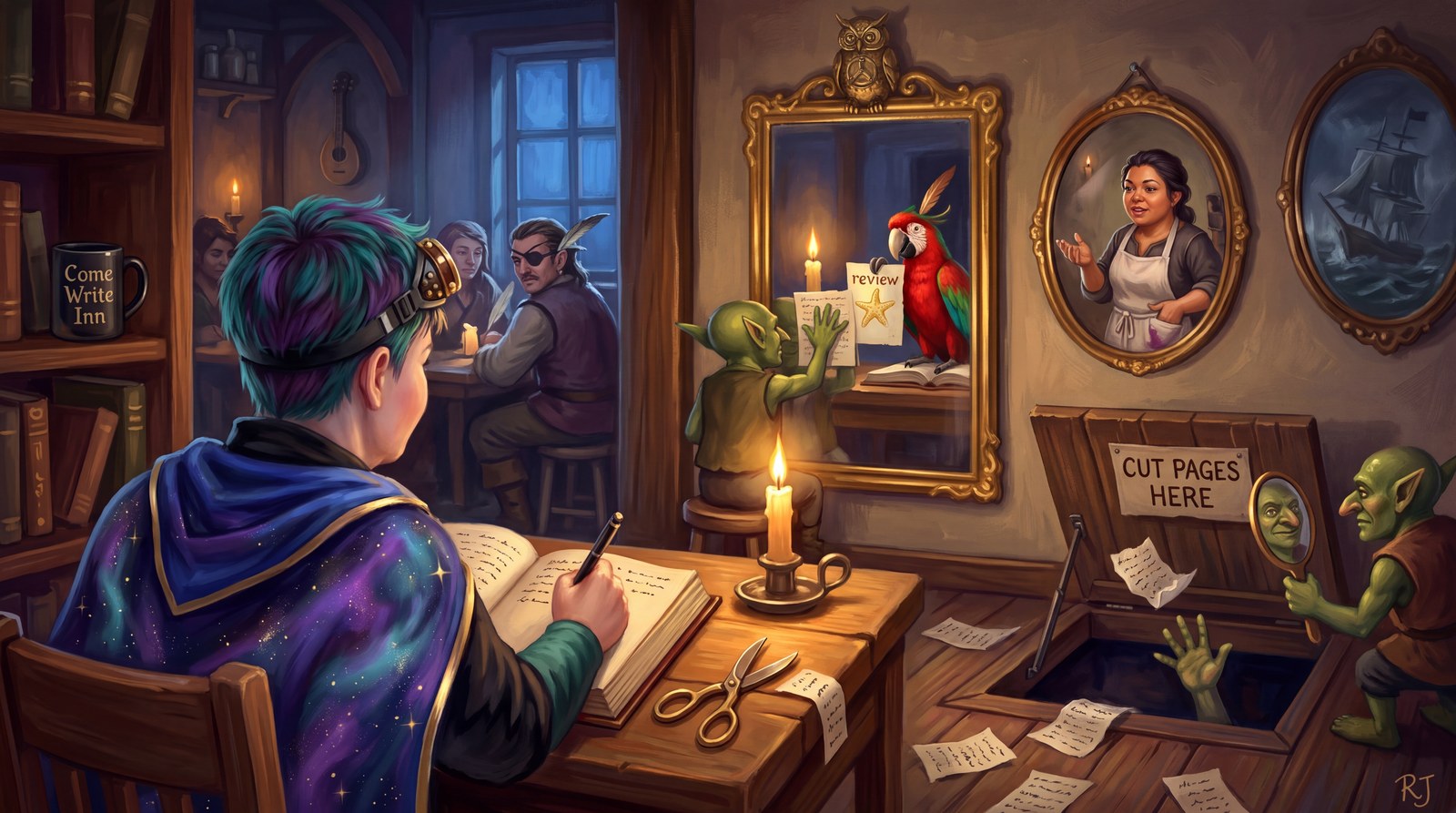
For my serial, that's Pumpkina confessing her side of a terrible night, and a parrot posting one-star reviews of the ship. Neither scene appears in the chapter. Both exist to send you to the original story.
(If you read my earlier post here, Don't Delete That!, this is that idea all grown up.)
And sometimes, a mirror is the same words in a new shape: the chapter read out loud, or painted stroke by stroke while you listen.
I chose mirrors for three reasons.
#1 - A mirror shows the story without being the story.
The writing comes first. Always. Everything else reflects it from a different angle, and a mirror can only reflect what's standing in front of it. If the chapter doesn't hold up, six mirrors just give a stranger six chances to notice.
#2 - A mirror lets people see what they can't see from where they're standing.
Think of the round mirror at a blind corner in a parking garage. A stranger scrolling YouTube, or picking a podcast for the drive home, can't see my chapter from there. A mirror hung in that spot gives them a glimpse of it, and shows them the way to the real thing.
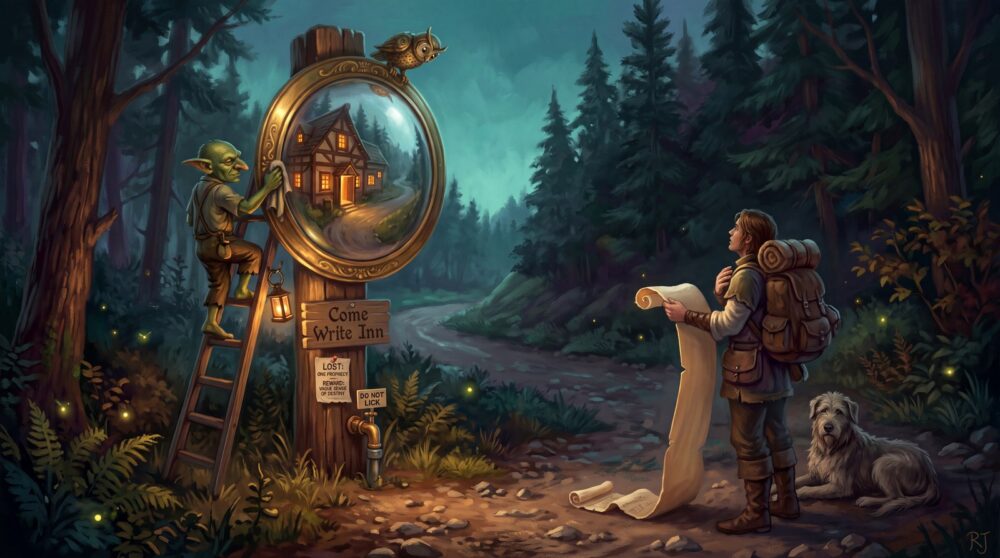
#3 - Nobody has to give you permission to hang a mirror.
Doors belong to gatekeepers: publishers, ad platforms, and the algorithms that decide what gets shown to whom.
Someone else decides whether a door opens. A mirror, I can hang myself, anywhere, today.
That last reason is the one that hooked me. It turns getting found into an experiment I can actually run, instead of a door I have to wait outside.
The Experiment: One Chapter, Six Mirrors
Chapter 1 is called Salt. It went up on a Thursday. By the following Monday, it had six mirrors around it, each one somewhere strangers already spend their time:
- An audio version, read in my own voice, on Spotify and in the Substack app, as Come Write Inn Radio.
- A painted film, on YouTube, on the Come Write Inn channel. Five paintings draw themselves, stroke by stroke, while I read the chapter aloud.
- Squawk, a short video on YouTube and TikTok, from the Inn's very own review site. It's run by a parrot with opinions and a quill. The ship got one starfish from the guy on the bucket line. The captain gave his own crossing five. (Of course he did.)
- Pumpkina's Confession, a short video on the same apps. She rambles about the night, apologizes for rambling, finds something in her apron pocket, and gets cut off mid-sentence.
- With Feeling, a third short video. Sway and the captain each tell their side of the same morning. Their stories do not match.
- The Barkeep's mug, in the Inn's little shop. (More on that in a minute.)
The question I'm testing: Which of these places actually sends a stranger back to read the chapter?
Is it working? I have no idea yet. It's early days.
Here's how I'll score it.
Every mirror except the mug points back to my Substack, so in 90 days I'll look at every new subscriber who arrived since the experiment started, and what brought them in. That's the main scoreboard.
Second, I'll look at whether any of these channels grew an engaged audience of its own along the way: people who watch, comment and come back.
Quick honesty break
(Because I'd rather say it than have it pried out of me.)
The paintings in the film (and the pictures in this post), the music, and the character voices in the short videos are made with AI tools.
The world, the characters and the story are mine, and so is the voice reading it. (The Barkeep's one dry line at the end of Pumpkina's video? That's me.)
And the fancy versions are not the point.
The audio, the reviews and the confession all have a phone-and-an-afternoon version. Your Squawk could be one grumpy review typed over a photo of your setting.
What Each Mirror Shows That the Page Can't
Every mirror has to answer one question before it's worth making: what does this show that the page can't?
- The audio carries my voice and the timing of the jokes.
- The film shows what the ship actually looks like.
- The confession shows who Pumpkina is when nobody is editing her.
Each one reaches strangers a different way.
Getting found mostly comes down to putting a piece of your story where strangers already spend their time, then giving them a clear way back to the words.
Book Discoverability Ideas for Every Budget and Energy Level
Your story can show up in more places than you think. Most of these need nothing fancier than the phone in your pocket.
Here are seven, from simplest to hardest to make.
1. Read it out loud.
Hangs in: podcast apps, and in people's earbuds on the commute.
Shows: your voice, your timing, the jokes landing exactly where you meant them. A phone and a quiet room will do.
2. A letter from your character.
Hangs in: your newsletter, or tucked into a bag at a signing table.
Shows: the character from the inside, in words they would never say out loud.
3. A recipe from your world.
Hangs in: Pinterest boards and actual kitchens.
Shows: what your world tastes like. (Ask me about the forty-seven extracts.)
4. Reviews from inside your world.
Hangs in: social media feeds, as a simple image or a few seconds of video.
Shows: your world's sense of humor. One grumpy review from a soggy sailor tells a stranger more about your world than any back-cover blurb.
5. A short confession video.
Hangs in: YouTube Shorts and TikTok.
Shows: personality. Let one character ramble, then cut them off right before the good part. People will go looking for the rest.
6. Merch with a line on it.
Hangs in: offices, laptop lids and kitchen cupboards.
Shows: that somebody loved your story enough to carry it around.
A mug goes to offices and coffee shops you'll never visit, and waits for someone to ask, "What's that from?"
Mine is the Barkeep's own mug, the Flagon of Rejuvenation. Its description says the Barkeep does not achieve consciousness until mug two. I am the Barkeep. I have no further comment.
7. A painted or animated film.
Hangs in: YouTube.
Shows: what your world looks like when it moves. This is the hardest one to make. It's also the one I can't stop playing with.
You Only Need One Mirror
Please do not hang all seven this week. (Says the woman who hung five in four days.)
Overwhelm is way too heavy, so just pick one. Pick the one that fits your energy, your budget and the story you already have. One mirror, made well, beats seven made in a panic.
Run the Experiment With Me
Here's my promise. In about 90 days, I'll share my results, back here if Writers in the Storm will have me, and on my Substack.
I’ll report honest results:
- which mirrors brought in new subscribers
- which ones grew a crowd of their own
- which ones got watched and sent nobody
- which ones I stopped making.
I'll report the good, the bad and the slightly embarrassing.
I'd love company while I find out. Pick one mirror. Make it this month. Then come back and tell me how it went.
So tell me... Which mirror would you hang first, and where? Drop it in the comments. I read every one. (Squawk may even leave a review.)
Want Company While YOU Build?
If you'd like help building a mirror or two, come spend a free week in my NO BS AI™ Guild.
There's live training every week, a community doing this together, and me being the guide on the side. On day one, you set the dials on your AI: what it may take off your desk, and where it never goes.
You'll pop a card in at checkout, and on day eight it rolls into membership at $97 a month unless you cancel first. (Canceling takes a couple of clicks.)
Start your free week at nobsai.now/free-week.
* * * * * *
About RJ

RJ Redden builds time machines. They run on AI. They skip you past the busywork and drop you off at someday: the book, the world, the business you keep meaning to create. You drive. She rides shotgun. She's a storyteller, the keeper of the Come Write Inn, and the guide behind NO BS AI. Pull up a stool at comewriteinn.com.
This post was drafted with AI assistance and finished with a very opinionated red pen.
Tagged as:
Subscribe to WITS



Recent Posts
- One Chapter, Six Mirrors: My Experiment in Getting Found
- Struggling with Character Voice? Check Your Point of View
- Conflict in Fiction Writing, 7 Main Types
- Author Blind Spots: The Gaps You Can't See
- When Is It Okay to Quit a Story?