Why writers need it and how to choose the right one.
You’ve felt it. That moment of crushing despair. That moment when you know the story you’ve been writing for months isn’t working. That moment when you wonder if you should toss the story aside or try yet another rewrite. Then the self-doubt pours in, and you don’t know if you should even bother. Stop right there. It’s not talent you lack. It’s not that your idea isn’t story-worthy. Most likely there’s a fundamental piece of storytelling that you’ve misunderstood. That piece? Story Structure. It’s not as arbitrary or simple as it sounds.
What is Story Structure?
Story structure is the way you choose to arrange story elements in an order that best serve your story and your audience. What exactly does that mean?
Most of you want to share your stories with others. And you’re reading this because you want to improve your skills. You’ve likely read a lot about plot and structure and may have come out of that feeling confused or frustrated because you can’t make it work for you. What you need is to take a broader look at story structure.
There are a lot of story elements we can use to tell a story that readers enjoy: genre tropes, plot, character arcs, theme, scenes, and a lot more. The way we present those elements, the order of those elements, affects a reader’s perception of the story in both the basic terms of understanding and emotional resonance.
Some of you will resist the idea of structure. It feels restrictive or forced. That may be true of some people’s definitions of structure, but that’s not how structure works in fiction or in life.
There is structure in life. We are born; we live; we die. Even in the smallest of ways, we live by structure. We sleep. We eat. We act.
I used to brag that I lived an unstructured life. But even an erratic schedule like mine has structure: my day begins, then there’s a middle, and an end to my day.
Structure Is Not Plot
It is crucial that a writer understands the difference. Structure is how we shape and reveal the story. Plot is what happens.
What happens in Cinderella:
Her stepmother and sisters mistreat Cinderella, but she remains kind.
Her act of kindness to the traveling prince leads to a happily ever after.
The Shape of Cinderella
The structure of Cinderella is a linear story told in the third person with rising action in three acts. It is told in order. One thing happens, then the next thing happens. With each action, tension rises until the climax.
Consider what kind of story it would become if it were told in media res—and started with her appearance at the ball?
It could have a dual timeline structure—the traditional story interspersed with what happens after Cinderella married the prince and brought her stepmother to live in the castle.
The shape of Cinderella would also change if we changed the genre to adventure. Or if we changed how we told the story to a first-person singular point of view.
The Five Most Common Plotting Methods
Most people call the five methods listed here plot structures. But they are only part of a story’s structure. Therefore, to avoid confusion, I will call them plotting methods. Here is a brief description of each of the five most common ones.
Three-Act Story
Loosely speaking, this is a beginning, middle, and end kind of structure. Act One is the setup: where we meet the protagonist in their normal environment/life right before an event forces them to step out of the normal. Act Two is the middle. This is where the protagonist tries and cannot return to normal, faces a crisis, and comes up with a new plan. In the end or third act, the protagonist faces off with the antagonist, wins or loses, and settles into a new normal. James Scott Bell has written an excellent book on the three-act method called Plot and Structure. Story Engineering by Larry Brooks or K.M. Weiland’s book, Structuring your Novel, are also very helpful.
Story Examples:
Cinderella,
Outlander by Diana Gabaldon (the original novel and the first season of the TV series),
The Girl on the Train by Paula Hawkins,
The Da Vinci Code by Dan Brown.
The Hero’s Journey
The Hero’s Journey, also called the monomyth or the hero’s quest, is a twelve-part method for plotting stories. A hero goes on a great journey and does great deeds, usually on behalf of his group, tribe, or civilization. The twelve parts include: The Ordinary World, The Call to Adventure, Refusal of the Call, Meeting with the Mentor, Crossing the Threshold, Tests, Allies and Enemies, Approach, The Ordeal, The Reward, The Road Back, The Resurrection, and The Return with the Elixir. You can read an in-depth discussion of this plot-type in Christopher Vogler’s book, The Writer’s Journey: Mythic Structure for Writers.
Story Examples:
The Hobbit by J.R.R. Tolkien,
Harry Potter and the Sorcerer’s Stone by J. K. Rowling,
Star Wars, the film
Save the Cat (beat sheet)
Created by Hollywood screenwriter Blake Snyder, the “Save the Cat” technique is a method of plotting that breaks stories down into three major acts and 15 “beats.” Intended as a screenwriting method, many people find it very helpful in writing fiction. Snyder’s book, Save the Cat!: The Last Book on Screenwriting You’ll Ever Need, is highly readable. The examples throughout are film and television examples.
For brevity’s sake, I won’t list all 15 beats here. You can learn more about this on the website savethecat.com or Snyder’s book, or the adaptation for novels, Save the Cat! Writes a Novel: The Last Book on Novel Writing You’ll Ever Need by Jessica Brody.
Story Examples:
(These hit all the beats of this method.)
The Hunger Games by Suzanne Collins.
The Martian by Andy Weir
Emma by Jane Austen
The Story Circle by Dan Harmon
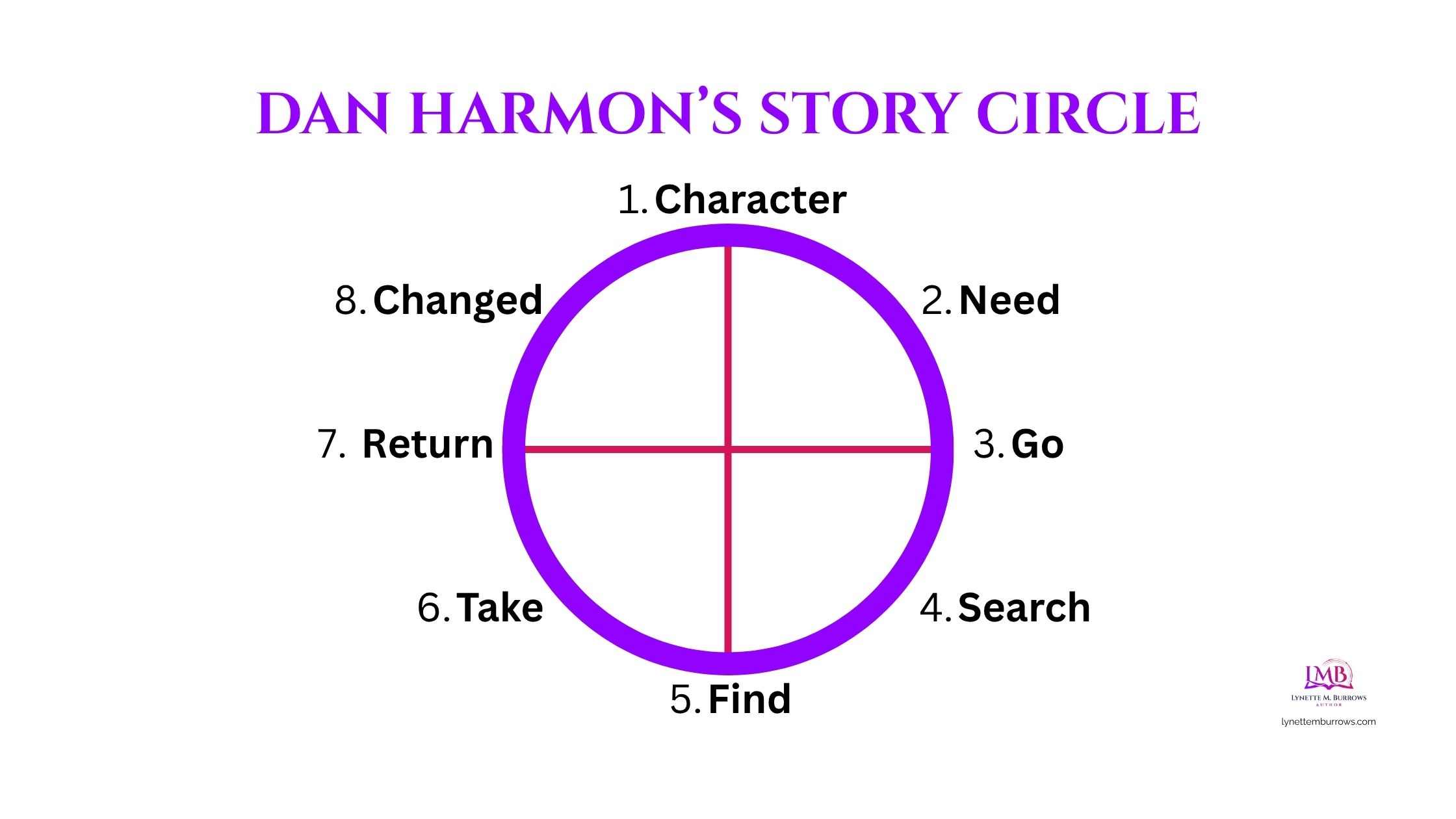
Dan Harmon is an American television writer, producer, animator, and actor. He developed the Story Circle when he got stuck writing a screenplay. Harmon adapted the Hero’s Journey to create a simple system for developing stories in any genre. He called it the story circle because he sees good stories as a complete circle. He describes the story circle as holding the “plot embryo.” It is a more flexible blueprint and one that prioritizes character arc and emotional growth more than the more action-oriented Hero’s Journey method.
Instead of twelve steps, it has eight:
- A character you can identify with
- Who has some kind of need, wish, incompletion that causes them to
- Go across a threshold where the story changes direction
- The character goes through a set of trials searching for something
- They find it whether or not they like it
- And pays a heavy price for it
- They return to the world they started in
- They have changed because of their journey.
While there is no definitive book on the Story Circle, you can watch Dan Harmon explain his plotting method. If that doesn’t make it clear, the Reedsy blog offers this explanation.
Story Examples:
Rick and Morty, a television comedy series written by Dan Harmon.
Toy Story, the movie
Harry Potter by R.K. Rowling
The Hobbit by J.R.R. Tolkien
Yes, I’ve included Harry Potter and The Hobbit in two places. Both stories fit both the Hero’s Journey and the Story Circle. You may think that’s because the Story Circle came from the Hero’s Journey. That is right, but that’s not the reason many stories seem to use more than one plotting method. Keep reading for more about hybrid plotting methods.
In Medias Res / Nonlinear
This plotting method drops the reader into the middle of a high-stakes scene without introduction. Flashbacks and dialogue fill in the backstory later. It has a beginning, middle, and end still, but they are not in chronological order. The author weaves events together for an effect. This often evokes an emotional response, like the feeling that it all makes sense in retrospect. In Catch-22, the nonlinear structure represents the chaos PTSD inflicts on sufferers.
Story Examples:
Catch-22 by Joseph Heller,
Station Eleven by Emily St. John Mandel
These methods are suitable for some stories, but not all. Remember, you can change or simplify any of these methods, just as the Story Circle simplifies the Hero’s Journey.
Beyond the Top Five Plotting Methods
Many of our writers here on Writers in the Storm have written about ways to think about plotting. Janice Hardy 5 Paths to Plotting Your Novel. John Peragine wrote about 7 Plot Structures for Pantsers and 7 More Plot Structures for Pantsers. There are mores post here, search for plot. Plus there are hundreds, probably thousands, more if you use a search engine. It's not that one plot type is the only way you'll write a best seller. But without a structure that readers are familiar with, it's unlikely you'll write a best seller. So find the one you understand, or make a hybrid.
How to Diagnose Which Method Fits Your Story
You can figure out which plotting method is best for your story before you write it or after you write it. Most writers instinctively write in the plotting method they read the most. In order to determine which method is best for your story, answer these three questions:
1. What is your core of your story about?
The core of your story isn’t the step by step, or even the theme, though theme is often strongly connected. This question is about the narrative drive of your story. Not all plotting methods fit all narrative drives.
Think about what change or resistance to change is at the heart of your story. If your story is about a transformation, then the Three-Act or Save the Cat methods will work best.
If your story is about a real or metaphysical journey through an unfamiliar world, the Hero’s Journey is the best fit.
If your story focuses on a character who remains the same but reveals their true nature, the in media res or nonlinear method may best serve your story.
If your story is about a community, a culture, or a system rather than a single protagonist, you may find no single method fits well. Try Dan Harmon’s Story Circle to give you more flexibility. Or, try a hybrid approach.
2. What do you want the reader to feel, and when?
Every structure, every plotting method, makes implicit promises to the reader about the emotional experience reading that story will provide. The emotional experience is not the plot. It’s the readers’ feelings. Feelings like the thrill of an emotional roller coaster. Maybe it’s that the reader understands more than the protagonist—or less. Maybe you want your reader to finish the book and feel the ending was inevitable in retrospect—or a genuine surprise.
A tightly plotted three-act mystery or thriller promises rising tension followed by release. A Hero’s Journey promises a genuine ordeal where the protagonist earns a triumph. The nonlinear method promises a puzzle that will resolve into clarity when the fragments suddenly click into place.
If your story does not fulfill those promises, your readers will find your story unsatisfying even if they can’t clearly identify why they are so dissatisfied.
3. Where does your story’s tension lie?
There are three broad areas of narrative tension (and many sub-areas). Most stories contain at least two areas of tension, but one dominates. Which type of narrative tension dominates your story?
Situational Tension
This is suspense in its purest form. The protagonist is in a precarious position—the reader turns pages quickly to learn if the protagonist will survive, escape, succeed, win, etc. As expected, the Three-Act and Save the Cat plotting methods are well-suited for this.
Dramatic Irony Tension
Dramatic irony is when the reader knows something the protagonist doesn’t. The reader’s tension lives in the gap between what the protagonist sees and understands and what the reader sees and understands. Nonlinear plot methods can work well for dramatic irony.
Relational or Internal Tension
Relational tension refers to the interpersonal conflict in your story. Not just between the protagonist and antagonist, but the push-and-pull between family members or team members, or even bystanders in your story. This conflict arises when your protagonist’s concrete goal stands between her and the other person. When you’ve learned to use these relational tensions skillfully, each one amplifies some aspect of your plot or theme or the protagonist’s character arc.
Internal tension is what happens inside a single character’s mind. It results from the character’s competing desires, misconceptions, or emotional needs. For example, in Tolkien’s The Lord of the Rings, Sam Gamgee’s love for a simple, peaceful life in the Shire is always in conflict with his fierce sense of loyalty to Frodo and Sam’s desire to see the Ring destroyed.
If you still aren't certain which method will work for your story, remember, most authors use a hybrid of more than one plotting method.
The Hybrid Approach
No single method of plotting works for every writer in every story they write. In fact, most stories are a blend of plotting methods. This is one reason stories like The Hobbit and Harry Potter fit more than one plotting method. Typically, even using the hybrid approach, one plotting method will dominate the others. Understanding which plotting methods promise what, and how they work, helps you understand which parts to choose for the best effect in your story.
And plotting methods aren’t the only story elements that create story structure. The point of view (first person, second person, etc.) influences story structure. Supportive elements like theme, setting, tone, and scenes also influence story structure and story promises. These inform the structure of your story to either the delight or disappointment of your reader.
A Word for Pantsers
You absolutely do not need to know what plotting method you’ll use when writing your first draft. You can free-write your first draft without a worry if that works best for you. After you’ve finished your draft, your story will be stronger and a more satisfying read if you evaluate your story, decide what plotting method is best, and retrofit your story with structure.
Retroactive structure can be difficult, especially for a first novel (don’t ask me how I know). But it is doable. The more you understand story structure, the easier you will find retrofitting your stories with structure. Depending on your knowledge and skill, you may need help from a more experienced author friend or a developmental editor.
Put It Into Practice
If you’re having difficulty deciding what plotting method to use, try these two exercises:
Break one of your stories down to see which plotting method comes closest to your natural way of writing.
Break down a favorite read and see which method fits. Most likely, whatever fits your favorite reading material will be the most comfortable method for you to use when writing.
Personally, I break down how a story’s structure by breaking the story into sections by page number. For example, if I were trying to decide if the Story Circle is the plotting method of a specific story, I divide the total number of pages for the story (first word to “the end”) by the number eight (the number of events in the story circle). Then I look to see if what those sections tell me meets the Story Circle method.
Structure Shapes Your Story for the Reader
Plotting methods are one of the key elements that give your story structure, but they are only the beginning. Scenes, point of view, tone—each of these carries structural weight too. Find the plotting method that gives your story the maximum impact on your readers, and you’ll have the foundation everything else builds on.
Next month we’ll talk more about structure and how it works in scenes.
Now I’d like to hear from you…
Do you know what story structure you will use before you write? Do you revise to retrofit story structure into your work? What works for you?
About Lynette

Lynette M. Burrows is an author, blogger, writing coach, and Yorkie wrangler. She survived moving seventeen times between kindergarten and her high school graduation. Her stories weave her experiences into speculative fiction stories that balance character growth with thrilling action and social themes.
Her Fellowship Dystopia series is the story of a young woman of privilege who doesn’t want to lose her identity to the rules of 1961 Fellowship America. She escapes and learns that her government and her family can judge her, one of the elite, an unbeliever. She will be a rebel even if the merciless Azrael hunt unbelievers. The trilogy is complete. Book One, My Soul to Keep, Book Two, If I Should Die, and Book Three, And When I Wake are on sale anywhere books are sold online.
When Lynette’s not writing she avoids housework and plays with her Yorkie. They live in Dorothy’s home state of Kansas. You can follow Lynette on her website or her Facebook page or Sign up for her newsletter.
Image Credits
Featured collage created by Lynette M. Burrows with images purchased from DepositPhotos.
Story Circle image created by Lynette M. Burrows based on Dan Harmon's demonstrations.