by James R. Preston
Once upon a time as a barely-eighteen-year-old freshman I walked into the Long Beach State bookstore and saw this little old man sitting at a table behind stacks of books, looking lost and alone. I stopped in my tracks. A writer? Yes! And I could just go up and talk to him! It was wonderful. That writer never knew how much talking to him meant to an eighteen-year-old kid who only knew he wanted to write.
That’s why you need to not only talk about your work, but to do it well. Hopefully this essay can help. Perhaps you will be standing in front of other writers, offering support. This essay can help you find a way to do that.
When I first started selling science fiction short stories, I was a kid, in grad school, and, uh, somewhat full of myself. I did not want to talk about the stories. I said — and if you think this is embarrassing, just wait — The stories are what’s important. They will stand or fall on their own.” Guess what? The stories ARE what’s important and now more than ever you have to help them as much as you can.
Since writing is your main job, talking about writing is a separate skill that may require some work, but it’s worth the effort. These rules are a good start.
We live in a world of fiction over-choice.
During the time it takes you to read this essay, mysteries, thrillers, and romances will be released; you have to compete to get noticed and talking to groups large and small will help. And it can be fun. It gets you out from behind the keyboard. And there’s one more reason that might surprise you. I’ll save that one for later.
I have three suggestions that will make it easier and illustrate my points with some true-life adventures about standing up in front of groups and trying to sound reasonably coherent. And I have tips about what you should not talk about, too.
Where writers get their gigs and their edge
Let’s start by listing where you can do this talking.
Book clubs.
There are thousands of them; the members are avid readers by definition and not only do they buy books and read books they also talk about books to people outside the club. And they don’t have to be local -- you can “appear” via Zoom these days.
A techie I worked with knew I was a writer and said his wife’s book club wanted me to talk to them.
The very first question they asked was “If Mac’s wife had lived, would he and Kandi gotten together anyway?”
I almost blurted, “They’re made up! They have no existence beyond what you see on the page.” But I stopped and thought. It dawned on me that these ladies treated my characters as if they were real. It was an eye-opening moment, and that’s another benefit of interacting with your audience: you learn. You learn about how readers see your work.
Writing conventions, like left coast crime.
You might be surprised at how organizers sometimes struggle to fill panel discussions. Register for the event well in advance, then send the organizers an email describing your book and saying if they have a spot on a panel you’d love to participate.
Professional organizations.
Writing is an important skill, one that needs work. In this case you may not talk about your book very much, but putting together a coherent report is something many non-writers struggle with. You can help, and your name will be out there.
Social organizations.
Clubs of all kinds are always looking for programs. You have writing tips to offer, in part because you are studying this blog.
So, how do you get that all-important first gig? Through your friends. I know a woman, a retired teacher, who is a member of a national women’s honor society. They are always looking for speakers. Be shameless! Just say, “I’m available if you need a program.” It may not work all the time, but it will get you started. Remember —- the characters in your story deserve it.
So now you have your talking gig. What’s next?
Standing up in front of groups and trying to sound reasonably coherent
Rule one
Practice — or not. If it’s a stand-up speech, yes, absolutely rehearse. On the other hand, if you are asked to host a table at an event, all you need to do is plan out some conversation starters, questions you can ask, like “Have you enjoyed the event so far?” Do I need to say that you should avoid, “So, have you read my new book?”
Rule two
Assess and modify. Watch your audience! If half of them are looking down at their cell phones, you need to speed it up. This relates back to Rule One. You need to have an idea of what you can cut. I was once asked to talk about grammar, a subject near and dear to my heart, and at the break the man who had invited me said quietly “You’re losing them.” I found it hard to believe, but not everybody is as interested in commas and semicolons as I am.
Rule three
Know your audience, know your time limit, and if at all possible know your venue. If the organizers want five minutes, make sure that’s how long you talk. No longer! Use the stopwatch on your phone to time your rehearsals.
“Venue” includes the actual place you will stand. Is there a podium? Microphone? Here’s a horror story from my past. At Cal State Long Beach I was in student government— Associated Students Chief Justice — and at the end of my Senior year I was to hand out awards to the other Justices.
I stepped up to the podium and could not be seen. Ok, I’m short. Fortunately, my speech teacher had trained me to think on my feet. l just stepped around the stupid thing and said, “Due to technical difficulties the use of the podium will be discontinued.” The audience erupted in laughter. The Dean, who followed me, said she was laughing so hard she forgot to give me my award. I got it as we were all leaving.
Not a rule, exactly, but beware of overconfidence. It can and will bite you. Years ago the Huntington Beach Sanitation Department — right, they process what you flush — asked two of us to come and talk about electronic document creation. Well, the lady and I had years of experience and we’d done this gig before, so we got our overheads ready, met a couple of times to decide who would do what, and in we went.
Everything went wrong. I set the overheads down in front of a fan and they flew everywhere; the audience had no interest in what we were telling them, and that was before the sewage smell crept in. I’m not making this up. We were so sure we had it wired that we neglected finding out about the audience and their needs, and we didn’t rehearse. So we paid. It’s still painful to talk about.
What NOT to talk about - one opinion
Now, in my opinion what not to talk about. Ideas. If you are thinking about a terrific love story between a vampire cheerleader and a shape-shifting alien prince, keep it under wraps at least until you have a draft. If you tell people about it before you write it, two things can, and probably will, happen. First, you can lose your edge, your enthusiasm, because after all, you have told the story. Second, the way you have described it will be locked in, settled, when in truth the tale will grow and change, evolve during the writing process. Either way the story can be damaged or even killed.
Final thoughts
So that’s it. By the way, that writer behind the books was Erskine Caldwell of Tobacco Road fame and the book was his novel Jenny by Nature. I still have the signed copy.
Now I’m the little old man behind the stacks of books, but I’m not lost and alone. I have you, gentle readers of WITS. Thanks for listening once again.
And now it’s your turn. Do you have presentation stories you are willing to share? Suggestions? C’mon, we’re all in this together.
Until next time, this is James, signing off.
About James
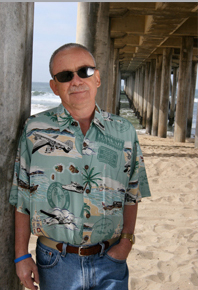
James R. Preston is the author of the multiple-award-winning Surf City Mysteries. He is currently at work on the sixth, called Remains To Be Seen. His most recent works are Crashpad and Buzzkill, two historical novellas set in the 1960’s at Cal State Long Beach. Kirkus Reviews called Buzzkill “A historical thriller enriched by characters who sparkle and refuse to be forgotten.” His books are collected as part of the California Detective Fiction collection at the University of California Berkeley.
Find out more about James at his website.