Writers in the Storm

A blog about writing

storm moving across a field
Writing Check-In: How’s 2026 Going?

by Liz Talley

Hate to break it to you, but we’re already over a third of the way through 2026.

Sound the alarm—the end of May is looming!

<cue weak knees and a frantic search for the fainting couch>

Hard to believe four and a half months have already flown by and summer is knocking at the door. Which makes right now the perfect time to stop, take stock, and adjust your goals for 2026.

Back in January, you probably stared down that shiny new year full of possibility and set some writing goals. I’m a big believer in two things when the calendar flips: choosing a guiding word for the year and creating a business plan. But even if you didn’t sit down with a fresh notebook and color-coded markers, I’m willing to bet you at least had a mental list of what you wanted to accomplish.

Maybe you planned to:

  • finally finish that first draft
  • revise the NaNoWriMo manuscript that’s been collecting digital dust since 2021
  • start an entirely new project
  • snag that elusive agent
  • figure out Amazon ads without losing your sanity

Whatever your writing goal was (or still is), this is the perfect time for a gut check. Because if you want to kick butt in 2026, you need to know exactly where you stand.

Before we deal with this year, let’s take a quick glance in the rearview mirror.

How was 2025?

Did you accomplish what you set out to do? Looking back isn’t about beating yourself up—it’s about honesty. Accountability matters in a writing career.

So… what did you accomplish?

I’ll wait.

drumming fingers…

Still waiting.

more dramatic drumming…

Okay, got it?

Maybe you’re thrilled with how last year went. Or maybe, like many writers, you didn’t quite get there. Maybe last year’s goal became this year’s goal.

That happens.

Life gets messy. Doubts populate like dust bunnies. The publishing industry does what the publishing industry does. Rejections pile up. Family needs you. Health takes you on a detour. But, whatever happened in 2025 is done.

Finished. Finito. In the books.

Forgive yourself. Then move on.

What now?

At this point, some of you are thinking, “Well, it’s too late to make a plan now."

Um… no.

No, it is not.

We still have nearly two-thirds of the year left.

That’s seven and a half glorious months to:

  • draft a manuscript
  • revise a manuscript
  • write a query letter
  • research agents
  • build a website
  • learn social media strategy
  • finally figure out what the heck Amazon ads do for you

That’s not “too late.” That’s opportunity.

So pick the goal that matters most.

Here’s the key: don’t try to do everything at once. Pick the goal that absolutely needs to get done.

For me? It’s drafting a new book.

Is that doable with the time left in 2026?

Yes.

So that becomes Priority One.

Now comes the important part: making the goal actionable.

Right now, I have the tiniest spark of an idea. Before I can send a synopsis to my editor for approval, I need to flesh out the story.

That means:

  • brainstorming with trusted writing friends
  • drafting three chapters to find the story’s voice
  • creating a three-page synopsis
  • getting all of that done by mid-June so I have six full months to draft an 80–90K manuscript.

Once the project gets approved, I can reverse-engineer the writing schedule and calculate exactly how many words I need to write each month.

See what happened there?

I created a deadline.

Okay, sure. Setting deadlines is easy. Keeping them? That’s where the rubber meets the road. Because ultimately, you have to honor the timeline you create.

One of the tools that helps me stay on track…

A business plan.

Every year, I sit down with a few trusted writing friends and walk them through my goals. That accountability makes all the difference. Something about saying your plans out loud and then pinning them to the bulletin board in your office makes them real.
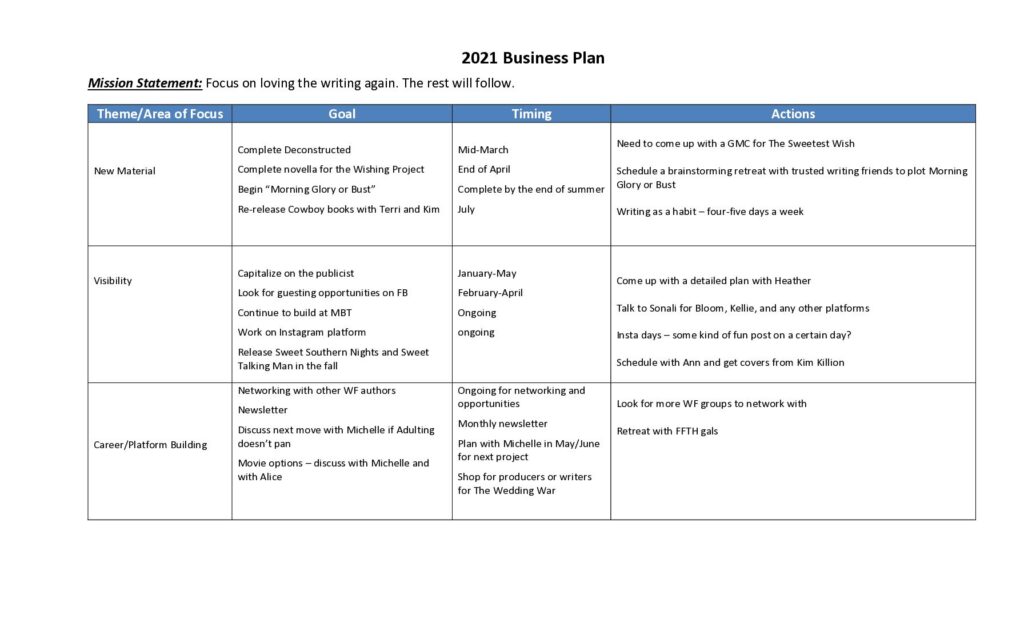
(Download the Sample Business Plan above by clicking here.)

For me, the top priority is always writing new material or revising a book. Always. But the secondary goals matter too. Because modern writers aren’t just writers. We’re marketers. Brand strategists. Social media managers. Website coordinators. Networking professionals. Occasional emotional support humans.

It’s… a lot.

My secondary goals for 2026 include:

  • building a website for my new pen name
  • hiring a branding consultant
  • researching publicists
  • getting updated headshots
  • requesting blurbs
  • developing a social media strategy

Honestly? It all feels a little overwhelming. But overwhelming goals become manageable when you assign deadlines.

Of course, setting deadlines can feel a bit like chasing a Slinky down the stairs. Remember those? One minute you’re motivated. The next minute it’s three weeks later and somehow you’re looking for your escaped slinky instead of writing Chapter Five.

That’s exactly why timelines matter. And why writing friends who lovingly hold your feet to the fire are priceless.

Final Thought

Creating a business plan and setting measurable goals can feel about as appealing as sticking your hand into a hornet’s nest. I understand. I am not naturally organized. Not even close. But I do believe visible, actionable goals help writers finish projects and move forward.

So let’s do a check-in.
What’s your big goal for 2026? How’s it going? Have you drifted off course? Do you have deadlines in place? Are you ahead of schedule?
(Or are we all collectively pretending May isn’t happening?)
Tell me where you are down in the comments!

About Liz

Liz Talley is the USA Today best-selling author of over thirty heartwarming stories. A finalist in both Romance Writers of America’s Golden Heart and Rita Awards, Liz has published with Harlequin, Hallmark, and Montlake where she reached number one in Kindle romance and was named to Publisher’s Weekly mass market bestseller list. Her stories are set in the South, where the tea is sweet, the summers are hot, and the porches are wide. In 2023, she also added screenwriter to her accomplishments, co-writing an adaptation of her novel The Wedding War, which landed in the Top 20 of the Louisiana Film Prize.

Find Liz Talley's books here.

Featured image purchased from Depositphotos.
Read More
Your Voice Is the Point. Stop Toning It Down

By Jenn Windrow

I was on vacation in Vegas celebrating my daughter’s 21st birthday, and suddenly I was tagged in a post. A review popped up that I had been waiting a year for. One I had given up on. But there it was. This reviewer was known to be blunt and honest, but not brutal. My little author heart started pounding, my hands were shaking, and I wasn’t sure I wanted to click and read. But curiosity won out over anxiety, so in I went.

And this is some of what it said…

“This voice heavy urban fantasy is off to a sleazy, gloriously over-written start. Too much, even, but in a good way.”
“The colors are bold. The sleaze is very sleazy. The stink is caked on.”
“It’s melodramatic. It reads fast. It has a sense of flair.”

While I was reading, my smile grew until my face hurt. Not just because of the positive review, but because it nailed something I care about deeply as both a writer and a developmental editor.

My author voice.

My voice is probably the single most important thing to me when it comes to writing. I work hard to make sure that the words on the page reflect me as a writer. My sass, my snark, my attitude, and well, just me. And this reviewer not only saw that, but he appreciated it.

And here’s the part that mattered even more.

It showed me that being authentic to my author voice doesn’t hurt me.

What “Voice” Actually Is

You author voice is so many things. Word choice. Cadence. Rhythm. Style. But it is also the way your narrator sees the world and how they respond to it. What they notice, dismiss, judge, and believe to be true.

That’s why two writers can describe the same scene and land in completely different places. They’re not just choosing different words. They’re telling different truths. They see things differently.

My voice is quirky and sassy and sarcastic. My characters have sharp edges and even shaper tongues. And I like it that way. I don’t write in a world of black and white, I like to explore the grey areas in between.

I guess you could say your “voice” is your author signature. It’s a promise to a reader right from the start. It gives them an idea of what kind of ride they are going on. Funny, serious, quirky, gothic.

What That Review Really Said

On the surface, that review talks about style. Sleaze. Over-the-top prose. Noir turned up to eleven. Melodramatic.

Some of those words could have sent me into a tailspin of depression, I mean, who wants to hear that their writing is melodramatic? Over the top? Sleazy?

(raises their hand) ME!

Because that is how I write. I put it all on the page and leave nothing behind. And when I read the review, my brain was going check, check, check, and check.  

But it was what was underneath those words, the deeper meaning of the review that really caught my attention. That showed me that even though my voice is irreverent on the best of days, my very LOUD voice is not taking away from the story itself.

And here is the proof in a few other lines that were mixed in as well.

“It doesn’t sacrifice anything in terms of clarity or focus.”

And this one:

“We get a very good sense of our MC’s situation.”

That’s voice holding the line. That’s a narrator who knows exactly what she thinks about her situation, even when the prose is big, loud, and unapologetic. That’s control.

Strong Voice Gives You Range

When your voice is anchored, you get to make bold choices. You can push your prose. You can lean into tone. You can be dramatic, sharp, messy, or restrained.

Let’s look at modern authors known for unmistakable voice:

  • Colleen Hoover leans hard into emotional immediacy. Her narrators feel everything in real time, and that intensity is the voice. Strip that out and the books stop working.
  • Sarah J. Maas writes with a sweeping, immersive intensity that blends internal emotion with high-stakes fantasy. The voice is declarative, emotional, and deeply committed to the character’s experience.
  • Leigh Bardugo shifts voice depending on POV, but each one is anchored in a clear worldview. Kaz Brekker doesn’t sound like anyone else because he doesn’t think like anyone else.
  • Tamsyn Muir in Gideon the Ninth is chaotic, irreverent, and wildly specific. The voice is so strong it borders on polarizing, and that’s exactly why it works.
  • Rebecca Yarros drives voice through urgency and emotional stakes. Her narrators are grounded in what’s at risk right now, and that perspective shapes every line.

None of these authors are playing it safe. And none of them would benefit from someone “toning down” their voice.

Why I Don’t Edit Voice

As a developmental editor, I will tear apart your structure. I will push on your pacing. I will question your character choices and motivations. I will tell you if you a messy mid-point. But I will not rewrite your voice.

Because voice isn’t a problem to solve.

It’s the part of your writing that is entirely yours. The part no one else can replicate, even if they tried. It’s what makes your writing, well…you.

And the second an editor starts smoothing that out? You don’t have a stronger manuscript. You have a safer one. And safe is forgettable. Safe is boring. Safe gets skimmed instead of sucking a reader into your world.

No one wants to be safe.

The Real Danger: Flattening Your Voice

A lot of writers try to fix their voice. They tone it down. Clean it up. Try to make it sound more professional or more polished. They try to write like other authors in the genre in order to fit in.

But in the end, they strip out the very thing that made their writing theirs.

I see this when writers chase:

  • Cleaner prose
  • Safer sentence structure
  • “More lyrical” language

None of those are bad. But they come at the expense of you being you on the page. You’re not improving your voice. You’re diluting it.

Right now, I am working on a romantasy. A genre that is wildly different than my normal urban fantasy series. And while I understand that romantasy is less punchy, and fast moving and sarcastic, I learned switching my voice so that I wrote like other romantasy authors was hurting the book more than it was helping it. In fact, I put the book aside because there was something off about it.

Then I figured it out. It was my voice, it was gone, and my writing was flat.

I decided I would rather stand out than fit in.

I am taming my voice a touch, cutting out cuss words, smoothing out the prose, but I am leaving in the sass and snark and melodrama that makes me…me. And now that I have stopped worrying about voice, the story is flowing again and I am happy with the outcome.

If You’re Worried About Your Voice

That means you care. That you have something to say, and you know exactly how you want to say it.

Lean into it. Learn to love. And stop worrying about fitting in, and allow your words to shine.

The Takeaway

Voice is not the thing holding your manuscript back. It’s the thing that will make it stand out.

So, protect it. Develop it. Let it be bold. Let it be specific. Let it be a little too much. Because the right readers aren’t looking for safe. They’re looking for something they can’t get anywhere else.

They’re looking for the authentic you.

Which authors make you feel their voice instantly, and why?

About Jenn Windrow

Jenn Windrow once attempted to write a “normal” book—and promptly bored herself into a coma. So now she sticks to what she does best: writing snarky, kick-butt heroines, broody supernatural men, and more sexual tension than a vampire in a blood bank.

She’s the award-winning author of the Alexis Black novels and the Redeeming Cupid series, where the undead never sparkle and the drama is always delicious. Jenn moonlights as a developmental editor, helping other writers wrangle their wild plots and tangle-free prose.

When not arguing with her characters or muttering about Oxford commas, she can be found binge-watching trash TV, wrangling the slew of animals that live in her house (husband and teenagers included), or telling herself she’ll only have one more cookie.

You can find her at jennwindrow.com or lurking on social media where she pretends to be an extrovert.

Photo by Hussein Abdullah on Unsplash

Read More
The Ghost in the Machine (Inherited Creative Blocks)

by Lisa Norman

We talk a lot about "The Muse" and "The Editor," those voices that whisper in our ears and either help our creativity or edit our writing into magic. Sometimes they help. Sometimes they block our creativity. In a perfect world, they work together as a creativity duet.

But there’s a third voice in my head that I inherited along the way: the Ghost of Scarcity.

There are other creative blocks that writers carry. Ghosts of shoulds long past: writing should be profitable, writing should be effortless, I should be further along in my career, and one of my least favorite to run into: I should be able to do this. Whatever this is at the time.

And there are as many others as there are writers.

The trick for me is to recognize that some of these ghosts, these fears, are not my own. Some I inherited from family. Some I picked up along the path of my writing career.

Recognizing the Sources

There’s a common marketing tactic, known as Agitation Marketing, where you state a problem that people might have as if it is a thing they DO have. This is especially powerful if it is a common issue that many people have occasionally. Suddenly, even those who don’t have the problem think that maybe they do. People hearing or reading the pitch begin to question themselves.

The marketer has created a problem, and now they can sell us the solution.

This technique turns a fleeting problem that lots of writers have into a chronic worry that the writer (or other buyer) must pay to solve, urgently. And hey, this advertiser or teacher just happens to have the perfect solution.

I’ve run into too many writers carrying beliefs and blocks that they picked up from a cleverly crafted marketing pitch.

Recognizing the Result

Let’s look at how these creative blocks derail our talents.

I’ll use myself as an example. Scarcity is one of my ugliest creative blocks.

I’ve shared before how my mother spent her life in a constant state of scarcity. Even when she was financially stable, she believed she couldn’t "afford" to be creative. She was a powerhouse in Silicon Valley real estate, winning awards and breaking records, while her sketches were relegated to the margins of high-value contracts. It wasn't until cancer robbed her of the ability to sell real estate that she discovered she could have made a living through the art she’d suppressed. Her true scarcity wasn’t money, it was her access to creative joy. She thought money would solve all of her problems, and so she drove herself relentlessly to make more and more money.

For me, my trigger was a brief stint when I first got out of college. My autoimmune condition took me down hard and I went hungry for a while. Now only one look at me these days and you’ll know instantly what my creative soul can’t seem to grasp: I haven’t been hungry in a long time.

Being too Honest

Here’s how I start my day, every day. I check my bank account balance. I eat and make sure there’s enough food for my family for the day. If my bank account drops close to my comfort level, I start panicking. I could sit down and write, but the first person who comes along and offers me a paying gig? Writing goes right out the window. Writing. The creative passion of my life becomes impossible.

I’ll be chasing someone’s broken website instead of my writing goals and not even notice that I changed direction.

That scarcity? It’s not real. But it feels real.

I find myself measuring my worth by "real job" metrics—output, Return On Investment (ROI), and efficiency—forgetting that my creativity is a living thing, not a factory.

When "Should" is a Hand-Me-Down

Creativity wilts under the weight of "should." Most of our "shoulds" are just recycled fears from people who didn't know how to tend their own creative sparks. We tell ourselves:

  • "I should write something 'marketable' instead of what I love." – Why? Why not trust that if I love something there will be readers on the planet that will love it, too?
  • "I should be farther along by now." – Why? People start their creative lives at all ages. There’s no magical age for success.
  • "I should justify the time I spend writing by making a profit." – Why? Many successful writers lost money before they made it. I’d hazard to say that most creatives invest time not making money before they start turning a profit.

When you live under the pressure of "should," your creativity becomes a debt you owe to yourself instead of a gift you give to others.

Here’s a question: if you carry any of those shoulds, are they actually real and true for you? Or are they something you inherited from someone in your life or a clever marketing campaign?

Reclaiming Your Fire

Breaking this cycle isn't about a grand rebellion; it’s about awareness. It’s noticing that the dread you feel when opening your manuscript might actually be a reaction to an inherited or absorbed expectation that isn’t yours.

Today, try a small act of discovery. Write one scene that has zero market value. Write something messy, weird, or "useless" just because it makes your heart lift.

The joy of creativity is about realizing that your creative presence is enough, exactly as it is. You aren't "behind" a universal timeline; you are arriving exactly when your spark is ready.

What is one creative "should" you’ve been carrying that feels more like a burden than a blessing? What happens if you set it down today?

About Lisa

head shot of smiling Lisa Norman

Lisa Norman's passion has been writing since she could hold a pencil. While that is a cliché, she is unique in that her first novel was written on gum wrappers. As a young woman, she learned to program and discovered she has a talent for helping people and computers learn to work together and play nice. When she's not hanging out with her family, writing, or teaching, she can be found wandering the local beaches.

Lisa writes as Deleyna Marr and is the owner of No Stress Writing Academy. She also runs Heart Ally Books, LLC, an indie publishing firm.

Interested in learning more from Lisa? Sign up for her newsletter or check out her school, No Stress Writing Academy, where she teaches social media, organization, technical skills, and marketing for authors!

Her most recent book, The Work of Joy is now available here.

Top image from depositphotos.

Read More
1 16 17 18 19 20 832

Subscribe to WITS

Recent Posts

Search

WITS Team

Categories

Archives

Copyright © 2026 Writers In The Storm - All Rights Reserved