
Writers in the Storm

A blog about writing

storm moving across a field
10 Common Kitchen Objects to Use As Weapons

By Piper Bayard
Of Bayard & Holmes

My writing partner, Jay Holmes, is a forty-five-year veteran of the military and intelligence communities, and we write espionage fiction and nonfiction. We are often asked what weapons we prefer for fights. We both advocate firearms training for the best self-defense in real life. However, in writing, we follow the advice of the great James Rollins, which is that authors should avoid killing people the same way twice in a book.

To help authors avoid such redundancy in fiction, we explored how common bedroom objects can be used as weapons in our last article, 10 Common Bedroom Objects As Weapons. This time, we take a look at common objects in the kitchen, a favorite setting of crime writers.

Excellent technique!

1. Knives

Knives are the obvious choice of weapon in the kitchen. People with experience using knives in close combat will have their favorite techniques and likely don’t need to read this article. For everyone else . . .

Have your character choose a decent, sturdy knife with a long blade—something large enough to do damage, but not anything too big to control.

So what to do with this blade?

Often, we see a character searching their home with a knife in their quivering hand, far in front of them, leading their way from one room to the next with the point. That is a great way to give their opponent a knife. Think about it. If the first thing coming through a door is a knife and a wrist, the adversary only needs to be waiting at that door to grab that wrist or smack it with any hard object and take control.

If the character prefers to live rather than offer a weapon to their adversary, they should lead with their empty hand and hide the knife. When they close for combat, strike first with the empty hand. The opponent will focus on that empty hand and block. That is the moment to drive the knife home.

But where is “home?”

A rule of all close combat is that the opponent determines the defense a character must use. Where the character aims with the knife is determined by what the opponent makes available in that instant. While groin, neck, and face are excellent targets, the character must take the shot they can get.

Don’t worry about perfection, such as a Roman gladiator plunge upward under the rib cage to the heart. Speed is most important in this moment. After your character quickly stabs the opponent a couple times, the opponent will be distracted by having been stabbed. At that point, your character has a little more breathing room to work on their technique with the subsequent stabs.

Wait. Subsequent stabs?

Yes. When your character (or anyone) is fighting for their life, they want to make sure the opponent is down and incapable of getting up again. Never stop with just one stab. If they fall to the ground, kick and stomp their head, and keep kicking and stomping until they are definitely not getting up to attack again. The most important thing in that moment is to survive by any means necessary.

2. Trash Bags

Trash bags are a great tool in a fight. Have your character lay them in front of doors or on stairs as slip traps. Once the opponent slips and is off balance, the character can follow up with a knife thrust or a can of dog food or Pyrex measuring cup to the side of the head. They could even have another trash bag in their hands that’s been twisted into a rope to strangle the opponent. Trash bags are also great for clean up once the fight is over.

3. Stove

We’ve all seen kitchen fight scenes where a person’s face is shoved down on a hot stove, illustrating the great truth about a hot stove—it can be used on both attacker and defender. However, if there is something hot on that stove, such as hot oil or hot water, your character can throw that hot oil or water at the opponent.

This is a double win in that the opponent then can’t use it on your character, and the opponent gets burned. After all, if someone is going to get burned, the opponent getting burned is always better. Be sure to follow up with punches, kicks, stabs, etc., until the opponent is completely incapacitated.

4. Salt, Pepper, and Chili

Salt, pepper, and chili spice. Have your character uncap the salt and pepper shakers or the chili pepper jar and throw them into the opponent’s face. Chili powder is best. That one really gets them. This is both distracting and painful for the opponent and gives your character a chance for follow up with . . . You guessed it. Punches, kicks, stabs, etc.

5. Countertop Tea Kettle

A countertop tea kettle is a great asset in a fight. Throw the boiling water in the opponent’s face, and while they are agonizing over that, beat them on the head with the kettle.

A boiling cup of water from the microwave can accomplish the same goals. If your character thinks someone is trying to break in, have them heat a cup of water in the microwave or turn on the kettle. That way, your character has the weapons at hand should they be needed.

Note that Holmes's grandmother did not even disturb her makeup. Out with the trash and ready for a night with the girls. For real. She went out clubbing and left the guy in the street. Go, Grandma!

6. Heavy Skillet

Hard to beat a good heavy skillet for beating someone. Have your character choose something heavy enough to do the job, but not too heavy to control. Since show is always better than tell, I’ll share an appropriate anecdote.

When Holmes was a boy many decades ago, his grandmother lived on the third floor of a big city apartment building. A burglar had been hitting her building regularly. One night, she came in and interrupted him, and he fled out the living room window with a bit of her jewelry.

The next night, she opened the window, turned out the lights, took hold of her cast iron skillet, and waited. Sure enough, he came back. She had always told Holmes, “Wait for them to get their shoulders through the window. Don’t give them the chance to back out.”

Once the burglar’s shoulders were in, she smacked him on the head with the skillet. Hard. He fell back out the window and down into the street. Holmes still remembers hearing her on the phone to his dad. “Don’t bother the police. They’re busy. The garbage man will pick him up in the morning.”

Moral of the story? Let them get their shoulders in before your character swings, and there will be no need to bother the police. Even if the opponent is not coming through the window, a good smack to the head with a heavy skillet should get them down or distracted to follow up with kicks, stabs, etc.

7. Cleaning Supplies

Cleaning chemicals are terrific weapons, and ammonia is the best. If the character is squeamish about firearms or they are not at hand, ammonia in a water gun can be very effective when squirted into an opponent’s eyes. Your character can also throw it in the opponent’s face from a glass or a bottle.

Another option is to have your character flick powdered Comet or other powdered cleaners into the opponent’s face. For a longer range, your character can spray Lysol, bug killers, furniture cleaner, or any other aerosol into their eyes.

As always, punches, kicks, stabs, etc., or your audience will declare your character too dumb to live.

8. Refrigerator

Ice cubes in front of the door with a bit of water make a great slip trap. Just keep in mind that it can also be a slip trap for your character.

Frozen meat can make a fantastic club, such as in Lamb to the Slaughter by Roald Dahl. In that story, the killer murdered her husband by beating him with a leg of lamb and then cooking it to feed to the detectives. A nice frozen pork tenderloin is easy to hold in the hand and could break rocks.

Dinner, a bludgeon, or both? You decide.

Liquids from the fridge can be great for throwing into the opponent’s eyes. Careful of throwing jars, though. If they don’t break, the opponent can throw them back, and if they do break, that glass will be there for your character to deal with, as well.

If it is convenient for your character, they might also use an open refrigerator door as a shield against projectiles.

9. Alcohol

In this age of Covid, many of us have bottles of alcohol all around the house. Your character could throw alcohol in the opponent’s eyes. Your character could also throw the alcohol on the character and light them on fire by pushing them into the flame of a gas stove. Just be sure your character also has a . . .

10. Kitchen Fire Extinguisher

If your character pulls off the “light the opponent on fire” trick from #9, they will want a fire extinguisher to keep from burning down their house. Your character can also use a fire extinguisher to smack an opponent on the head and/or to spray the contents into the opponent’s eyes.

Remember, in close combat, speed is more crucial than perfection, anything your character throws, their opponent can throw back, and, as always, the best weapon your character has is their determination to survive no matter what.

What kitchen objects would your characters choose to incorporate into a fight? What questions do you have for us?

About Bayard and Holmes
Piper Bayard and Jay Holmes of Bayard & Holmes are the authors of espionage fiction and nonfiction. Please visit Piper and Jay at their site, BayardandHolmes.com. For notices of their upcoming releases, subscribe to the Bayard & Holmes Covert Briefing. You can also contact Bayard & Holmes at their Contact page, on Twitter at @piperbayard, or at their email, BayardandHolmes(at)protonmail.com.

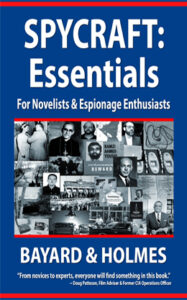
SPYCRAFT: Essentials takes the fiction out of spy fiction, covering the functions and jurisdictions of the main US intelligence organizations, the espionage personality and character, recruitment, tradecraft techniques, surveillance, firearms, the most common foibles of spy fiction, and much more. Available in digital format and print. See Bayard & Holmes Nonfiction for links to your preferred bookseller.

Top Image by Solomon Rodgers from Pixabay.

Read More
Memoir Writing 101 – Getting Started

By Linda Ruggeri

This post could also be called: What I Wish I Knew Before I Started Writing My Memoir. This is Part 1 in a three-part series.

As a nonfiction editor and writing coach, I often work with first-time memoir writers who have a story to tell and need help shaping it. These writer-editor relationships may last from six months to three years until what really needs to be said makes its way to the surface of a page.

Memoir writing is more than jotting down thoughts the way we do in a diary. In memoir, ideas need to be organized. Characters and themes developed. Context and sensory details added. Words, sentences, and paragraphs grammatically scrubbed and primed. Chapters need to work independently but also as a whole.

After our work together, it's rewarding see how these clients have grown stronger as writers, how they’re now able to identify inciting incidents (yes, we use those in memoir too!), what matters, what doesn’t, and perhaps more importantly—from a business perspective—what the reader is interested in reading about versus what they think the reader is interested in.

In the end, I get to see my client’s beautiful character arc of their own writing journey.

Universal Writing Truth

If there is one thing we know as writers, is that our cultural upbringing, age, gender, environment, all affect the way we approach our projects and how we work. None of my clients ever have the same experience when they set out to write their memoirs.

Recently, I interviewed some past clients (now published authors) and asked them to share their insights on what their memoir-writing experience was like. This is part one of our conversation, printed here with their permission.

My Question: Can you tell me three things you wish you’d had known before you started writing your memoir?

Christina: (inspirational memoir)

The first book I ever attempted to write was a memoir. I assumed that it would be the easiest of all the writing styles because it was about “me.” I thought it would be super simple to pick out a few memories and write a book based off of them. It ended up being extremely challenging and time-consuming because I wanted everything to be perfect on the first draft.

Every word, sentence, and paragraph needed to be perfect. I would write ten pages in a day only to come back the next day and erase or restart six of them because I thought it wasn't good enough. I was trying to be Michelle Obama or Oprah Winfrey.

Who was I kidding? I had to get out of my own way and shift my mindset. 

Then, I started noticing that for most of my writing process I held a lot back because I only wanted to show the pretty parts of my life. Because what if the pastors or people from church read it and disapproved? Or what if the mean girls from middle school saw it and made fun of me again now that we were adults?

It wasn't until I said screw it! and wrote about all the dark parts of my past did my book finally come together. Don't get me wrong...there were happy parts as well, but you cannot have the good without the bad. Otherwise, that's a fairytale and not a memoir.

Takeaways:

It's a memoir, not a fairytale.

Readers want to see the struggle, the mistakes, and the redemption.

When you’re truthful, the reader will support you the whole way.


Carolyn (memoir author about a 40-year friendship): 

I’ve learned that the telling and writing of each story has a value of its own. That writing in the voice of innocence is a necessary part of the process to practice before developing more insight as well as hindsight.

Instead of looking at each piece as crap, see more clearly how the crap is necessary and important for the flowers to bloom with the most color.

I learned that some sequences need to proceed from 1 to 2 to 3 to 4. This showed me that I was rarely clever in presenting things in a different order because it would become confusing to the reader when they came across events in a different sequence than they were expecting.

My Note: (Carolyn had a nonlinear way of telling a story or writing about events different from most writers I’ve worked with. Many times, she felt the story was clear, complete, and didn’t need additional information.

However, this was because the experience was strong in her memory, but the details hadn’t been put yet on the page. For me, as a reader and her editor, I often asked her for more, for more clarifications, descriptions, and context.)

Takeaway:

Writing is rewriting. And rewriting is learning.


Ed: (historical memoir)

I wish I had known how difficult it was going to be to get started. Where should my memoir begin? How much detail should I include? How revealing do I need to be to be able to tell the story well and yet feel comfortable at the same time? The feedback I received during the developmental editing stage really helped me focus on what I needed to do and include.

Also, when you told me “you know, you don't have to write your memoir," that removed the stress of thinking I had to do it (even if it was something I had chosen to do).

After accepting the notion that I didn't have to write my memoir it became a more enjoyable project because I realized it was something I wanted to do even if I never finished it. But after three long years, I did, and I love how it turned out.

Takeaway:

You don’t have to write your memoir. You’re choosing to write it instead.


Shelli: (inspirational memoir)

I wish had understood the writing process better. And that I would have taken the time to learn how to set up the basics of page formatting right from the start. I shouldn’t have worried so much about the technical aspect of my writing at the beginning (i.e. grammar, spelling, punctuation) and instead focused more on just getting all my thoughts down.

I would have also stayed away from setting deadlines for myself in the first draft since I didn't know how long things take to get done, and learning how to do things adds to that time (i.e. getting permissions to use quotes, fact-checking, reader feedback).

Other people's ideas of setting deadlines were not helpful at that first draft stage. Setting goals, yes, but deadlines, no.

Takeaway:

Set achievable goals, not deadlines.


5 Mindsets of a Successful Memoir

Knowing we want to write a memoir is never enough. We need a lot more than intention. It pays to research memoir types, structures, and what the writing process might be like for you. Our chances of writing a successful memoir, and most of all, our chances of enjoying the process of writing our memoirs, seem to increase when:

  1. We recognize writing our memoir is a choice, not an obligation.
  2. We set reasonable writing goals for ourselves.
  3. We are willing to write about our successes just as much as about our failures.
  4. We know a first draft is exactly that: A first draft (getting our word onto the page.)
  5. We recognize we will be revising, rewriting, and rewriting again to fine-tune our story.

In Part II of Memoir Writing 101, we will discuss positive things and surprises that came out of their projects, so keep reading Writers in the Storm Blog for more information.

Now it’s your turn... Have you written a memoir (or wished to)? If so, what do you wish you’d known when you started writing?

About Linda

Linda Ruggeri is a full-service editor and project manager based out of Los Angeles. She co-authored the historical memoir Stepping Into Rural Wisconsin: Grandpa Charly’s Life Vignettes from Prussia to the Midwest and can be found online at The Insightful Editor and on Instagram. Her new book Networking for Editors will be released this summer.

Read More
Book Cover 101: Design Pitfalls to Avoid on Your Way to Bestseller

by Melinda VanLone

Whether you’re designing your own covers or hiring someone to do it for you, it’s easy to fall prey to some common traps along the way. Here are five pitfalls to avoid as you navigate the wild world of cover design.

Genre Misfire

A great-looking piece of art that doesn’t represent your genre won’t help you in the long run. If it tricks the wrong reader into thinking they’ve just picked up the romance of the century, only to find it’s a thriller inside, they won’t be happy no matter how pretty you make the cover. And it will lead to bad reviews. If you’re hiring someone to design your cover, make sure they understand your story’s genre.  

DON’T DO THIS: Can you tell what genre this cover is trying to convey? This one is actually an example of both genre misfire and our next pitfall - Image Overload. The book is actually a horror novel, but the image has a romance vibe if you don’t look close enough. And if you do look close enough you’ll see six different images, making it a muddy mess. 

Image Overload

A picture is worth a thousand words, but it shouldn’t try to represent all the plot points of your novel. In fact, it shouldn’t represent any actual plot points at all. An overload of different images on a cover lets the reader know that the story will be just as convoluted. Less is more. Keep it simple. One main focal point will grab the reader and pull them into the story far better than a cover with five people, two dogs, and a fish.

DON’T DO THIS: This cover is clearly filled with every major plot point from the story, a problem because the reader has no idea what the plot is and these items don’t look related, much less inviting. 

Shy Author Syndrome

They say you should dress for the job you want, not the job you have. The same applies to your cover. First time authors tend to place their names in small letters huddled at the top or bottom of the page, almost as if they’re embarrassed. If the book is ready for a cover, you are about to be a Published Author. The reader can’t tell if you’re a Big Name or a Small Name unless you show them that by hiding. Be brave. Be bold. Put your name big enough to read in icon size. You are branding you, not the book. You want the reader to remember your name.

DON’T DO THIS: Notice how I’ve hidden my name in the lower right hand corner? It’s almost like it’s trying to crawl off the page. Nobody will ever find me again if I keep it that way. I’m not saying the name has to be so big it obliterates everything else, but don’t be afraid to let it shine. 

Special Snowflake Disorder

Your cover does not have to be a unique one of a kind piece of art. Instead, it should look very, very similar to the other covers in your genre.

Embrace the cliches. Those tropes you see over and over again on covers are the reason readers sigh with happy pleasure when they find your book. Ah, they say, pastel beach scene…here’s the sweet romance I’ve been looking for! If you wander too far outside the genre tropes, they not only won’t say that, they won’t buy your book. Your story is unique. Your name is unique. Your artwork should play nice with the other covers in the schoolyard.

DO THIS: You tell me…do you know what genre this story belongs to? Did you even have to think about it? Probably not. Neither will the reader. That’s a good thing.

Suspicious Source Sickness

Make sure the images used on your cover are purchased from legitimate stock photography sites. Whether you design your cover or you hire it done, it's your name is on the final product and you can be held liable for copyright infringement (even if you had no idea the image was stolen). Professional designers will produce a proof of purchase and/or license agreement on request.

DON’T DO THIS: While I won’t give you a live example here because that would violate copyright (irony, right?), I will simply reiterate the point: Do not use an image that has a watermark on it, a clear sign it’s been stolen. Do not use any great image you find on Google. Just because it’s on the internet doesn’t mean you have the right to steal it. 

Final Thoughts

Now that you know what to look out for it should be easier to navigate the cover infested waters. Know your genre tropes and use them to your advantage. Keep the image simple and your name bold. Use ethically sourced images. Do these things and you’ll be well on your way to a great cover.

What are your image pet peeves, or must-buys? Also, if you have questions or suggestions for a future article, please let me know in the comments!

About Melinda

Melinda VanLone writes urban fantasy, freelances as a graphic designer, and dabbles in photography. She currently lives in Florida with her husband and furbabies.

When she's not playing with her imaginary friends, you can find Melinda playing World of Warcraft, wandering aimlessly through the streets taking photos, or hovered over coffee in Starbucks.

Her elementary fantasy series, House of Xannon, begins with Stronger Than Magic. For more information on covers, visit BookCoverCorner.com.

Read More

Subscribe to WITS

Recent Posts

Search

WITS Team

Categories

Archives

Copyright © 2026 Writers In The Storm - All Rights Reserved


