Today I'm sharing an emotional memory, a memory that I recalled while working on my WIP. For me, connecting with my past feelings can really open up my writing by connecting emotions with my characters.
I received my best Christmas present years ago.
My father went to Chicago on business the week before Christmas. He bought a fake-fur-lined hat that had ear flaps, along with a pair of gloves, and a heavy coat for the trip. It's the only business trip he ever took, and I was a devastated five-year-old Daddy's girl when he left the house in a taxi. I'd never seen a taxi before that night.
My mother had to have earned sainthood that week. All I did was ask how long until Daddy got home. I used to run out of the house when my dad drove in the driveway, home from work. He'd pick me up, ask what was for dinner, and carry me up the four stairs to the front door. Every day he was gone, I waited for him to drive up the driveway. My mother and I baked Christmas cookies for him. A lot of cookies, a batch everyday he was away. Amazing, I didn't eat any of them. I saved them all for him.
Finally THE DAY arrived. Because my mom didn't drive, friends took us to the airport to pick him up, so we didn't have to wait for a taxi to return him to us. I don't remember much about the airport, except my mom's hand squeezing my hand like hers was a vise. There were so many people hurrying, crying, laughing, and kissing that she was probably afraid I might get separated from her and lost. And there was a big Christmas tree with lots of wrapped presents under it. An attractive nuisance for a five-year-old who was there to meet her father.
Back then, the planes landed on the tarmac, workers rolled stairs up to the hatch, and the passengers exited down that long flight of steps. A rope held back those waiting outside for the travelers.
My mother's friends explained that my father would come out the door of that huge, tall plane, walk down the stairs, make his way across the red carpet to the outside of the building where everyone meeting their loved ones had gathered. Except, we weren't anywhere close to that carpet. We were behind all the others waiting for loved ones.
I watched each head duck through the door. Too many people left the plane. I was sure he wasn't going to come out. I almost started crying.
And then, I saw his dark hair duck under the door and he stood at the top of the stairs, scanning the crowd before he started down. I broke free from my mother's hand and ducked under the rope, dashing toward those stairs, yelling, "Daddy! Daddy!"
I don't remember pushing people aside, but I ran up the stairs and met him on the gangway. He laughed, picked me up and kissed me, then carried me to my mother, who stood waiting behind the rope, like the rule-follower she was.
Best present ever. I had my Daddy back.
Your turn! Tell us about your best memory—and how you could use it in your writing—in the comments!
ABOUT FAE:
Fae Rowen discovered the romance genre after years as a science fiction freak. Writing futuristics and medieval paranormals, she jokes that she can live anywhere but the present. As a mathematician, she knows life’s a lot more fun when you get to define your world and its rules.
P.R.I.S.M., Fae's debut book, a young adult science fiction romance story of survival, betrayal, resolve, deceit, and love is now available at Amazon and Barnes and Noble.
You don’t know what you don’t know, right? That’s part of what makes writing in deep point of view so hard. I have spent years studying this technique and continue to learn more about it. But if you had a place to start maybe you could get started on your own.
But what if you had a checklist?
I’ve been teaching deep point of view for six years online, and my students have repeatedly requested this resource, so I thought I would first post it here with the good readers of WITS.
The Basics
The basics of deep point of view is often where a lot of books and writers start and stop learning about deep point of view. Without these bits, the more advanced techniques are going to fall flat, but there’s so much more than these bits to build on to really make deep pov work for your story.
Immediacy
The power of deep point of view is creating a sense for readers that they’re IN the story AS IT’S HAPPENING with your characters. This isn’t a question of using past or present tense, instead write as though the action is happening in real time for readers.
Avoid Naming Emotions
Deep point of view takes telling more seriously than any other writing style, I’ve found. If you write an emotion word (to describe how your protagonist feels) that’s probably telling in deep point of view. Instead, show what that emotion feels like. Don’t tell me they’re happy, show readers what happy looks like to them. What happy feels like to them. Deep point of view is IMMEDIATE and PERSONAL.
Limit Distance
If story is a car and your protagonist is the driver, deep point of view puts the reader in the driver’s lap. They want to see what the protagonist sees, feel the vibrations in the wheel, the pressure under the feet from the brake, the lurch as the car shifts gears—all of it AS IT’S HAPPENING.
Some words that raise red flags because they automatically create distance for readers include:
When these words are used to ‘tell’ the reader something you could ‘show’ them you force the reader into the theatre seat and out of the story.
Incorporating Senses
We want to provide readers with an immersive fictive dream with Deep POV so using as many of the senses as possible is important (but maybe not all at once).
Choose one sense, the most prominent detail, to help bring an individual scene to life. The most prominent sense to show/provide insight into your character based on their fears, past experiences and associations, level of tension, etc.
Advanced Deep Point Of View Techniques
Subtext
Subtext can happen in dialogue between two characters, between a character’s thoughts and their outward actions, in internal dialogue, and in the setting.
Beats
In deep point of view, we want to avoid using dialogue tags (he said, she said) because it builds distance and instead use beats, which is bits of action to attribute speech. Take this idea an extra step and strive to use beats but avoid stage directions. Make each beat move the story ahead in some way rather than just attribute speech.
Literary Devices
Many literary devices give readers information about our characters, but it’s subtle. The reader will say what they know, but may not know why they know that detail. Look into devices like foreshadow, personification, pathetic fallacy, simile, metaphors, metonymy, etc.
Character Voice
This is tricky because it’s often confused with author voice. In deep point of view, you (the writer) are not telling the story the protagonist is. How would they describe things? What would they be sure to notice or overlook? Each character will tell the story using their own truth.
Emotional Arc
Emotional arc is another level of intensity for readers. How does the character change throughout the story? Think of a movie like The Greatest Showman. Hugh Jackman’s character starts out pushing against what seem like impossible odds, but when he gains the success he’s always dreamed of that changed him. In order to reach his personal goals, he had to change his priorities, goals, and personality. He didn’t just go back to the way he was before he was successful, there was an arc not a circle.
Layering Emotions
This goes along with the emotional arc. By using emotional layers, you learn to work backwards from the emotion you want portrayed to find the primary emotions fueling that behavior. This adds nuance and authenticity.
Internal Dialogue
Many of these advanced techniques are evidenced in a character’s internal dialogue. There’s so much to learn here. I strive to learn one or two new things about internal dialogue with each manuscript. Each step forward helps you get closer to where you want to be.
Body Language
Become a student of how people communicate. We say so many things to others with facial expressions, posture, tone of voice, gestures, etc. This really goes hand in hand with emotional layering.
Backstory
Backstory should answer one question and leave the reader with two more. Keep it relevant to the scene at hand. Backstory is one of the advanced bits that bleeds into many of the others such as internal dialogue, character voice, and emotional arc.
Write Tight
With deep point of view, very likely your wordcount will increase. This doesn’t have to be a bad thing as long as every word you use moves the story ahead. It’s very easy to have a character catalogue the furniture in a room without any purpose to it, or recount the physical details of someone they meet when that description could be used to give readers insight into your protagonist.
Intimate Point Of View
Your protagonist can only share with readers what they know, see, hear, feel, taste, touch, assume, etc. If your protagonist doesn’t know something, the reader can’t either. This restriction means this writing technique will serve certain genres better than others. However, you don’t have to use deep point of view for your entire novel. You could use deep point of view to create a specific effect in key scenes to ratchet up the tension or create emotional punch for readers.
What aspect of writing in deep point of view do you struggle with the most?
Get your copy of Method Acting for Writers: Learn Deep Point of View Using Emotional Layers on Amazon or Kobo.
* * * * * *
About Lisa
Lisa Hall-Wilson was a national award-winning freelance journalist and author who loves mentoring writers. Fascinated by history, fantasy, romance, and faith, Lisa blends those passions into historical and historical-fantasy novels.
I'm taking a break from first page critiques this month, because something is bugging me and I have to get it out.
Continue to send your pages, though, I'll be back next month with a crit!
I traveled to speak at a writer's group last weekend (I do that, you know. Contact me if you're interested). I was talking to a writer there, and she bemoaned the fact that she didn't have this down yet. She was still making mistakes. I've heard this many times. I'll bet you've said it to yourself, too (God knows, I have). So I thought a reminder of what 'writing' entails, might help you give yourself a break already!
First the science: (and thank you to Roger Manning for explaining this to me).
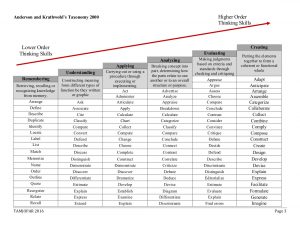
Higher-order thinking, known as higher order thinking skills (HOTS), is a concept of education reform based on learning taxonomies .The idea is that some types of learning require more cognitive processing than others, but also have more generalized benefits. You can read more about it HERE, but I think a chart is easier to understand:
Trust me, there are a lot more items in the lists, but I didn't want to bore you. But take a look at the items here - any look familiar? Yeah. Most of them are used in creative writing! YIKES!
"The reason typos get through isn't because we're stupid or careless, it's because what we're doing is actually very smart, explains psychologist Tom Stafford, who studies typos of the University of Sheffield in the UK. "When you're writing, you're trying to convey meaning. It's a very high level task," he said.
As with all high level tasks, your brain generalizes simple, component parts (like turning letters into words and words into sentences) so it can focus on more complex tasks (like combining sentences into complex ideas). "We don't catch every detail, we're not like computers or NSA databases," said Stafford. "Rather, we take in sensory information and combine it with what we expect, and we extract meaning."
When we're reading other peoples' work, this helps us arrive at meaning faster by using less brain power. When we're proof reading our own work, we know the meaning we want to convey. Because we expect that meaning to be there, it's easier for us to miss when parts (or all) of it are absent. The reason we don't see our own typos is because what we see on the screen is competing with the version that exists in our heads.
This can be something as trivial as transposing the letters in "the" to "hte," or something as significant as omitting the core explanation of your article. In fact, I made both of these mistakes when I wrote this story. The first was a misspelling in a sentence that my editor had to read aloud for me before I saw it for myself. The second mistake was leaving out the entire preceding paragraph that explains why we miss our own typos."
See? We're trying to complete low level tasks and very high level tasks at the same time! Can you imagine how complex your brain is to be able to do that?
Then there's the mechanics:
SPELLING
Yes, we have way more tools than they did years ago (Thanks, Word, for telling me when I'm wrong-most of the time), but this is the nit-picky, in the mud, the blood and the beer editing that make my eye twitch. Even when we're careful, we tend to read what we meant to write, not what's on the page.
Suggestion: Have Word, or another program, read it back to you. You'll hear things you won't see: missing words, clunky sentences, change in tense, etc. OR, pay someone to do it. It's worth it to me not to have to go over that ms one more time (and you know I'm cheap).
GRAMMAR
Sentence structure, punctuation, adverbs, pronouns, dangling participles! There is SO much to know here, and finding out you're doing something wrong after your book is published is uber-embarrasing. Word can suggest, and Margie Lawson is the queen of rhetorical devices, but when it comes right down to it, you have to know this stuff to earn your chops as a writer. Personally, I'll never get Lay vs Lie (had a college professor try) and I'll admit to comma-drama.
GETTING THE STORY OUT OF YOUR HEAD, AND ON THE PAGE IN A COMPELLING WAY
It seems so easy when you're reading a good book, but anyone who's tried to write can tell you, it's like the Olympics; Those little girls make gymnastics look easy because they learned it right after walking, and then practiced for years.
The only thing that works here is sweat-equity. Sorry, but if I knew a faster way, I'd be using it. Keep writing - you'll get better.
STORYTELLING
This is probably the highest thinking of all. We all know a story needs a beginning, middle and an ending. Sounds simple. It isn't.
ALL THE REST
Writing fresh
What tense to use?
What genre?
Jump-off-the-page characters
which POV to choose?
Where to begin
Backstory
And you wonder why you keep putting e after I? Why you mix tenses? Sheesh people, you're doing the equivalent of riding a unicycle and learning to swing a golf club, all at the same time!
It takes YEARS to master all of the above, and I haven't even mentioned voice! So give yourself a break. Give yourself time. Adopt a child's view of mistakes: they're just ways that didn't work.
Be gentle with yourself, people, keep going, and you'll get there. I guarantee it.
Do you scold yourself for mistakes? Friends who do? What's your worst offender?
* * * * *
Like Laura's books/posts? There are two ways to get more! Sign up for her quarterly newsletter, or her Write Stuff short podcasts on the craft of writing, and have them delivered to your inbox. What's easier than that? Want her to come speak or teach online to your group? You can do that here. Oh and did she mention she has a December release?