This is a true story:
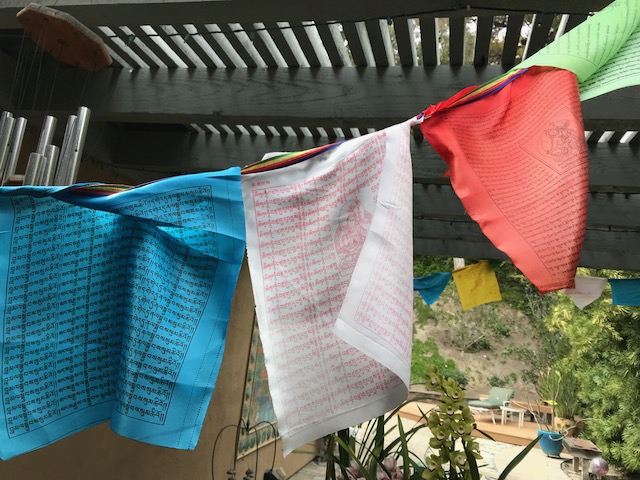
I looked out my window this morning, as I always do while drinking my breakfast protein shake.
In the heavier than usual wind, the prayer flags flapped loudly.

Through the narrow gaps of brightly-colored material I saw a profusion of blooming tropical flowers.
Behind them, a mermaid sat on her rock. Surrounded by water. Unconcerned by the wind. Blowing through her conch shell.
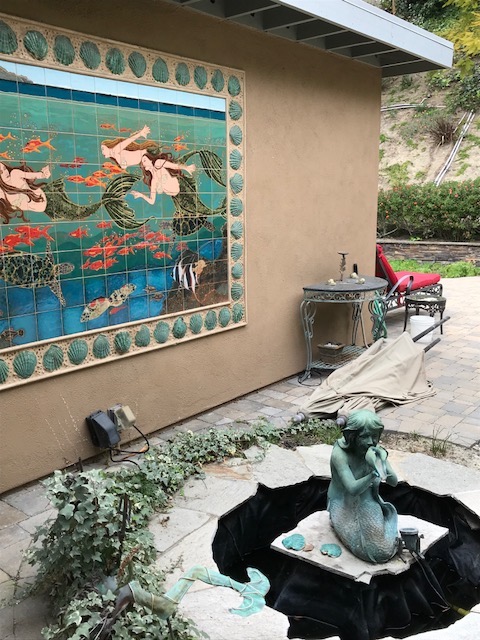
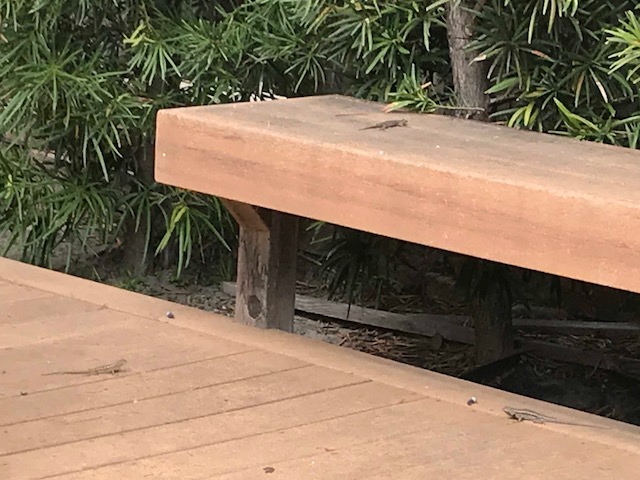
Beyond her, an angel stands, arms wide, watching the tiny decedents of millenia-dead dinosaurs perform their morning sun salutations, ignoring the war machines flying overhead.
I write science fiction. Do you have a feeling for this place?
But this is not a setting from anything I'm working on. This is how I look out my kitchen window, mug in hand, while I down 10 ounces of water blended with grapefruit, ice, protein powder and spinach, while a military helicopter flew overhead. It's how I look at the world. Different from non-writers. Different from anyone else.
And you look at the world differently than anyone else, too.
That's the beauty of being a writer. We have a license to see our world through whatever lens we want, whatever lens our characters see their world.
I'm always surprised when one of the first things other writers say when I tell them I write science fiction is, "Oh, you have to do world building. I could never do that." News flash! Every writer must build the world their character inhabits so readers know how that world operates. Even contemporary genre writers must world build.
Think about a story with a cowboy, or a short-order cook, or a doctor. We have to see—and feel—what the characters do, how they live. Otherwise we can't connect with them. This requires world building skills.
World building traditionally means describing the character's physical surroundings and societal influences.
What better way to do this than to use deep POV for your characters? If they are seeing their "usual" world and walk past the burnt out husk of a tank, sand blowing so hard they've pulled up the scarves they wear around their necks, guns slung over their shoulders, you might be reading a book about today's soldiers in the Middle East on a routine patrol in an area they are familiar with.
How do you know they are familiar with the area? From the details given through the character's POV. The "common" details are glossed over. Only enough essentials to ground the reader are shared. Something out of place or different will be noted and examined either from a distance or close-up. Danger or interest can be conveyed in the tones, attitude or physical approach or the dialogue between characters or the thoughts of one character.
A writer of historical fiction takes great care to describe the style of furniture, the material and cut of the curtains, a rug, a silver tea service—all to show you the opulence of a duke's home.
If the view is through the eyes of someone who is courting the favor of the duke, different details and a different tone will be used than a an outdoor servant who is called into the duke's study for an unknown reason and is waiting for the worst to happen. Again, tone and the careful selection of details can perform double duty by "world building" the setting and conveying the emotions of the character. For example, someone who thinks they are going to lose their position or be accused of something will definitely notice the miniature guillotine on a shelf in the study, while someone in love will notice a book of poetry lying open on a table.
Try an experiment: Pick a genre in which you don't write. Look around the room you're sitting in and describe what you see for that genre. Extra points for being a character with an agenda as you look around the room.
See, you can world build, even in a different genre. How much easier will it be in your own genre?
World building is most important at the beginning of your story, but you've got to be careful not to info dump. Using your character's POV not only shows the setting, but also the character's "take" on the setting and their overall feelings about being there. Whenever your words can do double or triple duty, your writing is more powerful.
I wrote a series on world building a while back. You can read about World Building Techniques with examples from my upcoming Winter 2018 release, Keeping Athena, here , or World Building: Social and Cultural Aspects here , or World Building: Physical Setting here. These posts were written with all genres in mind.
Do you have a question about world building (in any genre)? What techniques do you use to show the world your characters live in?
* * * * * *
ABOUT FAE:

Fae Rowen discovered the romance genre after years as a science fiction freak. Writing futuristics and medieval paranormals, she jokes that she can live anywhere but the present. As a mathematician, she knows life’s a lot more fun when you get to define your world and its rules.
Punished, oh-no, that’s published as a co-author of a math textbook, she yearns to hear personal stories about finding love from those who read her books, rather than the horrors of calculus lessons gone wrong. She is grateful for good friends who remind her to do the practical things in life like grocery shop, show up at the airport for a flight and pay bills.
A “hard” scientist who avoided writing classes like the plague, she now shares her brain with characters who demand that their stories be told. Amazing, gifted critique partners keep her on the straight and narrow. Feedback from readers keeps her fingers on the keyboard.
P.R.I.S.M., a young adult science fiction romance story of survival, betrayal, resolve, deceit, lies, and love.
When she’s not hanging out at Writers in the Storm, you can visit Fae at http://faerowen.com or www.facebook.com/fae.rowen