A Writer's Guide to Managing the Inner Committee
By Sarah Sally Hamer
I have a theory about writers. Actually, I have quite a few theories about writers, but this one keeps coming back no matter how many times I wander off and chase a different explanation.
I don't think most of us are struggling with creativity nearly as much as we think we are. I think we're struggling with management. Not project management or time management, although heaven knows those can cause enough trouble on their own. I'm talking about internal management. The kind that involves trying to write a novel while sharing office space with a collection of personalities who all have opinions, none of which agree, and several are convinced they're in charge.
Some mornings I sit down at my desk feeling hopeful. The tea is exactly right (I don't do coffee). The story has been waiting patiently. There's that little flicker of anticipation that writers know so well, the feeling that maybe today will be one of those wonderful days when the words arrive on time and everybody cooperates.
Then the interns show up.
One walks in carrying a folder labeled Things We Should Still Be Ashamed Of. Another has spent the entire night creating a presentation explaining why nobody will enjoy the manuscript. A third would like to discuss a completely different book idea and sees no reason whatsoever to continue working on the project that's already halfway finished. Within a few minutes, what began as a writing session has turned into a staff meeting.
The older I get, the harder it becomes for me to believe all those metaphors about the mind being a finely-tuned machine. Maybe some people have minds that operate like elegant, well-maintained machinery. Mine feels more like a small nonprofit run by enthusiastic interns who keep losing important documents and then forming committees to search for them. Oddly enough, realizing this has made me a better writer. It's certainly made me a kinder boss, at least of myself.
Maybe It Isn't Writer's Block
Writers have a habit of taking a remarkable variety of experiences and stuffing them into the same box labeled writer's block.
But, sometimes we're stuck because we've hit a genuine story problem. Sometimes we're exhausted and trying to create from an empty tank. Sometimes life has handed us grief, uncertainty, stress, illness, change, or one of those seasons where simply being a human being is using up most of our available energy. Sometimes we're afraid of failure. Sometimes we're afraid of success, which sounds ridiculous until it happens to you and suddenly makes perfect sense. The strange thing is that all of those experiences feel remarkably similar when you're sitting in front of a manuscript. The words seem farther away than they did last week. The pages feel heavier. The work that once felt exciting begins feeling strangely difficult.
For years, I automatically blamed the manuscript. It was sitting there in front of me, so naturally it became the prime suspect. Over time, though, I've become less convinced that the manuscript is always guilty.
These days I'm more likely to ask myself what kind of stuck this is. Am I confused? Tired? Discouraged? Afraid? Have I lost the thread of the story? Or have I lost the thread of myself? I've noticed that question usually leads somewhere useful. The answer isn't always comfortable, but it's almost always more interesting than simply declaring that I've lost my creativity.
Welcome to the Writing Committee Meeting
One of the great surprises of adulthood is discovering that nobody ever arrives at the perfection we thought we'd find.
When we're children, we imagine grown-ups eventually reaching a place where everything makes sense. Maybe not perfection exactly, but some magical destination where confidence appears, self-doubt disappears, and decisions become easy. Then we become adults ourselves and realize most people are still figuring things out. They've simply gotten better at looking calm while doing it.
Writing exposes this reality because it forces us to spend enough time alone with our own thoughts to actually hear them. And what we discover is that there isn't one voice running the show.
There are many.
Some parts of us want adventure. Some want security. One part wants to send the manuscript out into the world tomorrow. Another thinks hiding it under the bed forever sounds like an excellent plan. What fascinates me is that most of these voices aren't trying to sabotage us. Nearly all of them believe they're helping. The conflict comes from the fact that they're trying to solve different problems.
The growth department is endlessly optimistic. It keeps pointing toward possibility and saying things like, "Look at that. Let's go see what happens." The safety department finds this deeply irresponsible. It would like a detailed plan, three backup plans, a guarantee of success, and preferably a signed statement from the universe before moving forward.
So, let's meet a few of the staff

Let's start with Anxiety.
Poor Anxiety. The older I get, the harder it becomes to stay angry with her. She's exhausting, certainly. She's dramatic. She tends to treat a difficult review and a charging rhinoceros as roughly equivalent situations. But she's also sincere.
Her whole job is protection. The trouble is that evolution trained her for predators, not publishing. Once I started paying attention, I realized she wasn't trying to ruin my writing life. She was trying to protect something she believed was precious. The problem wasn't her intentions. The problem was her inability to distinguish between danger and discomfort. The older I get, the more I realize how often I make that same mistake.
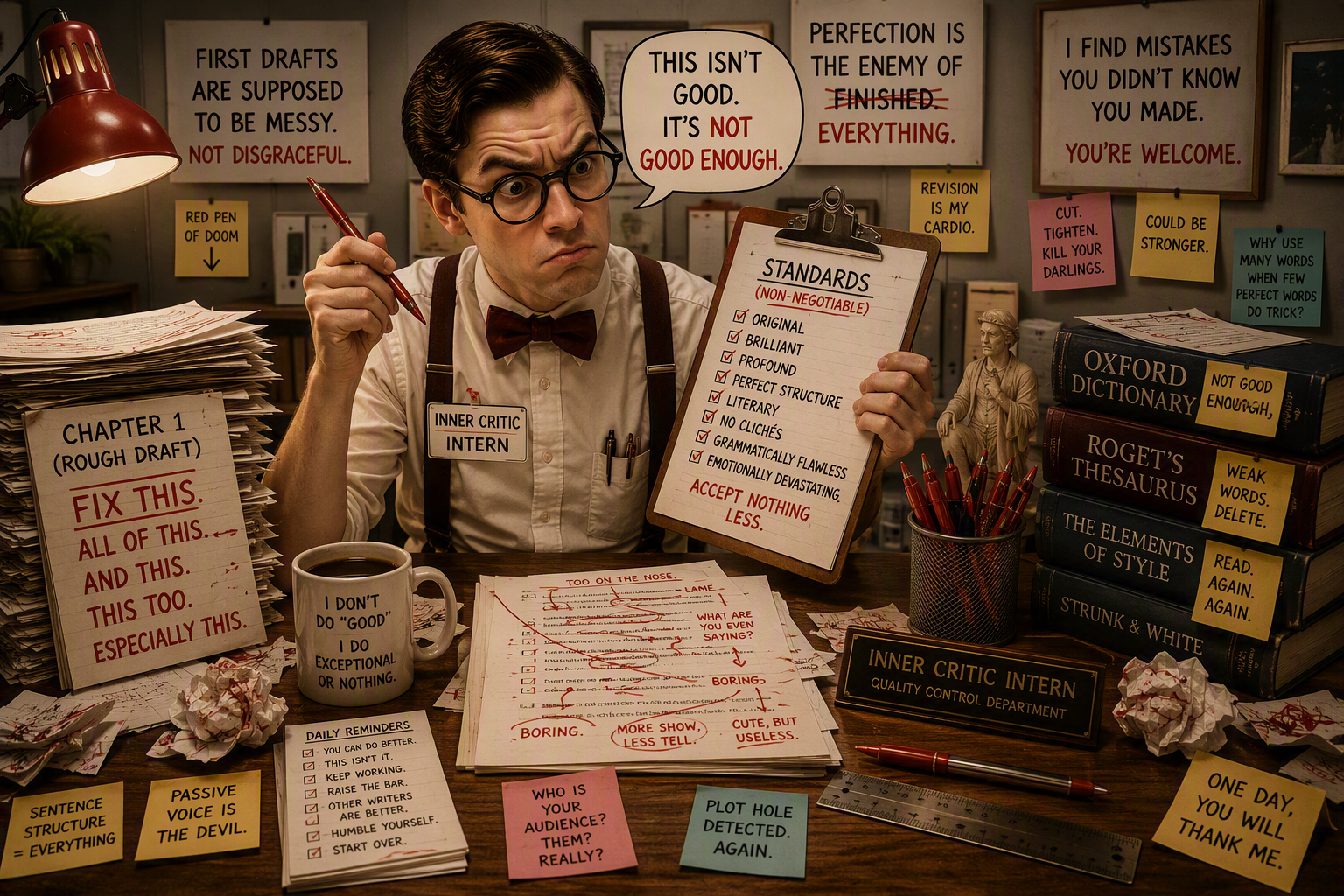
Then there's the Inner Critic, who somehow promoted himself into management without consulting anyone else first. The irritating thing is that he's actually useful. He notices weaknesses. He catches mistakes. He spots problems that might otherwise slip through unnoticed. During revisions, he's worth his weight in gold. During a first draft, however, he's like a building inspector showing up while the foundation is still being poured. Everything he says may eventually matter, but it's too early. The ideas are still becoming what they're meant to become.

Creativity is another story entirely. She doesn't believe in calendars. She vanishes without warning and reappears while you're folding laundry with the exact answer you've been looking for all week. And for reasons I've never fully understood, she seems to enjoy arriving immediately after you've decided the solution probably doesn't exist.
I suspect she finds this funny.
The Three Writing Departments
For years I assumed every writing struggle belonged to the Mind Department. If the work wasn't flowing, then clearly I needed another craft book, another class, another productivity tool, another way to organize my notes.
Then I started noticing a pattern.
Not every problem was a craft problem. Some problems belonged to the Body Department. Some belonged to the Soul Department.
The Body Department handles sleep, energy, stress, movement, hormones, nourishment, and all the practical realities that come with living inside a physical body.
The Mind Department handles focus, learning, interpretation, storytelling, and craft.
The Soul Department asks deeper questions. Why does this story matter? Why am I writing it? What truth am I trying to understand? What am I really searching for here?
I've watched writers spend months trying to fix what they believed was a craft issue when they were actually exhausted. I've watched people chase increasingly sophisticated productivity systems when what they'd really lost was their connection to the work itself. I've done both. Usually with great confidence.
The department matters because the solution matters.
A tired body doesn't necessarily need motivation. A discouraged soul doesn't necessarily need a better calendar. And a confused mind usually doesn't need more criticism.
Living Inside the Triangle
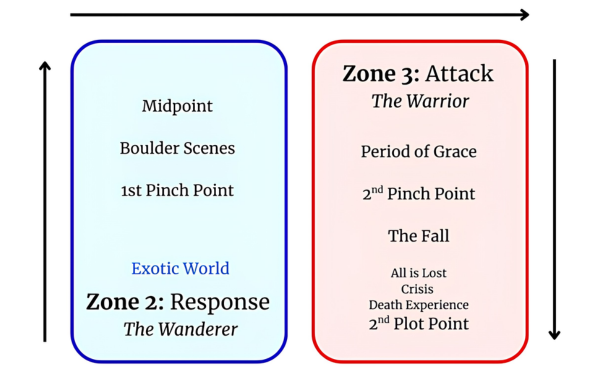
Many of you know I love the Triangle of Structure: the Inciting Incident, the Reversal, and the Black Moment.
I believe that writers (and other humans) live inside that triangle just as much as our stories do.
In the "Wizard of Oz," Dorothy's Inciting Incident arrives when the tornado carries her away from Kansas and drops her into a completely different world. But sometimes the Inciting Incident isn't dramatic at all. It might be the day your child leaves home, the end of a relationship, or simply the realization that something in your life no longer fits. An idea keeps tugging at your sleeve until you finally stop long enough to listen. Before long you're rearranging your life to find out where that question leads.
Following Dorothy again, the Reversal is when she believes that the Wizard is the answer to all her problems. But her entire world view collapses when the Wizard refuses to help her without a payment that may kill her. At this point in the story, she can't rely on a magnanimous father-like figure to fix her. She has to do the work herself. Our personal reversals arrive when the thing we thought we were chasing turns out not to be the thing we needed at all or that we have to take responsibility for our choices. Suddenly the story changes direction, and so do we. That's when the work gets deeper. And stranger.
Eventually we arrive at the Black Moment. For Dorothy, it's when she achieves the goal of acquiring the broom after a terrifying adventure and finds the Wizard is a fake. Her confidence and faith packs a suitcase and leaves town because her choices create the way her life continues. For us, the rejection letters keep coming. The manuscript looks like junk. Gardening starts looking like a respectable career choice. Our choice at this point can also be life-changing. Do we really want to write? Is it worth going on or should we really bury our computer?
What intrigues me is how quickly writers assume this means they've failed. Every meaningful story reaches a place where the old answers stop working. Every protagonist eventually finds themselves standing in uncertainty, unable to go backward and unsure how to move forward.
Why would writers be any different? What if the Black Moment isn't proof that we've gone off course? What if it's proof that we've finally gone deep enough? And, ultimately, what will we choose?
(If you'd like to read more about the Triangle Structure, click here.)
Learning to Lead the Writing Meeting
For a long time, I treated difficult thoughts as enemies. My goal was to eliminate fear, uncertainty, vulnerability, and doubt. If those troublesome employees would simply stop talking, surely everything would run more smoothly. So, when the mischievous interns showed up, I argued with them instead of finding answers.
These days I'm much more interested in leadership than warfare. I've stopped treating every thought as an instruction and every fear as a prophecy. Most of them are just information. Useful information sometimes, but information nevertheless.
Anxiety doesn't need to become CEO. The Inner Critic doesn't need to attend every meeting. Creativity doesn't need to explain where she's been every time she disappears.
The goal isn't silence.
The goal is cooperation.
Tomorrow you'll sit down to write, and the committee will probably be waiting. They'll bring worries, hopes, distractions, opinions, old stories, and maybe one genuinely brilliant idea buried beneath a mountain of unnecessary paperwork.
That doesn't mean you're broken. It means you're human.
And maybe writing has never really been about imposing perfect order on chaos. Maybe it's about helping a room full of mischievous interns create something beautiful together.
If you'd like to continue exploring this subject, click below.
So I'm curious: if your writing brain really is a room full of mischievous interns, who's currently running the meeting? And what might happen if, instead of trying to silence them, you got curious about what they're trying so hard to say?
More on Sarah Sally

Sarah (Sally) Hamer is a lover of books, a teacher of writers, and a believer in a good story. Most of all, she is eternally fascinated by people and how they 'tick'. She’s passionate about helping people tell their own stories, whether through fiction or through memoir. Writing in many genres - mystery, science fiction, fantasy, romance, medieval history, non-fiction – she has won awards at both local and national levels, including two RWA Golden Heart finals.
A teacher of memoir, beginning and advanced creative fiction writing, and screenwriting at Louisiana State University in Shreveport for over twenty years, she also teaches online at both margielawson.com and nostresswriting.com and blogs for writersinthestormblog.com/ and thewriteconversation.blogspot.com. Sally is a free-lance editor and book coach at Mind Potential, with many of her students and clients becoming successful, award-winning authors.
You can find her at sally@ mindpotential.org
Image Credits: All AI-generated images in this article were created using Microsoft Copilot.