
Story Landmarks Keep The Reader Engaged and Oriented

by Lisa Miller
One definition of a landmark: Prominent features used for orientation.
Landmarks may mark a boundary. Landmarks often mark locations with historical, cultural, or geographical significance.
How do landmarks relate to a story?
Story Landmarks are events or interactions within a story. They help keep the reader oriented to what has happened so far and what the reader might anticipate coming. Readers expect specific Story Landmarks within each genre.
No love genre can exist without the two main characters meeting and developing a growing attraction.
Police procedurals and mysteries often begin with the discovery of a body and then investigating suspects that may be blamed for the death.
If the writer leaves out even one of these Story Landmarks, especially early in the story, readers may feel unsatisfied and hesitate to read another book from this author.
Four-part structure makes the most sense to me to study and develop stories. I call each of these parts Zones. Each Zone making up approximately ¼ of the story.
Each of those four Zones has elements and situations of character development unique to that part of the story. Those are the Story Landmarks.
Think of this four-zone overlook as having a square story arc shape.
Scenic Overlook of the Four Story Zones With Story Landmarks
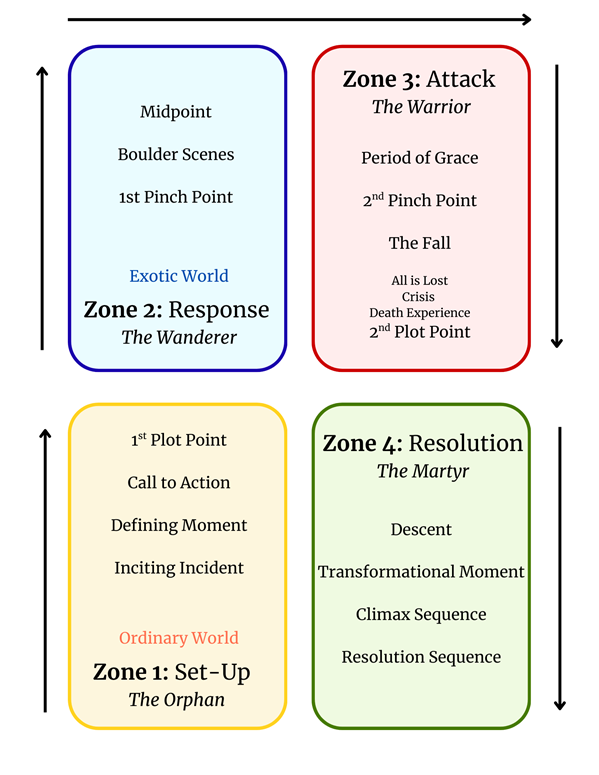
Each Zone has its own purpose and personality.
Think geographic or climate zones.
The desert in summer gives us different obstacles and challenges than does a mountain range in winter. We must wear certain types of clothes and carry specific equipment to survive a hike in these two very different ecosystems.
The same is true of the protagonist moving through the four zones of a story. His or her behavior and the obstacles he or she will face will be different in each zone and impact the character’s need to change.
Zones Need to be Connected
What I’ve discovered in all my studying of story breakdowns and analysis is how connected the Zones must be.
You can’t have the needed Reactions in Zone 2 without the Set-up in Zone 1.
Zone 2 is necessary to force the protagonist from reaction behavior and thinking into becoming a Warrior and taking action in Zone 3.
The All is Lost Moment aka the 2nd Plot Point at the end of Zone 3 thrusts the Protagonist into their lowest point in the story and movement into Zone 4.
Sacrifice and transformation in Zone 4 make the Protagonist ready to face the Climax so that the story and the characters can find a Resolution.
Each Zone needs to prepare the Protagonist and the reader for what is coming next in the story.
The Three Most Important Story Landmarks
These are the non-negotiable Landmarks. Every story must have them.
These are the Landmarks that transition the story from one Zone to the next Zone.
They are the 1st Plot Point at the end of Zone 1, the Midpoint at the end of Zone 2, and the 2nd Plot Point at the end of Zone 3.
The 1st Plot Point is what thrusts the protagonist out of the Ordinary World of Zone 1 and into the Exotic World of Zone 2.
To give that feeling of a big change, I want you to think of that end of Zone 1 as making ready the catapult.
Your character is going to be literally or emotionally catapulted into Zone 2. So, the beginning of Zone 2 is no soft landing, and the Protagonist is likely confused about where he is.
An Example
I’m a practical teacher. I encourage my students to find examples from successful writers or filmmakers. Study what an effective scene or character looks like on the page or in a show. I call these books, shows, or movies Creative Guides.
This Creative Guide example come from Jennifer Estep’s Kill The Queen novel. That story has one of the most literal 1st Plot Points I’ve read.
Part One of the novel is The Royal Massacre. So, we know right up front this is likely an action, fantasy with lots of death involved.
The main character, teenager/young adult Lady Everleigh, has a low level of magical powers and is relegated to the shadows of the royal court. She’s 17th in line for the throne.
During a big royal event, her cousin Vasilia, the crown princess, assassinates her own mother, the Queen, and takes the throne by force. All the royal family is being killed in front of Lady Everleigh.
Vasilia turns towards Everleigh, who is standing, horrified, by the wall surrounding the castle. Vasilia throws a deadly bolt of lightning at Everleigh, whose hidden power is her immunity to magic. The bolt of magic doesn’t kill Everleigh, but the force throws her over the wall and down into the wilderness below.
Everleigh literally falls into the Exotic World of Zone 2.
Focusing on the Most Fun Zones
The most worked on parts of a story or novel are usually the beginning and the end. Zones 1 and 4.
But my two favorite Zones to work on with my students are Zones 2 and 3. Often maligned as the Mushy Middle.
In Part 2 of the Story Landmarks blog I’ll dig deeper into the specific Landmarks of Zones 2 and 3 and how they impact a story.
* * * * * *
About Lisa

Lisa taught middle-school science and was a certified counselor in Texas for 30 years. Her passion for teaching met her love of writing. After not finding the writing classes she needed, Lisa spent several years on a deep study of story structure. That led her to create a powerful and well-loved online course Story Structure Safari.
She has joined the staff at Deleyna Marr’s No Stress Writing Academy where she is developing new classes. Her Creating A Constellation of Characters is available there January and June 2027. Story Structure Safari runs every September and April. The next Safari is September 2026.
Top image licensed from Depositphotos.
Leave a Reply
10 comments on “Story Landmarks Keep The Reader Engaged and Oriented”
Tagged as:
Subscribe to WITS



Recent Posts
- Conflict in Fiction Writing, 7 Main Types
- Author Blind Spots: The Gaps You Can't See
- When Is It Okay to Quit a Story?
- Living at the Corner of FEAR and FINE
- Could Your Novel Become a Microdrama?
Lisa, thank you for the clear description of story zones. I've read many guides through the process, but this is by far the easiest to understand.
Rather than feeling muddled about the story I've created so far, and whether or not it includes the required landmarks, I understood how what I've written follows the path and what I could do to make it better. Even more, I have a map to use when creating my next story.
Thank you!
Gale, I'm glad you found the Story Zones discussion and map helpful.
A map is there to help us find where we are going. And to be able to do that with your own story is so valuable. It allows you to see what you may be missing in your story or need to amp up.
Excellent post. Thank you, Lisa!
Glad you enjoyed it Lori!
Lisa - it is so exciting to see Story Structure Safari available again. I've always been impressed by the people who use it and how much they appreciate it. You are a fantastic teacher!
Most structures don't stick for me, but this one makes so much sense.
LisaN - I'm so excited to be teaching Story Structure Safari in September. I learn so much working with the writers. They inspire me to keep updating and improving the lessons.
Thanks for your support.
Thanks for sharing your story structure.
You are most welcome, Denise.
Sharing new or different ideas makes us all stronger.
Great point about how, in To Kill The Queen the character has such a clear closing-of-the-door moment, launching her into her new life. The mushy middle is right. It is hard to figure out what needs to go when to meet the reader's expectations. Thanks for the information.
I've heard the stages of a story described many ways, but usually in three parts. Stories are fluid, though, therefore perhaps the squishy part(s) in the middle aren't so restricted. For my own novels, I look at them as being in three parts–the set-up, the evolving understanding of the challenge, and the resolution.
The set-up introduces the characters and propels them to face the inciting challenge. The evolution forces characters to change how they see the challenge, leading to a enlightening climax. And that enlightenment, spurs their final journey toward resolution.