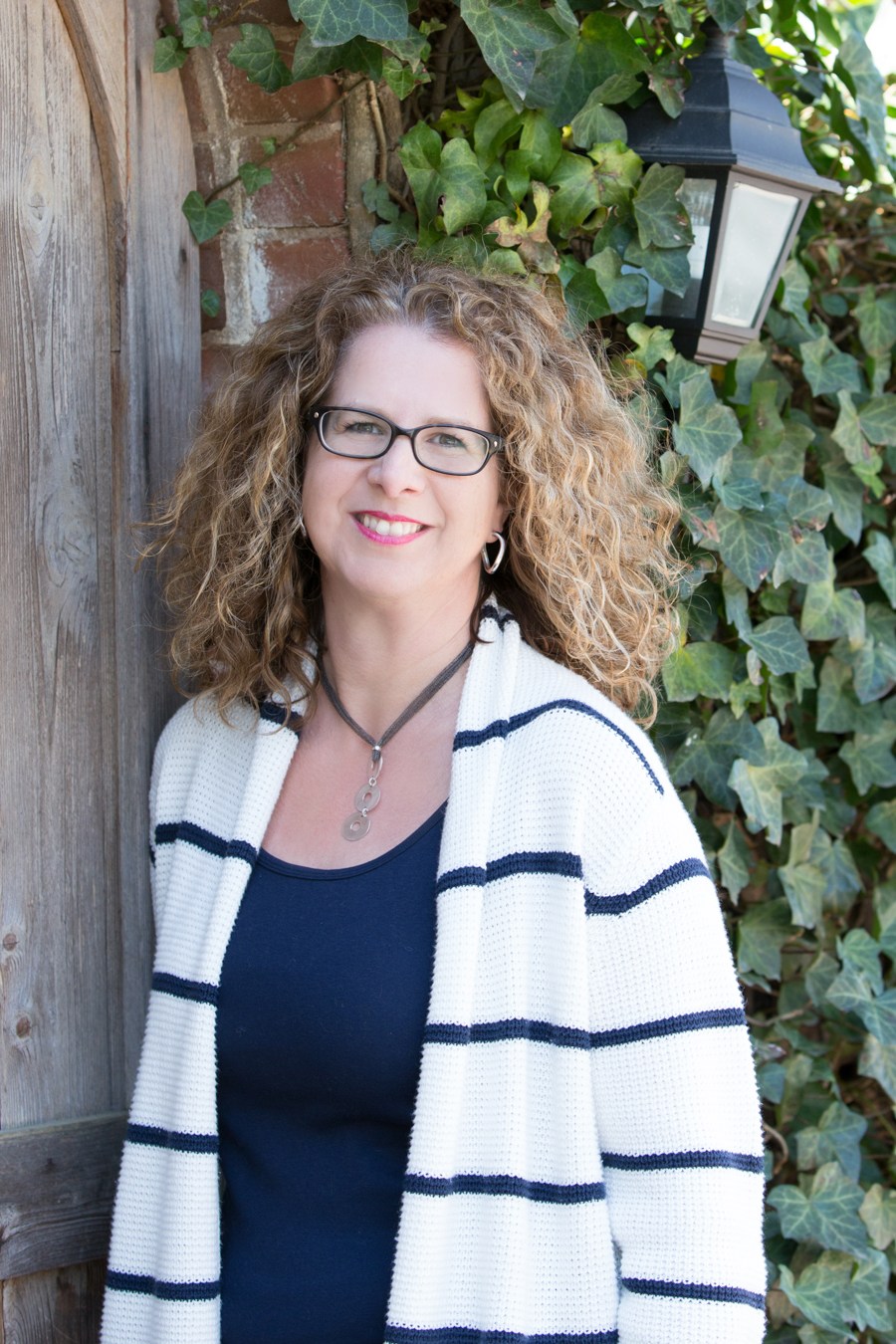
Creating a brand that represents you as an author and reflects your writing as a whole is hard enough when you write in just one genre. Often, when an author writes books in just one series, their author brand gets tied inextricably with their series brand. That isn’t ideal, but it isn’t necessarily a problem either. But what happens if the author starts writing a completely different series or even a standalone novel? What’s more, what if the new novel is in a completely different genre? It stands completely outside of the author’s known brand. The author now has two choices, either change their brand or use a pseudonym.
I was once on the 'pseudonyms for different genres' bandwagon. But that was over a decade ago. As the digital age has matured and social media has become a necessary part of an author’s platform, the ease of keeping up more than one author name has become more difficult. It entails maintaining websites, blog posts, newsletters and active social media accounts for each pen name. That is both expensive and time consuming. If you write within several subgenres, maintaining your pseudonyms would be unmanageable, and it would leave little time for writing.
The best option is creating an author brand that can encompass all that you write, and what you may write in the future. In short, you want to brand yourself as an author, not your genre. I’ve worked with several clients to create author brands that can represent their work as a whole.
The first step is figuring out what exactly does all of your work have in common? Do they have a common audience, common themes, etc? I always ask my clients to list at least three things all their books have in common. At first most of them say “nothing, they are all different.” But when pressed, they can usually find many more common traits than just three.
Next is to pick one of those common threads, or even all three, to come up with a tagline to represent you as an author. Not all authors choose to use taglines, and ultimately you may choose not to either, but choosing one can help you decide what direction you want to go with the visual aspects of your brand, such as colors, fonts, and logos.
CASE STUDY: LAURA DRAKE
The best way to illustrate is to walk you through the re-branding process I went through with Laura Drake. Laura writes both romance and women’s fiction. In her mind, they are very, very different and on her website she was using two different taglines and branding images for them and had them separated into different sections of her website. That was a little confusing for the reader, and made it confusing for Laura when it came time to promote her books.
When Laura came to me to consult on her branding, I asked her to list three things that all her books had in common. She balked at first, saying they were very different. That’s a normal reaction, we like to think every series, every genre is unique. But we are humans and our styles don’t change just because we write different genres.
As a reader and fan of Laura’s work I had the advantage of being able to suggest a few things, and once the ball was rolling, Laura jumped in, a little more at ease.
We determined that all her books feature strong women at turning points in their lives, the stories focus on those women’s relationships (whether romantic or interpersonal), and they all take place in small towns or communities.
We then took her two existing taglines, and decided that one of them was already perfect to represent all her work:
Ordinary women on the edge of extraordinary change
Once she simplified her author brand, it made it possible for her to focus on the individual brands for her series. She created lovely images with the book covers of each series, and then listed her series titles (with each book title popping up when the mouse passes over) in her menu bar. This makes it easier for fans of a particular book who may not know the series title (or genre) to find what they are looking for. It also brings the focus back on her books, and not the genres.
Finally, she pulled it all together with the black and creamy gold color scheme of her website and her very simple initial logo in the top corner. It’s sleek and elegant, just like her writing.
Click on the photo to view the site.
Laura’s case was actually pretty simple. But what if you write is wildly different genres, such as paranormal romance, contemporary romance, and nonfiction?
It’s not easy, but it’s not impossible. How do I know? My first “multiple genre client” was myself. I started out in contemporary romance, then added paranormal/urban fantasy. Then recently put out some non-fiction.
The three things my books have in common: 1. My audience is women, of all ages. (even though I do have male readers) 2. I write strong female characters (even my non-fiction is about women’s strengths) 3. I focus on relationships and emotions
My tagline represents everything I ever want to write, no matter the genre, even non-fiction: Damsels Not in Distress. But, my brand also represents me as a person, at least the public part of me.
I chose the color scheme of hot pink and dark grey because they are my favorite colors and they pop with the tagline. Everything about my brand kind of screams. And that is perfect for me. I have purple hair and I’m kind of in your face. My brand is brash and bold.
To make it even better, there is no shortage of awesome images out there that I can use to make “Damsels Not in Distress” promotional images. And it’s okay if they are all different, it’s even better that way, because my damsels are all very different.
The thing to remember when thinking about branding is that everything your readers see says something about you. So, you need to think about more than just the words in your stories. Who is the “you” you want the public to see, to get to know, not just through reading your books, but through your website and your social media. That is the person you are branding.
What do you think, WITS readers? Are you rethinking your brand? Any questions for June?
* * * *
Hey all, June is offering WITS readers a special!
About ABE
Author Branding Essentials is dedicated to offering comprehensive author centric branding and design services at competitive prices. As an Author, your name is your brand. Building your Author Brand is key to success. Many agents encourage authors to begin building that brand long before they are published. At Author Branding Essentials we understand the unique criteria it takes to build an author brand, versus another type of business. We can help you decide on the best options for your author brand and help you implement them.
In case you didn’t know, there’s a little thing called NaNoWriMo going on this month. It’s basically a month in which writers lose sleep, stop talking to their families, give up binge watching Netflix, and forget how to spell without Word’s autocorrect feature, all to meet a challenging word count of 50,000 words in 30 days. So, we’re writing a novel in a month.
A really horrible, crappy novel. (I’m not talking about those gold-fingered mythological writers whose turds smell like lavender. You guys suck.)
It’s November 11. You are 11 days into NaNoWriMo and this is the point you start wondering:
What the crap kind of story am I writing?
You may be tempted (or have already fallen into temptation) to stop your forward movement and, gasp!, edit.
Don’t. And I’ll tell you why.
I’m switching to metaphor mode, because I like metaphors and because I can. Go with me.
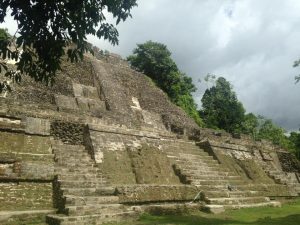
A few weeks ago, I hopped on a tiny boat on a river in Belize and speedboated for an hour to see some Mayan ruins. On the way, our guide told us a tale he heard from his grandparents when he was a boy.
Back then, Belize was very much a developing country. In many respects, it still is. Since Belize imports almost all their goods, they’ve had to be resourceful in meeting their day-to-day living needs. 50 years ago, our guide’s grandparents and parents were still going into the jungle for weeks at a time to forage for food and supplies to make soap.
And they came back with tales.
Tales of a city being swallowed by a jungle.
They were ignored.
The tales simmered into myth and local lore until about 1970, when the Canadian government and Harvard University took an interest.
Guess what?
There actually were cities being swallowed by the jungle.
What came next was years of excavating, slowly revealing the Mayan story that the jungle had hidden. A thousand-year-old empire that had been taken back by the jungle, until not even the tops of the tallest temples could be seen.
It’s so much like our first draft, don’t you think? So often, our story gets hidden behind the jungle of run-on sentences, under-developed characters, plot holes, and blah-writing. It takes a while before we, the author, can push aside the vines and dig through the dirt to discover the ancient treasures hidden inside our stories.
But we have to write them down, first.
The archaeologists who first came to the Mayan ruins of Lamanai didn’t put one foot down on land, then dig, put their other foot down on land, then dig, and so on. That would have been the most inefficient way to discover the story!
Instead, they walked the jungle, exploring before digging, and then stepped back and studied the big picture. They looked at the “first draft” in its entirety and only after understanding the scale of what they had to work with did they start excavating.
NaNoWriMers, you are drafting this month. You are writing the foundation of your story, but the first draft jungle is swallowing it up.
Let it.
Your story needs the vines to take hold and the roots to grow around it. Your story needs to be buried in warm, fertile soil. You story needs to be held safe in the cocoon of the jungle to be able to deepen the mystery.
Get the first draft out before you start excavating.
After NaNoWriMo, break out your story tools. Uncover your story once you take a step back and look at the vast empire you’ve created. Only then can you discover the true treasures: the deep conflicts, the twisted plot lines, thematic point of view, the heart of the story you are telling.
But for now, pull on your mosquito netting, lace up your hiking boots, and go back into the jungle.
Are you doing NaNo? Is the jungle taking over? Report in your progress!
* * * *
ABOUT CHRISTINA:
(http://www.christinadelay.com/) is the hostess of Cruising Writers (http://cruisingwriters.com/) and an award-winning author represented by Deidre Knight of The Knight Agency. When she’s not cruising the Caribbean, she’s dreaming up new writing retreats to take talented authors on or writing the stories of the imaginary people that live in her heart.
About Cruising Writers
Cruising Writers brings aspiring authors together with bestselling authors, an agent, an editor, and a world-renowned writing craft instructor together on writing retreats. Go to France with us in April (http://cruisingwriters.com/retreat/southern-france-writing-retreat/) and stay in a historic chateau with Margie Lawson, agent Louise Fury, Shelley Adina, Kobo Writing Life, and Literary Translations. Or cruise with us to Grand Cayman (http://cruisingwriters.com/retreat/7-day-western-caribbean-writing-retreat-cruise-september-10-17-2017/) with Lisa Cron, Anglea Ackerman, agent Michelle Grajkowski, and editor Deb Werksman of Sourcebooks!
My debut comes out in May. It’s exciting. And terrifying.
btw, The Distance Home is on Goodreads if you want to add it to you TBR list and it's available for pre-order if you're inclined. Cat not included. :-)
A box of galleys arrived a week ago. Even before I had the box completely open, I was crying. The top two books are slightly tear- stained now – those will stay on my shelf. :-)
I mentioned exciting, right? Seeing all of your hard work come together in a real life book is amazing. That’s my name on the cover!!!! And I’ve been touched by the number of people who’ve cheered and asked about ordering and cheered some more.
I’m not worried about reviews. I know this book isn’t for everyone. I know there are people who will love it and others who will find fault with it. That’s not to say the negative reviews won’t sting. But I’m not freaking out about them (check with me after the reviews start coming in, I may have a totally different take on this).
What I am freaking out about, is making an ass of myself.
If you look up the word “introvert” in the dictionary, you’ll see a picture of me. I’m perfectly happy working in my cave, doing what needs to be done. I’m extremely uncomfortable in the spotlight. You’re looking at a person who never wanted birthday parties and tried ducking out of her own bridal shower. So the thought of doing book events scares the bejeesus out of me.
I love watching kids and their absolute lack of inhibition. It doesn’t matter to them whether they’re good at what they’re attempting or not, they do it to have fun and they have fun doing it regardless of how they look or what others think.
Doing something – anything – that’s out of my comfort zone is scary. I used to do a lot of things when I was younger that I shy away from now because I don’t want to embarrass myself. Somewhere along the way, I lost the ability to let go of my inhibition.
For the last four plus years I’ve spent a ton of time at the climbing gym with my son. We’re there three or four days a week, for several hours each time. Climbing fascinated me but fascinated me from the ground. Two years ago my son challenged me to climb. It took time but I finally succumbed to the pressure of a determined 9-year old and had my husband belay me on a day when the gym was mostly empty and in the back room where very few people climb. It was a blast.
And I refused to climb again. Why? Because I was too intimidated by how I thought I needed to look and what I thought others would think of me.
But here’s the thing. If you don’t put yourself out there, you lose. I put myself out there by writing a book and sending it to agents. I now have a book coming out by an amazing New York publisher. I put myself out there by co-founding a writing association. I’m now part of a fabulously supportive writing community. It can be done!
Name of the climb: Story Book. Of course I had to do this one!
So I buckled back into my harness and started climbing regularly with a handful of other parents while our kids are at team practice. Yeah, it still makes me queasy to think what my big behind looks like in that harness from below, and yeah, I still can’t haul my butt over that roof and conquer the baby head climb, but I let go of the inhibition and I’m having fun.
(No worries, folks, I’m still holding on to enough inhibition – there won’t be any karaoke singing or dancing on tables.)
How will climbing help me when I have to talk about my book in front of people? Because it’s reminded me that it’s not about how I look or what I do or don’t do. It doesn’t matter if I have to yell “take” ten times during a climb or if I’m still climbing 5.7s (and an occasional 5.8) while everyone around me is doing 5.10s. I’ve learned that when I don’t put pressure on myself to be perfect, I can send the climb. It may not always be pretty but I can do it. And the next time it’s a little better. And the time after that, it feels pretty damn good.
Will I be perfect when I do my first book event? Probably not. I may forget a character’s name (or my own), get all flushed and stuttery when asked questions, and break into hives with strangers staring at me. But I’ll mumble “take” under my breath and reach for an imaginary chalk bag, I’ll take a deep breath and look around for the next move. And just like with climbing, the next attempt will be easier.
What scares you about writing or publishing and what techniques have you used to get past those fears?
* * * *
About Orly
Orly Konig is an escapee from the corporate world, where she spent roughly sixteen (cough) years working in the space industry. Now she spends her days chatting up imaginary friends, drinking entirely too much coffee, and negotiating writing space around two over-fed cats. She is a co-founder and past president of the Women’s Fiction Writers Association, and a member of the Tall Poppy Writers. She is rep’d by Marlene Stringer, Stringer Literary Agency LLC.
Orly’s debut, The Distance Home, will be released by Forge on May 2, 2017.