NaNoWriMo, for those of you who are unfamiliar with it, is National Novel Writing Month, where hundreds of thousands of writers gather to bang out many many words in a month. Many writers skip it and many writers treat it as a yearly pilgrimage to Writing Mecca.
NaNoWriMo is my birthday present to myself each year. Every year, I love it. And every year, I hate it...there's simply too much to do in the tiny little month of November.
Even without my birthday falling at the beginning of the month and Thanksgiving at the end, there always seems to be unexpected craziness. One year it was shingles, another year a family vacation.
I tend to arrive at December 1st a little bit out of breath.
And still, I love NaNoWriMo.
I love the community, the late-night writing sprints, the before and after parties my local team throws. I love the write-ins, the pep talks, the excitement and uploading my word count. I adore getting the chance to encourage my peeps and watch everyone chase their goals.
Whether you're gearing up for NaNoWriMo or not, I wish you luck in your writing goals this month.
I'd like to address the dreaded phenomenon of the Week Two Wall in the NaNo challenge where the initial endorphins have faded and the grind of the 1,667 words-a-day writing schedule sets in. The shiny has worn right off our shimmery fabulous idea.
Words like "can't," "shouldn't," and "haven't" begin to rear their ugly heads.
We all hate those words, whether we're doing a writing challenge or not. So before NaNo starts, I'd like to chat about what I consider to be a NaNo "win":
- Your very best = a NaNo win
- Achieving your goal numbers = a NaNo win (ex: my goal this month is 30K, not 50K)
- Finishing a project = a NaNo win
- Forming amazing writing habits = a NaNo win
I think people get twitchy about some things that don't matter during the month of November. You've seen this cartoon, right?
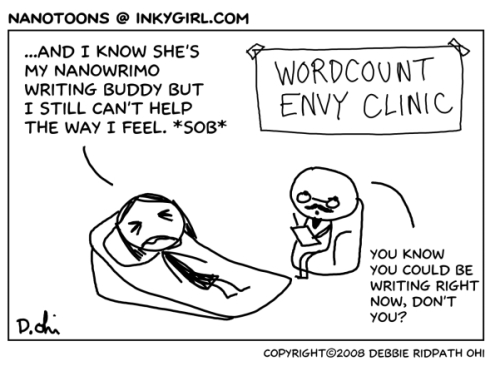
NaNo should be fun.
The only word count that matters is YOURS.
However, if you're still feeling the push to "Go 50K or Bust"... Behold the NaNo Team's 2012 Tips for Successful WriMos...things we wish we had known for our first NaNoWriMo:
1. It’s okay to not know what you’re doing. Really. You’ve read a lot of novels, so you’re completely up to the challenge of writing one.
2. If you feel more comfortable outlining your story ahead of time, do it! But it’s also fine to just wing it.
3. Write every day, and a book-worthy story will appear, even if you’re not sure what that story might be right now.
4. Do not edit as you go. Editing is for December and beyond. Think of November as an experiment in pure output.
5. Even if it’s hard at first, leave ugly prose and poorly written passages on the page to be cleaned up later. Your inner editor will be very grumpy about this, but your inner editor is a nitpicky jerk who foolishly believes that it is possible to write a brilliant first draft if you write it slowly enough. It isn’t.
6. Every book you’ve ever loved started out as a beautifully flawed first draft. In November, embrace imperfection and see where it takes you.
7. Tell everyone you know that you’re writing a novel in November. This will pay big dividends in Week Two, when the only thing keeping you from quitting is the fear of looking pathetic in front of all the people who’ve had to hear about your novel for the past month.
8. Seriously. The looming specter of personal humiliation is a very reliable muse.
9. There will be times you’ll want to quit during November. This is okay. Everyone who wins NaNoWriMo wanted to quit at some point in November. Stick it out. See it through.
Above are the NaNo team's words. They have them squinched together into just a few tips, but I spread it out. All this wisdom needs to be heard. (There's years of writing pep talks here.)
Now, for my #10. (cadged from an earlier post here at Writers In The Storm.)
10. Wherever you are on your writing journey, DON’T STOP.
The best is always yet to come because we keep improving the more we do it. I heard Linda Howard speak at a writer’s conference in San Diego some years back and I’ve never forgotten her words, which made me cry at the time.
“Everybody dreams,” she said. “But writers are special because they write down their dreams."
As writers, we can do anything and be anyone. You can be astronauts or spies or time travelers. Writers can go to amazing places and build imaginary worlds for others to visit."
The sad fact is that no matter how hard you try, the music and the magic of your dreams will never be equaled by the words you put on a page."
Do it anyway.”
My hope is that this November (and every month), even on those days when you feel that all is lost, when you wonder why you ever believed that YOUR words were important, you keep at it.
Do it because you have to. Do it because you need to. Do it because the act of sharing those words is more than most people will ever attempt.
DON'T STOP, my friends.
Your story is calling you.
Do you participate in writing challenges? Do you do NaNoWriMo? For my WriMo pals, what do you do in advance of November to get ready?
* * * * * *
About Jenny Hansen

By day, Jenny provides training and social media marketing for an accounting firm. By night she writes humor, memoir, women’s fiction and short stories. After 18 years as a corporate software trainer, she’s delighted to sit down while she works.
When she’s not at her personal blog, More Cowbell, Jenny can be found on Twitter at JennyHansenCA or at Writers In The Storm.