In case you didn’t know, there’s a little thing called NaNoWriMo going on this month. It’s basically a month in which writers lose sleep, stop talking to their families, give up binge watching Netflix, and forget how to spell without Word’s autocorrect feature, all to meet a challenging word count of 50,000 words in 30 days. So, we’re writing a novel in a month.
A really horrible, crappy novel. (I’m not talking about those gold-fingered mythological writers whose turds smell like lavender. You guys suck.)
It’s November 11. You are 11 days into NaNoWriMo and this is the point you start wondering:
What the crap kind of story am I writing?
You may be tempted (or have already fallen into temptation) to stop your forward movement and, gasp!, edit.
Don’t. And I’ll tell you why.
I’m switching to metaphor mode, because I like metaphors and because I can. Go with me.
A few weeks ago, I hopped on a tiny boat on a river in Belize and speedboated for an hour to see some Mayan ruins. On the way, our guide told us a tale he heard from his grandparents when he was a boy.
Back then, Belize was very much a developing country. In many respects, it still is. Since Belize imports almost all their goods, they’ve had to be resourceful in meeting their day-to-day living needs. 50 years ago, our guide’s grandparents and parents were still going into the jungle for weeks at a time to forage for food and supplies to make soap.
And they came back with tales.
Tales of a city being swallowed by a jungle.
They were ignored.
The tales simmered into myth and local lore until about 1970, when the Canadian government and Harvard University took an interest.
Guess what?
There actually were cities being swallowed by the jungle.
What came next was years of excavating, slowly revealing the Mayan story that the jungle had hidden. A thousand-year-old empire that had been taken back by the jungle, until not even the tops of the tallest temples could be seen.
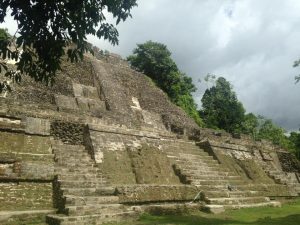
It’s so much like our first draft, don’t you think? So often, our story gets hidden behind the jungle of run-on sentences, under-developed characters, plot holes, and blah-writing. It takes a while before we, the author, can push aside the vines and dig through the dirt to discover the ancient treasures hidden inside our stories.
But we have to write them down, first.
The archaeologists who first came to the Mayan ruins of Lamanai didn’t put one foot down on land, then dig, put their other foot down on land, then dig, and so on. That would have been the most inefficient way to discover the story!
Instead, they walked the jungle, exploring before digging, and then stepped back and studied the big picture. They looked at the “first draft” in its entirety and only after understanding the scale of what they had to work with did they start excavating.
NaNoWriMers, you are drafting this month. You are writing the foundation of your story, but the first draft jungle is swallowing it up.
Let it.
Your story needs the vines to take hold and the roots to grow around it. Your story needs to be buried in warm, fertile soil. You story needs to be held safe in the cocoon of the jungle to be able to deepen the mystery.
Get the first draft out before you start excavating.
After NaNoWriMo, break out your story tools. Uncover your story once you take a step back and look at the vast empire you’ve created. Only then can you discover the true treasures: the deep conflicts, the twisted plot lines, thematic point of view, the heart of the story you are telling.
But for now, pull on your mosquito netting, lace up your hiking boots, and go back into the jungle.
Are you doing NaNo? Is the jungle taking over? Report in your progress!
* * * *
ABOUT CHRISTINA:
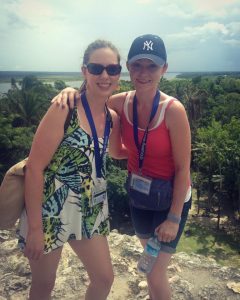
(http://www.christinadelay.com/) is the hostess of Cruising Writers (http://cruisingwriters.com/) and an award-winning author represented by Deidre Knight of The Knight Agency. When she’s not cruising the Caribbean, she’s dreaming up new writing retreats to take talented authors on or writing the stories of the imaginary people that live in her heart.
About Cruising Writers
Cruising Writers brings aspiring authors together with bestselling authors, an agent, an editor, and a world-renowned writing craft instructor together on writing retreats. Go to France with us in April (http://cruisingwriters.com/retreat/southern-france-writing-retreat/) and stay in a historic chateau with Margie Lawson, agent Louise Fury, Shelley Adina, Kobo Writing Life, and Literary Translations. Or cruise with us to Grand Cayman (http://cruisingwriters.com/retreat/7-day-western-caribbean-writing-retreat-cruise-september-10-17-2017/) with Lisa Cron, Anglea Ackerman, agent Michelle Grajkowski, and editor Deb Werksman of Sourcebooks!