Writing bestows faith. It’s easy to believe we might succeed when with each draft we can see our work improving. So it makes sense that we unravel a bit when we must trust that we have done enough, and it is time to query.
It is such an exciting time.
It is such a vulnerable time.
It is such an anxiety-producing time.
Because stampeding all over your dream for your novel is an army of Orcs that arose from the black slime of Factors Outside Your Control: Assessment of your talent or preparedness. Response to your hook. Perception of salability. Hidden personal tastes. Shifts in trends, shake-ups at publishing houses, bad news from Barnes & Noble, another Amazon feud.
The potential worries are legion. But it isn’t the things you can’t control that cause the black slime. It’s your reaction to them.
“Sometimes, despite our best efforts and positive thinking, health, fortune, and/or peace elude us. But the one thing we do have absolute control over is the quality of our days. Even when we’re grief stricken, racked with pain, sick from worry, deeply depressed, squeezed by circumstances—how we greet, meet, and complete each day is our choosing. We hate to hear this.”
—Sarah Ban Breathnach
We hate not knowing. But letting fear get the best of you can cause you to turn on the very people whose support you are seeking: the agents. I have heard so many aspiring writers whine about the very agents they hope will foster their careers—in public and on social media—that I can only hope karma has turned a deaf ear.
Here are five tips to help you rise above the slime when living in the query trenches.
Divorce your effort from the product you’re selling.
No one will ever be able to repay you for the years you spent honing your craft, whether that was in preparing one novel, writing eight novels, or getting an MFA. You chose your internship, it is now behind you, and no one owes you anything for it. With any luck you spent less than what a doctor paid for his training, and no one will pay him back either. For every decision you make from here on out you need to be facing toward your future career, not toward the past.
Assume your ideal agent is looking for you, too.
If you can get this notion inside your marrow you will come across as a confident partner instead of a desperado. Cast from your language words like “gatekeeper” and “rejection,” or a phrase like “I lost out on my dream agent”—they bestow way too much power on someone who doesn’t even share your vision. When you hear “not for me,” thank these people silently for stepping out of your way so you can find your work’s best advocate.
Accept that your submission package is all they’ll need.
You’re an avid reader—how do you make purchasing decisions? You read the back cover copy (similar to a query pitch) and if it doesn’t suit your tastes you set it down. If it intrigues, you read the first couple of paragraphs to see if you respond to the style and voice and situation. That’s it—you’re ready to either buy or put it back on the shelf. Why ask more of an agent’s reading decision than you’d invest in yours?
Adjust your attitude with industry knowledge and empathy.
Waiting is never easy. But you need to know that reading queries is not an agent’s full-time job. After tending to agency duties and the needs of current clients, your query and dozens more like it will be what stands between that agent and a good night’s sleep—will yours be enough to keep her up, wondering what happens next? When tempted to whine that you did not receive a personalized rejection, or that an agent doesn’t read her own slush, ask yourself if you’d volunteer to wait another few months for your query to be read.
Acquiring an agent with query #113 over the course of eight years, I am proof that the query trenches can be survived with your soul intact—but every step of the way requires extraordinary faith. And what is the easiest way for a writer to connect with her faith?
Write another story.
The agent who finally connects with your work is going to ask about what else you’ve written anyway, so you’d better get cracking. Writing will help you believe that the effort you expend on these adjustments of attitude is worthwhile. If you want to be an industry insider, act like one by building bridges to the professionals who can help you.
And if feedback suggests your beliefs were premature, writing will help you believe that if you go back and prepare some more, you’ll be successful.
Do you have any questions about query strategies? What was/is the most challenging aspect of your time in the query trenches? How did you make it through?
*******
About Kathryn
Her work as a developmental editor at Writing-Partner.com, specializing in storytelling structure and writing craft, follows a nineteen-year career as a dance critic. Long a leader in the southeastern Pennsylvania writing scene, she hosts lakeside writing retreats for women in northern New York State, leads workshops, and speaks often about writing.
Kathryn lives with her husband in Bucks County, PA.
This is the second of three posts on this subject. You can read the first HERE.
“Copyright” actually contains of a number of “bundled” rights that belong to the author (or copyright holder). Each individual format and language is actually a different (but related) part of an author’s copyright, and the author has the choice to retain them or to license them, and to license them separately or as a group.
Last month, my guest post looked at the “bigger” rights in the bundle—print and ebook rights (including “enhanced ebooks”), translation rights, and audiobooks. We also looked at “territorial rights”—the places where the contract allows the publisher to sell.
This month, we’re taking a look at some of the other “subsidiary rights” commonly seen in publishing contracts, many of which should be retained by the author.
Many publishing contracts try to move subsidiary rights into the publisher’s corner with sweeping language that treats them all as a group.Beware!
Watch out for clauses that grant the publisher “all subsidiary rights” or which license the right to subsidiary rights “listed elsewhere” in the contract (or in an exhibit). Subsidiary rights often lurk in several different paragraphs, so always read the entire contract carefully.
Now, let’s take a closer look at some common subsidiary rights, what they actually include, and which ones the author should consider keeping (instead of licensing them to a publishing house):
Serial Rights: the rights to license printing of the work in newspapers, magazines and other periodicals, in serial format. Sometimes the contract distinguishes between “first serial rights” and “second” or “subsequent serial rights”—and the publisher normally wants them all, mainly to prevent the author letting someone else arrange for serial publication before the publisher’s book edition is released.
Selection Rights:the rights to create, publish, and license condensed, adapted and abridged versions of the work. Sometimes, these are also called “extraction rights” or “anthology rights”—and the publisher often wants these, too. Like the other subsidiary rights, whether or not to grant them is a business decision for the author to make.
App and Gaming Rights: the rights to create mobile apps or games, including tabletop, electronic, board, and video games based on the work and its settings, plot, characters, and events. Normally, the author retains these rights.
Dramatic Rights:the rights to create and perform live theatrical stage productions (including plays and musicals) and dramatic radio or podcast productions based on the work. Normally, the author retains these rights.
Film and Television Rights:(Sometimes also called movie rights or motion picture rights.) Most authors recognize this one: it’s the right to license creation of film adaptations of the work. Many publishers try to grab these rights (or at least a share of them) but authors should insist on keeping film and TV rights wherever possible. Despite what some publishers may try to tell you, it’s your story—not the publisher’s efforts—that studios will want to license, and you alone should have the right to determine the terms of any film or TV productions based on your written works.
Graphic Novel (Comic Book) Rights:the rights to create, license, and publish comics or graphic novels based on the author’s work. Normally, the author should retain these rights as well.
Merchandising Rights:the rights to create or license merchandise based on the work, from T-shirts to toys and even branded candies. Publishers want them, but authors often need them…and since there’s so much to say about them, merchandising rights will be the topic of my next guest post. Tune in next month for more!
Non-dramatic Reading Rights: the rights to non-dramatic readings of the Work (for example, live or pre-recorded readings over the radio). These are separate rights from audiobooks, film, TV, and stage adaptations, and contracts split on whether to leave them with the author or license them to the publishing house. Generally, these rights end up with whoever has (or retains) the audiobook rights.
“Enabled Access” or “Disabled Access” Rights:the right to produce and license Braille and other “enabled access” editions of the work for disabled readers. Generally, the author grants these rights to the publisher royalty-free, so the publisher can license them free of charge to various groups that translate works into braille and other formats for use by disabled people. However, many publishers will agree to insert a clause stating that any proceeds the publisher receives from licensing these rights will be split equally with the author.
Ultimately, whether or not to grant some or all of these rights to a publishing house is a business decision only the author can make. Often, it makes sense to license certain subsidiary rights (at proper royalty percentages) in order to make a deal. Other times—and especially when the contract over-reaches—it’s better for the author to insist on keeping these rights for himself or herself.
Some contracts don’t list subsidiary rights individually. If not, make sure:
-- The contract does not grant all subsidiary rights to the publisher.
-- The contract does contain the following language: “The author reserves and retains all rights not specifically granted to the publisher in this contract.” (If the language is missing, ask the publisher to insert it.)
This was a long one, but we had lots of ground to cover. So…how do you feel about licensing your subsidiary rights?
*********
Susan Spannwrites the Hiro Hattori Novels, featuring ninja detective Hiro Hattori and his Portuguese Jesuit sidekick, Father Mateo. The fourth book in the series, THE NINJA’S DAUGHTER, will release from Seventh Street Books in August 2016. Susan is the Rocky Mountain Fiction Writers’ 2015 Writer of the Year, and a transactional attorney whose practice focuses on publishing and business law. When not writing or practicing law, she raises seahorses and rare corals in her marine aquarium. Find her online at http://www.SusanSpann.com, on Twitter (@SusanSpann), and on Facebook (SusanSpannAuthor).
Hello writers! If you have read my guest posts on WITS before, you know I love talking about Crossing Emotional Barriers and Crossing Physical Barriers in Fiction. Today I will be diving into another very important element of story craft that you should be paying close attention to.
Dramatic momentum.
Dramatic momentum from the first chapter to the last.
The momentum of scenes leading up to a romantic climax, seems like a no-brainer. A who-done-it mystery of scenes domino-falling until the big finish, seems like common sense. So what kind of dramatic momentum am I talking about?
The kind of dramatic momentum that is usually overlooked.
From the end of one chapter to the beginning of the next. No, I am not talking about the one-line gimmick to shock you into turning the page. I want writers to push themselves beyond the mere end-of-chapter gimmick. I am talking about writing with purpose throughout the entire chapter to make it easy for a reader’s mind to imagine turning the page before they actually do it because they have to know what happens next.
How do you build this dramatic momentum?
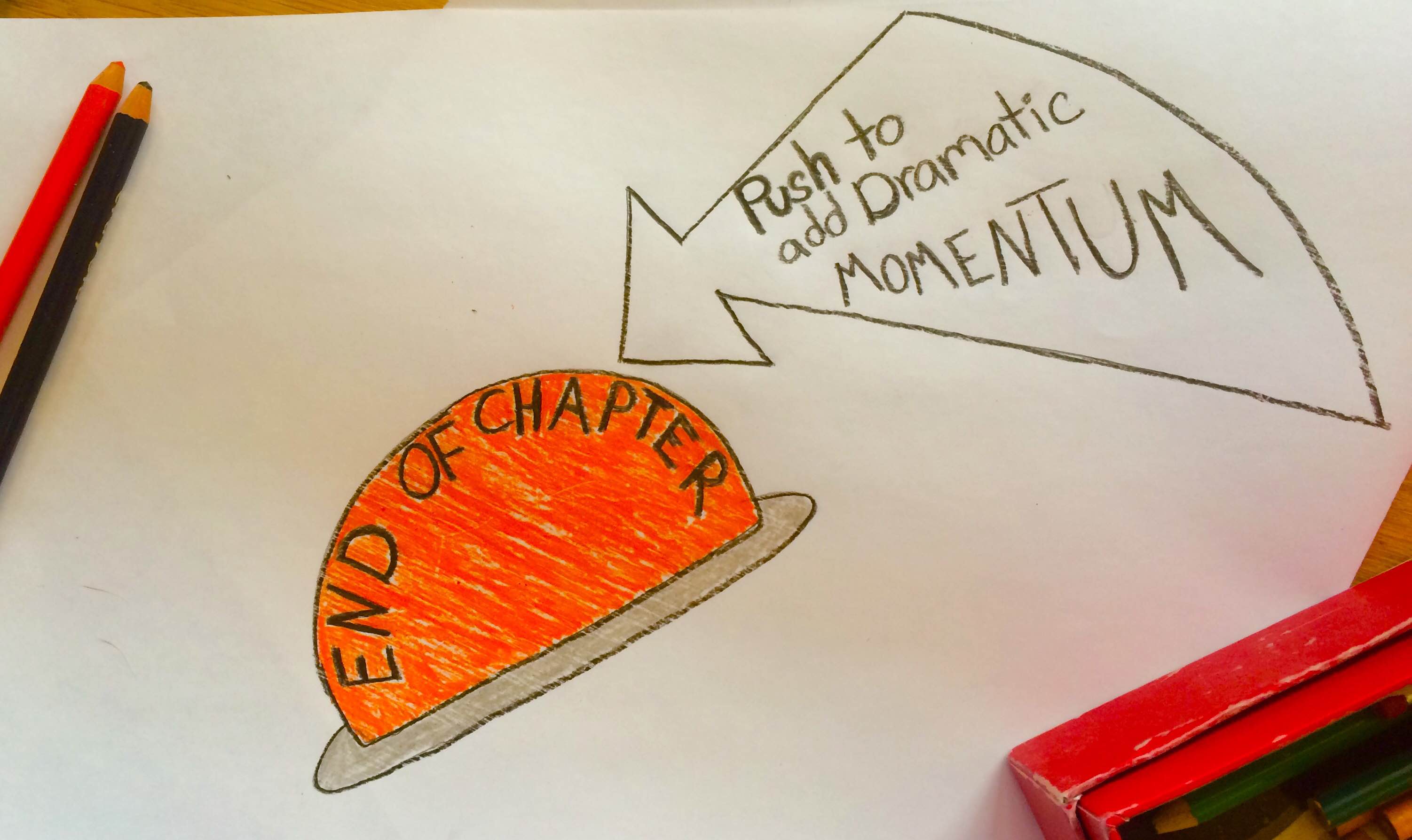
Build an End of Chapter Button.
A what?
A button. The phrase “button a scene” comes from Theatre. You, know that old school way of showing live action fiction? Its original use was not: “A TV writing term referring to a witty line that "tops off" a scene.” As it is so simply stated in a few screenwriting texts and glossary indexes.
Button is a term some folks misunderstand to mean close the scene with a button, as in shut it down or make a complete ending.
Nope.
A Chapter Button is more of a tool to leave the audience (reader) in a state of want, and also at the same time a feeling of satisfaction.
What elements of story craft makes up a Chapter Button?
Action. Thought. Active emotion. One, two, or usually a mix of all three. It is almost like stringing out a trip wire towards the end of a chapter or scene for the readers to read and then be forced forward from the explosion (big or small) from whatever nugget of greatness you left for them at the end. I have heard it described as "progressing but not closing anything off.” Or, an ignition switch that finishes one thing and starts another. Modern comedians actually use them to finish one joke and take the momentum from that one joke to move into another more in depth storyline.
Something that would leave the reader with something new to think about (as well as the characters.)
My twist on the button is that you writers cannot simply think about this button as being one tiny round thing you push at the end of a chapter. There are many pieces of writing craft that you must use to build the Chapter Button.
Let us step a little further out of the box for a second and hmmmm…oh, heck, why not?! Let’s talk about fiction by using a scientific analogy. My thought process is all thanks to the many reruns of The Big Bang Theory on during dinner time.
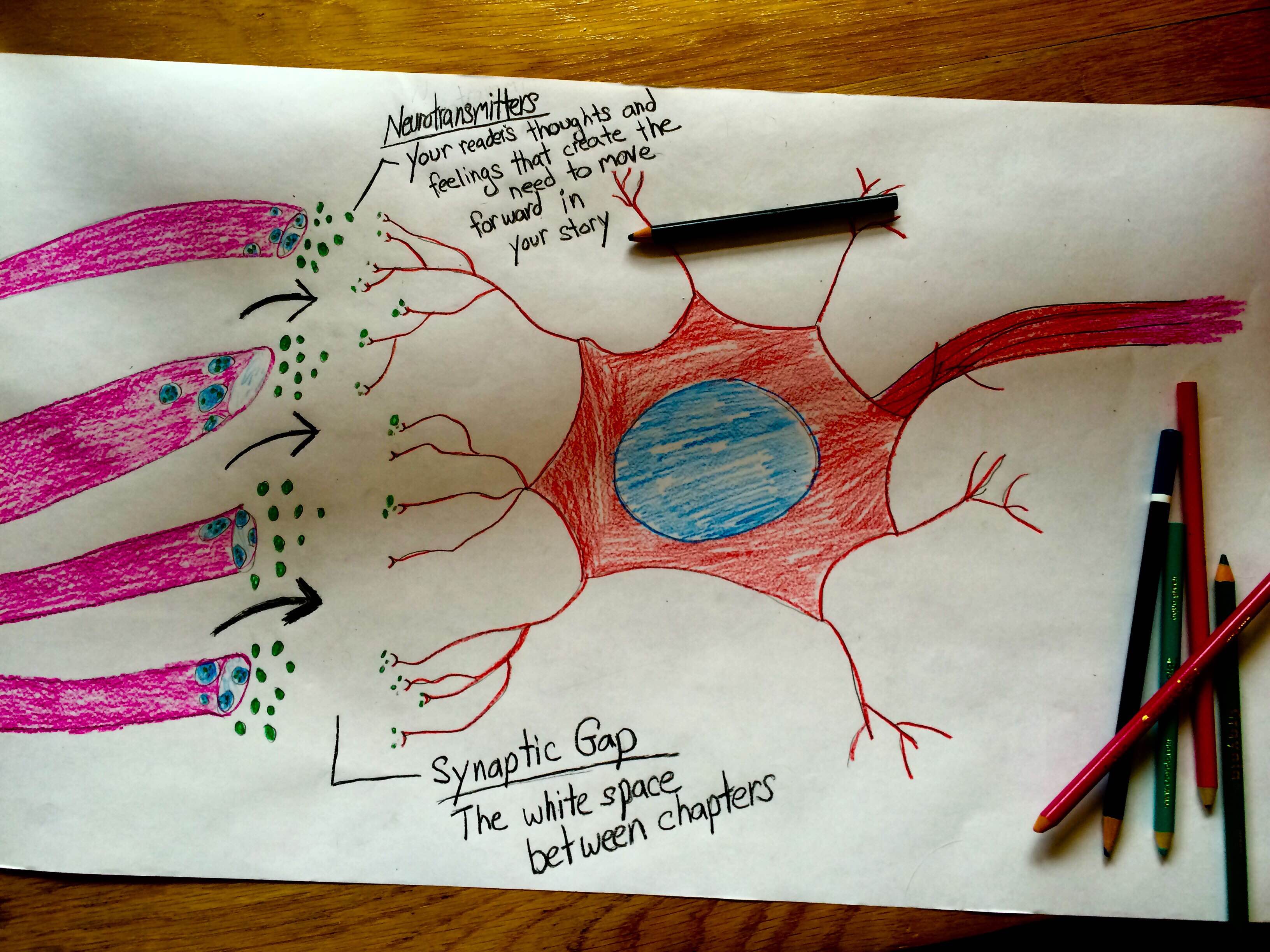
To help us realize what elements make up and work to create a Chapter or Scene Button, think of the components of a chapter like the components of a nerve axon.
An axon, or nerve fiber, is a long slender projection of a nerve cell, or neuron, that conducts electrical impulses away from the neuron's cell body or soma. An Axon is made up of several parts.
**I have attempted to draw few diagrams for better understanding…or for your entertainment. **
Fiction Translation: The story makes up the electrical impulses moving from one chapter (cell) to the next.
Fiction translation: This nucleus is everything your reader knows about your story and characters spanning from the first time they heard about your book to reading the blurb to then reading the first chapter to whichever chapter they are on now. This is your story’s DNA and memory and future.
Fiction translation: These are your receivers. They make up the first line, paragraph, page of your next chapter. Yes, I am talking chapter and scene transitions. Writers have to take the energy and information from the last chapter, absorb into the nucleus of the new cell (chapter) and reconfigure into fresh story (electric impulses) and ZAP! Start a new Chapter built with even more energy than the last.
Fiction translation: The synaptic gap or synaptic junction is not only the white page or half page between chapters. That gap is mental just as much as it is physical. Within that gap are HUGE amounts of thoughts (neurotransmitters) going through a readers mind. Thoughts that have been created by YOUR story.
But what if our axons (chapters) had synaptic vesicles with dead neurotransmitters inside? The synapse would fail, right? If your story is stale and isn’t creating a charge within you reader’s head or heart, then they won’t get very far in your book.
Fiction translation: I like to think of the Myelin Sheath’s fat and proteins as helping to feed the story and make it stronger/faster. The Myelin Sheath is the KEY TO DRAMATIC MOMENTUM. The different layers are the yummy bits of :
Subtext shown through thought and action.
Character deepening details shown through thought and action.
Non-cliché, intricate character relationships shown through thought and action.
Real and active emotion shown through visceral and physical and mental action.
Reader questions built by how and what and when you show story details through thought and action.
These layers will better secure your Chapter Button. These threads make the Chapter Button stronger. Without it, all you have is flat and slow information moving at glacial speed towards the end of a chapter and when your reader gets there, they just might put your book down and go do something more interesting with their time. EEK!
Note that without the Myelin Sheath being present, being healthy, or having all of the layers involved, the nervous system fails to function properly. This is what causes muscles not to listen to the brain, sharp and jittery movements, no control over movements, and then the nerves (your story) dies.
As you are writing, think about all of these electrical elements as they make smooth and energetic transition after transition after transition, moving your reader deeper and deeper into your character’s world. You are building a story as a whole to get fat and wide and deep with many layers, but it also needs to take us on a journey and each and every section should shoot the reader forward like we are taking rides through a complex nervous system.
Wooownelly, did I take the analogy too far? Maybe. But did it make you think? I hope so.
Did seeing how all of these components work together to create dramatic momentum make you realize you cannot skimp on story craft? I hope so!
Thank you so much for going on this Big Bang Theory style journey. Next month I will leave the analogies in my head and get back to Crossing Emotional Barriers with digging into big ways to show little emotion and little ways to show big emotion.
Drop me line in the comments - What authors pop into your head when you think of stellar chapter transitions and strong Chapter Buttons? Have any books you have read, broken the barrier on how fast you have read them? Did you look back and wonder how they did it? I’d love to hear about them!
I will put EVERY COMMENTER’S name into random.org to spit out a winner to win one of my online courses I teach at Lawson Writers Academy. Writing Action and Emotion and Scene Writing, oh my!
***********
About Tiffany
Tiffany Lawson Inman claimed a higher education at Columbia College Chicago. There, she learned to use body and mind together for action scenes, character emotion, and dramatic story development. Tiffany’s background in theatre provides her with a unique approach to the craft of writing, and her clients and students greatly benefit. As a freelance editor, she provides deep story critique, content editing, and line editing.
Stay tuned to Twitter @NakedEditor for Tiffany’s upcoming guest blogs, classes, contests, and lecture packets.She teaches Action and Fighting, Madness to Method: high intensity emotion, Triple Threat Scene Writing, Writing Humor For Every Genre, and Short Story Workshops for Lawson Writer’s Academy online. She presents hands-on-action workshops, and will be offering webinars this year.