If that sounds like you, you're sure not alone. Even writers who are naturally gifted at self-promotion - and, boy, don't we envy them? - find it tough to condense their fabulous book into 50 words.
Which is easy to understand. If you had to condense your entire life into 50 words, where would you even start?
Getting just 50 words to sum up everything that's great about a story you've spent the past however-many months on can be every bit as challenging.
So that’s why it helps to think like an advertising copywriter.
All you marketing people already know this, right? I DIDN’T know it when I started wondering why writing blurbs came so easily - far easier than writing the actual novels - until I realized blurbs are all about presenting the product in its best possible light.
In a very short space.
To the people who want it.
Who ARE those people?
It’s a good idea to figure that out early in the game. After all, no advertiser would waste money producing a TV commercial or a full-page ad in the New York Times or a billboard on Main Street without knowing who they want the ad to reach.
(Er, whom. But that sounds so pedantic!)
Anyway, we writers tend to be a bit more all-inclusive and democratic than the advertisers who maintain "the ONLY consumers we care about reaching are suburban females age 35-49 with pre-schoolers in a $50-75K household."
We tend to say "I want to reach every reader on Planet Earth."
But, drat it, that makes it tough to target our blurb toward any specific market.
It could very well be, of course, that every single reader on earth will agree HERE's the book they've been waiting for their entire life, and they'll order millions of copies for all their friends.
(And even as we authors dismiss such a premise as being unrealistic, some little secret part of us still thinks "yes, exactly!")
The realistic part, though, recognizes that not every reader WILL want this fabulous book. Someone seeking a sweet romance doesn’t want incredibly hot love scenes. Someone who wants a medieval historical won't be satisfied with the Old West. Someone shopping for a relaxing escape doesn’t want a nail-biting thriller.
But who cares? Those aren’t your readers anyway.
The readers YOU want already know what they're looking for...and it's the kind of book you write.
In a blurb, you flip the traditional show-don’t-tell advice on its head. Here, telling instead of showing is doing the reader a favor. Someone who’s skimming through a whole selection of possible stories wants to get the flavor of yours in just a few sentences or paragraphs.
Think of it like writing a commercial for a brand new car, or a traditional favorite snack food. You have fifteen seconds to present the image of how this car or this snack food will make life better for someone glancing through videos.
Seems daunting, right?
But you have an advantage -- because you don’t have to catch people glancing through videos. They’re glancing through story descriptions because they ALREADY want to buy your kind of book.
So you need to make the most of that advantage, putting your best blurb-writing skills to work. And that’s where we come up against today’s question:
What’s the best blurb you've read lately? It can be your own or somebody else's, just mention the book's title and author.
Everyone who answers will go into a drawing pool, and the winner gets free registration to my class on “Blurbing Your Book” June 1-26.
Fun stuff, right?
Although maybe not quite as much fun as choosing who stars in the movie of your book...
About Laurie
Laurie Schnebly Campbell (BookLaurie.com) works in advertising, where her job is to convince buyers they'll love a particular product. She's spent years writing about products people might not think of buying, until they saw a message that makes 'em realize "yes, THIS is what I want!" She's always pleased, but not surprised, when people who've taken this class report increased sales with their new and improved blurbs.
Sometimes you have a flat tire, real or symbolic, and a planned writing session doesn’t happen. Sometimes you are“stuck” and have to think awhile on a solution for the corner you’ve written yourself into. Life gets busy and other responsibilities take precedence. Or a host of other daily intrusions muscle into your schedule.
This is not what I’m talking about today.
When you are slammed with a major life-changing event, death or loss, it can take months (or even years) for your heart to have healed enough to have your writing spirit back onboard. Without a heart that is open to feelings, it’s hard to write, let alone write anything compelling.
I know this place well.
After my father died suddenly, I thought that writing a new book about a girl's love for her father would be cathartic. It was, to a point. But I was unwilling to lay my feelings out on the page, so the book wasn’t all it could be and the process didn’t help as much as I’d hoped.
I’m still recovering from a death early this year. For six months I was the primary caregiver for the after-care of two surgeries and a battle against two kinds of cancer (others, not myself). I am finally able to sit at the computer and write again. Until recently, I didn’t have the heart to write.
But here is a list of what I was able to do.
1. Use a post-it pad to jot down snippets of dialogue or a word, like desolation.
You know how forgetful you can be when you’re severely stressed. I now keep a pad of paper in my car. Seeing just one word on a page has helped me address that feeling - and remember the love.
2. Spend time in nature.
While life is slows in your grief, notice everything - the colors of the sky at dawn, the sounds of traffic, the smells in a bouquet of flowers. A bunny scurrying across the trail, or a mother duck shepherding her ducklings down a creek can make me smile at the worst of times.
3. Listen to music.
Music can put you in touch with feelings at light speed. That’s why a producer spends big bucks for the right composer for a film. Initially, I listened to a lot of what I call “Angry Young Man” music (AKA alternative rock). My choice in music softened as my heart healed.
4. Consider characters that have no relationship to what you’re going through.
Give your brain a break. It doesn’t do any good to beat yourself up about things you could have done better. A new life means a new outlook. Who doesn’t get energized thinking about new characters.
5.Think about characters that are going through the same thing as you.
When you’re ready, let your fictional characters walk your path. Perhaps through their eyes and hearts, you will see and feel things you’ve overlooked.
6. Critique other’s work.
This kept me in the writing game. I could engage in a writing activity by editing my critique partners’ pages, with a mind detached from my own problems. It also reminded me that I had stories to tell and made me sit at the computer to try to tell them. Even though I did a lot of “trying to proceed,” the act of critiquing kept my writer’s muscles from atrophying.
7. Build a movie in your head of a brand new project.
This is another “get out of your world” technique. Of course, as a science fiction writer, I have to admit I use this one often, even when I’m not stressed. I worked on my “movie” and now that I’m writing again, the words are flowing.
8. Record new story ideas, new characters, new settings that intrigue you.
I’ve found memory and stress to be mutually exclusive, so if I come up with what I think is a great idea, I write it down and save it for later. Even if it seems pretty stupid. Heck, I’m a writer. I can use pieces of everything.
9. Research something totally new, unrelated to any current project.
You may find something to help you out of your writer slump and life funk.
10. Write short paragraphs about how you feel.
Save these pages! You will be able to use them in your books. Maybe not your current project, but your raw emotions will propel your work to places it hasn’t reached before. The more we share our life journey, whatever the masquerade of genre and characters, the more our readers can relate. After all, don’t we all read to feel?
11. Read.
Reading will not only take you away from your misery for a time, it helps to open your heart. And an open heart not only lets us take in, but allows us to release doubt, pain, anger and so much more. Reading also will remind you that you are a writer. And eventually you will start telling your stories again.
The curse of life is that nothing is permanent. The beauty of life is that nothing is permanent.
What have you done to help you “soldier on” during a life crisis? How have you been able to come back to your writing?
* * * * * *
About Fae
Fae Rowen discovered the romance genre after years as a science fiction freak. Writing futuristics and medieval paranormals, she jokes that she can live anywhere but the present. As a mathematician, she knows life’s a lot more fun when you get to define your world and its rules.
Punished, oh-no, that’s published as a co-author of a math textbook, she yearns to hear personal stories about finding love from those who read her books, rather than the horrors of calculus lessons gone wrong. She is grateful for good friends who remind her to do the practical things in life like grocery shop, show up at the airport for a flight and pay bills.
A “hard” scientist who avoided writing classes like the plague, she now enjoys sharing her brain with characters who demand that their stories be told. Amazing, gifted critique partners keep her on the straight and narrow. Feedback from readers keeps her fingers on the keyboard.
Writing is often about finding a balance. Too much left in subtext can lead to confusion. Too much explanation can feel like an info dump or be too "on the nose." Etc., etc.
With our characters, if we want our protagonists to seem heroic, they need to have strong traits. Yet at the same time, if we want our protagonists to be relatable, they need to have vulnerabilities. This is never an easy balance, especially when clichés fill our heads about what a "strong character" means.
Stereotypes Don't Allow for Diversity or Three-Dimensional Characters
On the heroine side, Ripley from Alien is often brought up as a "strong female character." The stereotype refers mostly to physically violent, butt-kicking women. Furthermore, it assumes women who need rescuing—ever—can't possibly be strong.
On the hero side, the stereotype is all-alpha-male-all-the-time. And not just a normal level of alpha male, oh no... In some genres, the expectation is for an amount of alpha-ness that reaches *sshole level—leading to the label "alpha-hole." Again, the assumption is that heroes who are caring or sensitive—ever—couldn't possibly be strong.
With all those clichés and stereotypes swirling about our head, it's no wonder that we might struggle with making likable characters. There's no room in those clichés for vulnerabilities that will make them relatable to the reader.
Those expectations also prevent us from making three-dimensional characters. How can a character who has to conform to such narrow expectations ever seem unique and real? How can they ever make decisions that follow who they are rather than who the clichés expect them to be?
To my mind, "strong" means the ability to handle that which the character thinks they can't. Whether they're handling a situation, an emotion, a conflict, a weapon, a threat, or a relationship, there should be multiple ways of showing strength, or else we've lost a different kind of diversity and dimensionality for our characters.
A Disclaimer—Characters Who Conform Aren't "Bad"
All that said, I don't think it's bad if some of the characters we write follow the stereotypes. As with other kinds of diversity, the problem is when that's the only depiction or considered the norm.
Many readers like heroines who literally kick butts, and many readers don't. Many readers adore alpha-hole heroes who are jerks to the nth degree, and many readers don't. As authors, some of us naturally write those types of characters, and some of us don't.
None of that is wrong. If we tried to eliminate those characters, we'd once again be limiting the options for our characters, which is the opposite of my point. Rather, my concern is that too often characters lose the "strong" label when they display any characteristics that deviate from the narrow expectations, regardless of their other “strong” qualifications.
A Closer Look at Strong Heroines
In many paranormal romances, the hero is a paranormal being and the heroine is a “mere” human. Between her gender and her human frailty, the heroine is usually at a big disadvantage.
No offense to many of my favorite books, but I didn’t want to write that kind of paranormal romance. When writing romance, I love exploring the power struggles and negotiations between the couple.
To me, a romance where the couple figuratively battles each other for the upper hand and gradually learns to function as a partnership and team feels true-to-life. So to write those kinds of stories, I needed heroines who were on equal footing—power-wise—with the hero.
Case Study: Elaina of Treasured Claim
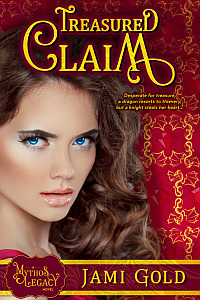
In Treasured Claim, my debut paranormal romance novel releasing next week, the paranormal being of the couple is the heroine. Not only is the hero a “mere” human, but Elaina—a shapeshifting dragon—is also physically stronger than the hero. In addition, she has attitude to spare, to the point that the strength of her voice helped me discover my author voice.
However, when I first started entering contests with the story, I received feedback that some found her unlikable. They didn’t like that she starts off the story as a jewel thief with a callous attitude.
The key to unlocking her character from a reader perspective was to show her vulnerability. In other words, I had to balance her strengths with her vulnerabilities.
Strengths: Her physical strength alone shouldn’t define who she is. She has other admirable traits, such as being comfortable in her own skin and not letting others shame her. She also has a strength of will and character and makes the hard decisions because they’re the right thing to do.
Vulnerabilities: There’s a reason she’s stealing jewels—she’s on the verge of death and needs them to stay alive. And yes, she’s flippant, but she also has a strong sense of right and wrong and is weak because she refuses to murder humans for their treasure (unlike other dragons). And to top it off, she’s on the run from her father, who’s trying to kill her.
A mix of strong admirable traits and vulnerabilities brought the character—and the story—up to the level it needed to be to win over readers. After making those changes, Treasured Claim won First Place in three contests and was a finalist in six other contests. *smile*
A Closer Look a Strong Heroes
In paranormal romance, for better or worse, the norm for that subgenre is often extreme alpha male/alpha-hole heroes. But I don't write alpha-holes, and some of my heroes have some downright beta traits (along with their alpha traits).
I don't want to write jerks. I don't want to read jerks. I want romances where the characters grow in a partnership based on respect that I can believe will last for the "ever after" part of the happy ending. That's just my preference.
Alpha Males vs. Alpha-Holes
Heroes can be dominant without being domineering. They can be protective without being controlling. And they can be confident without being overly arrogant.
On the other hand, when I look at a domineering, controlling, arrogant male, I don't see a leader. I don't see an alpha male. I don't see a hero.
I see a poseur, a male who's so insecure that they put on an act to hide who they really are and who's so afraid that they need to control everything. Their jerky behavior is all about posturing and overcompensating for their weaknesses.
“Confidence isn’t walking into a room and thinking you’re better than everyone. It’s walking in not having to compare yourself to anyone at all. — Unknown”
To me, the real alpha heroes are the ones so confident they're not afraid of revealing their vulnerabilities. The ones so confident they can be nice and not fear that will erase their assertiveness or power. In other words, the ones we might actually like if we met them in real life. *smile*
Case Study: Alex in Treasured Claim
In many ways, Alex is the typical romance hero: He’s a billionaire business guy who’s used to getting what he wants. But through his father, he also grew up with first-hand insight into the dark side of what domineering, controlling alpha-holes are like in real life.
Unfortunately (for him), while Elaina intrigues Alex, she also brings out his dominating side more than anyone else. With her, he’s more aggressive, more controlling, and more disrespectful, and he doesn’t like it.
His struggle was fun for me to write because I got to play with the expectations of the genre in a way that fits the character. And just like with my heroine, I worked to give him a mix of strengths and vulnerabilities:
Strengths: He excels with the (good) alpha male traits of focus, decision making, and problem solving. Beyond being a gorgeous billionaire, he’s admirable (and relatable) for his desire to rise above his history and for his goal to build a healthy partnership with Elaina. He just happens to make a lot of mistakes along the way. *smile*
Vulnerabilities: At the same time, he’s terrified of turning out like his father, and he worries about how much he seems to be sliding in that direction. He’s also willing to admit to himself how much he’s obsessed with Elaina. He doesn’t play the stand-off-ish game with her, and that means she knows exactly how to hurt him.
In other words, unlike the stereotypical alpha-hole, he consciously tries to be kind (he throws a charity fundraiser for a cause close to his heart, and he treats his employees exceptionally well), and he also allows himself to show emotions. He’s not implacable or untouchable. He’s relatable.
Again, I'm not saying that no heroes should ever be arrogant, controlling, domineering playboys or that no heroines should be butt-kicking Ripleys. But I reject the idea that characters must conform to narrow stereotypes to be considered "strong."
I want to read stories with more diverse characters than that. That's why I'm not going to change the kinds of characters I write. I'll continue writing both heroes and heroines who are strong and vulnerable. And I'll just hope that others are looking for the same. *smile*
Do you struggle with writing characters who are strong yet likable? Have you ever experienced pushback for making your characters vulnerable? Do you think characters can be strong and vulnerable? How do you think genre affects that possibility? How would you define a strong character? What heroes or heroines have you liked that follow or break the stereotypes?
A shapeshifting dragon on the verge of starvation…
For Elaina Drake, sparkling jewels aren’t a frivolous matter. Without more treasure for her hoard, she’ll starve. On the run from her murderous father, she’s desperate enough to steal—er, acquire.
A modern-day knight seeking redemption…
Disgusted by his father’s immorality, Alexander Wyatt, Chicago’s biggest corporate titan, is determined to be a man of honor. Yet the theft of a necklace, stolen by an exotic beauty at his latest fundraiser, threatens to destroy all his charitable work.
A predator made prey…
Passion ignites between thief and philanthropist, sparking a game of temptation where jewelry is the prize. But when Elaina’s exposure jeopardizes Alex’s life, she must choose: run again to evade her father—or risk both their lives for love.
After triggering the vampire/werewolf feud with an errant typo, Jami Gold moved to Arizona and decided to become a writer, where she could put her talent for making up stuff to good use. Fortunately, her muse, an arrogant male who delights in making her sound as insane as possible, rewards her with unique and rich story ideas.
Fueled by chocolate, she writes paranormal romance and urban fantasy tales that range from dark to humorous, but one thing remains the same: Normal need not apply. Just ask her family—and zombie cat.