Make Your Setting Work Harder
by Julie Glover
We writers spend a lot of time thinking about our characters, knowing that their backgrounds, personalities, moods, and more impact the story in so many ways. Setting can do that too. It can convey personality, mood, tension, and conflict; reveal or reinforce character and themes; and make a story more relatable and alive for readers.
So how can we use setting to its full effect?
Consider Your Characters
When choosing where to set your story or specific scenes, ask a couple questions about your characters.
Where are your characters most likely to be found? What does your character’s home look like and contain? What’s their workplace like? Where do they hang out with friends? Do they spend time in nature? How could you describe those settings to illuminate who your character is?
Where are your characters least likely to be found? Putting them in such settings provides opportunities for tension and conflict. How your character copes with being outside their comfort zone tells a lot about who they are.
Mark of the Gods, the first book of my co-written supernatural suspense Muse Island series, starts with main character Piper Prince in a federal prison where she works as a forensic psychologist. Despite the chaos of criminals, she’s in control there, feeling confident of her mission and ability. But to track her long-missing parents, she flies to a tropical island where various mythical creatures live among unsuspecting humans. Unlike those other humans, she can see their true selves. Slowly but surely, Piper’s sense of control crumbles, as she moves from a place where she’s most likely to be found to a place she never knew existed. The island and its individual locations helped uncover Piper’s strengths, weaknesses, and desires while presenting fresh challenges that pushed the story forward.
You can also put these two questions together in a single scene. In our latest novel, Heir of the Chaos, we needed a setting for a pivotal conversation between two longtime friends, one of whom happens to be the Egyptian goddess of fertility. So, we chose a place where she would be found but he would not. The goddess summoned her bestie, Finn, to the one and only nude beach on the island. Admittedly, that setting was also fun to write, but opting for that location substantially increased the tension of their interaction.
A Well-Known Example
Unless you’ve read our Muse Island series (which you should!), those examples may not be as useful as one you’ve seen—or at least heard about.
Let’s consider what the choice of setting in Star Wars: A New Hope tells you about its main character, Luke Skywalker, in each of these scenes.
Luke would, of course, be found on his home planet of Tatooine, which looks like this:
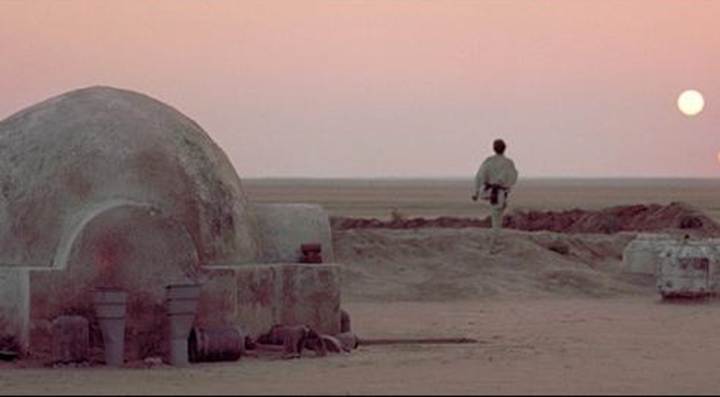
That setting reinforces that Luke is an orphan, somewhat lonely, and likely seeking an adventure outside this desert planet. It conveys a feeling of emptiness in his life.
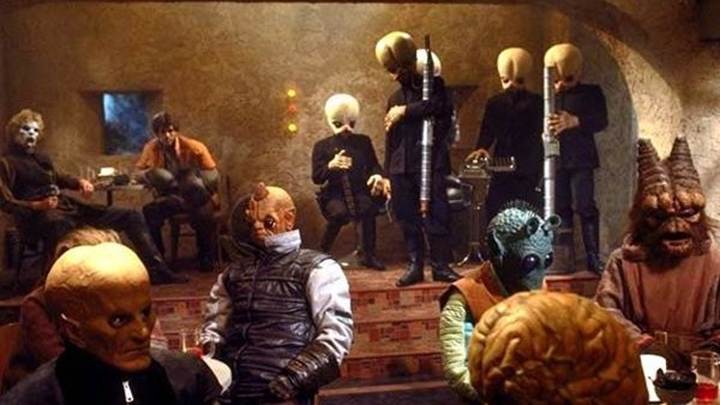
Once he leaves the planet, he finds himself in completely different settings, such as the Mos Eisley cantina:
Here’s Luke at the bar:
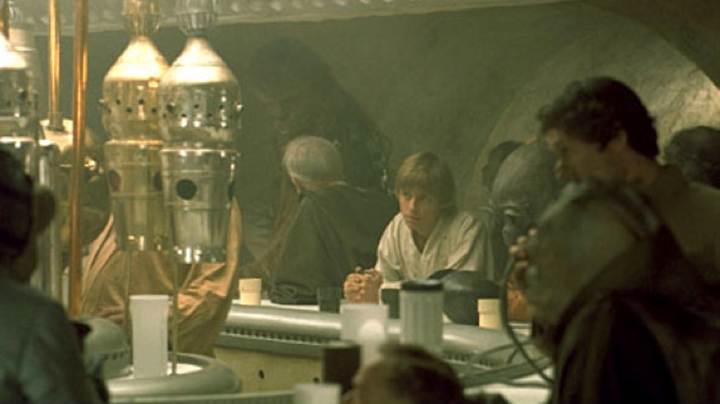
How brilliant was this setting? Luke looks out of place (which he is), and the cantina's vibe is a mixture of hedonism and danger. At any moment, someone could lose an arm.
We also have the opportunity to see how the other characters engage in this setting—for instance, the calm of Obi Wan and the shadiness of Han Solo.
Finally, consider all the scenes in movies where people are trapped. Star Wars: A New Hope took it to nth degree.
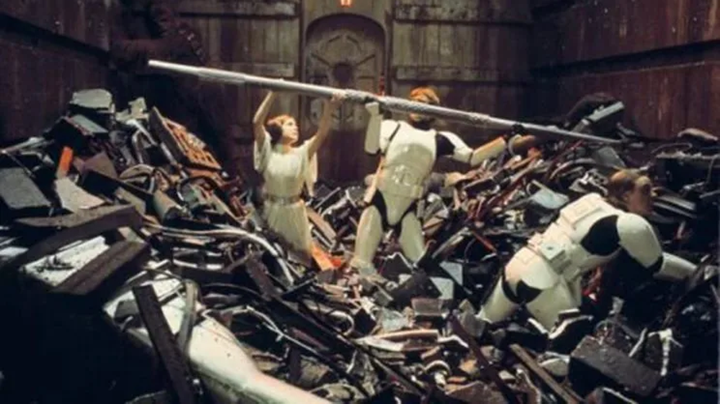
It’s not just that the walls are closing in on Chewbacca, Luke, Han, and Leia. Making the trap a garbage compactor reinforces the idea that the Empire views the Rebels as trash to be discarded.
Settings Have an Arc Too
As you can see in Star Wars, settings have an arc too. We can trace the story and character growth through changes in setting. Luke begins on an empty planet, lands up in crowded cantina, and ends up fighting alongside friends in an Empire stronghold. The settings follow his growth.
For each scene you write, think about where you are in the character arc and the story’s progression. A story structure arc might be helpful in determining what kind of setting to choose. Let’s take a fairly simple one with a baseline, rising action, a climax, and resolution.

If you’re following an arc like this, you don’t want your most tense setting to be in the rising action section. You want to save your OMG setting for the climax. But also, you will need some calm settings in places, as your character steps back and reflects on what’s happened and how to move forward.
In Power of the Song, book two in our Muse Island series, we begin in Piper’s new office—not as comfortable as her previous one, but a safe and calm space nonetheless. As action rises, she finds herself in a forest of faerie (a bit unusual, but trees are still trees), a creepy hotel (where the vines get out of control), and a police station (with a not-so-friendly sheriff). In between, we return to Piper’s office for breathers. As tension ramps up, though, so do the settings. After the climax, we return to her office again, creating setting bookends.
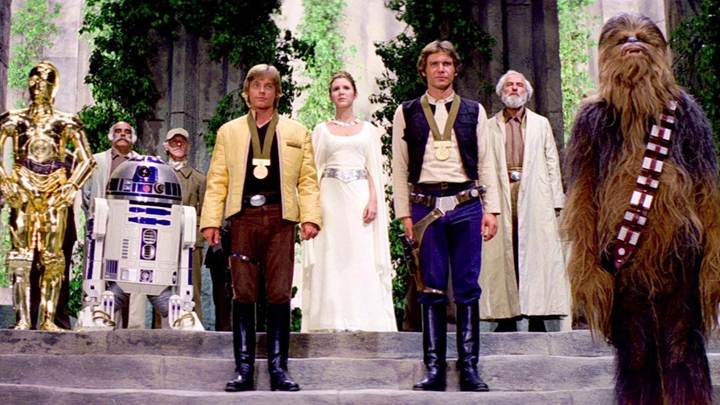
Of course, there are other narrative arcs. In Star Wars: A New Hope, the final scene couldn’t be more different from our introduction to Luke Skywalker on his desert planet home. He’s now surrounded by friends, filled with purpose, and hailed as a hero. And that setting is perfect for his character arc.
Be Intentional About Setting
If there’s one takeaway from this post, it’s this: be intentional about setting. Choosing a setting that reveals your character, sets the right mood, creates tension or conflict, and follows the characters’ growth can enhance the story in more ways than you realize.
Ditch the neutral settings. Get creative! Consider your characters and the arc. Look at examples (beyond Star Wars) for inspiration.
And if you want some great resources on writing setting, you’ll find plenty here by typing “setting” into the search bar.
How have you used setting to challenge or reveal character? What other examples come to mind that demonstrate good use of setting to show story progression?
About Julie

Julie Glover is an award-winning author of young adult and mystery fiction. Her contemporary YA includes Sharing Hunter, Daring Charlotte, and Pairing Anton, releasing in the next couple of weeks! She has also co-authored five supernatural suspense novels and two short stories in the mythology-based Muse Island series under her pen name Jules Lynn. She's especially excited that this series is finally available in print!
A native of Texas, she now lives in Denton with her hottie husband, her loquacious cat, and her large collection of cowgirl boots.
Image credit: Michelle Maria from Pixabay
Leave a Reply
10 comments on “Make Your Setting Work Harder”
Tagged as:
Subscribe to WITS



Recent Posts
- Craft in the Age of AI: Sending a Scout Into Your Draft
- One Chapter, Six Mirrors: My Experiment in Getting Found
- Struggling with Character Voice? Check Your Point of View
- Conflict in Fiction Writing, 7 Main Types
- Author Blind Spots: The Gaps You Can't See
I'm using setting as a character, but have not previously given it an arc or thought about using calm versus tense settings. Looking back in my writing, I do some of this already. This is a layer that will strengthen my story emotional impact. Thank you!
My pleasure, and good for you! All the best to you and your writing.
My main character's need is freedom without fear. Every setting he's in until he runs away is closed. It's a car, a basement classroom on a closed compound, an apartment. Even the cockpit of a small plane, which feels more free but is still enclosed. When he is outside once, the day is humid and close feeling. After he runs, he feels wary and exposed until he has to take action in a dark alley at night. Running away doesn't make him free, but that action shows he's more capable than he thought and leads to a truer freedom. (No one is ever fully free.)
Wow, that's fabulous, Debbie! Those setting choices certainly reinforce the theme and increase tension.
Readers have told me they want to live in Kary's house. We meet it most in the first book of the trilogy, Pride's Children: PURGATORY, because, although the story starts in NYC, it quickly moves to her isolated house on her hill in New Hampshire, where she welcomes the star she met in NY because he is filming nearby.
In her house, Kary is serene, surrounded by nature. But her writing room's windows have floor to ceiling drapes so that nature doesn't keep her from her work.
Actor Andrew goes home to Ireland, and in the second book, NETHERWORLD, you see some of his family's farm and house and his future building plans.
Actress Bianca's house in Hollywood is her Tara, with the infinity pool overlooking the Pacific where she does the laps that keep her fit.
A big question remains: when it is over, where will who live with whom?
That sounds absolutely lovely, Alicia. And what a compliment from your readers!
You write fantasy, but setting can work otherwise. My novels are set in ordinary places (this world) where the characters are put through their paces.
Yes, I do write fantasy (the examples used here), but I also write contemporary teen fiction set in ordinary places. Being intentional about setting can also, as you say, put characters through their paces. Thanks for commenting!
I love that you included that setting arc diagram. I need to be more intentional about that.
As you know, I LOVE to use setting to make characters really feel like a "fish out of water." (An example you know: a nun having to work in a health clinic that caters to the adult film industry.)
That kind of thing makes a character examine their beliefs and STRETCH.
Thanks for the post!!
Oh yes, I LOVE that contradiction for your character. Tension, revelation, and humor—all from setting! 🧡