Fabulous first lines tend to stick with all of us. We ponder them, agonize over them, rewrite them, and rewrite them again. And more than once, we've actually purchased a book based on breathtaking first line or paragraph.
Plus, a good first line is quotable. Who doesn't remember these?
“It is a truth universally acknowledged, that a single man in possession of a good fortune, must be in want of a wife.” – Pride and Prejudice, Jane Austen
"Happy families are all alike; every unhappy family is unhappy in its own way." –Anna Karenina, Leo Tolstoy
"Last night I dreamt I went to Manderley again." – Rebecca, Daphne du Maurier
"Call me Ishmael." –Moby-Dick, Herman Melville
Also, our own Laura Drake has offered some great advice on writing a winning first line here and here.
But today, we invite you to share the opening lines of your current WIP (work-in-progress) or recently finished novel in the comments! Or share a favorite from someone else. Give us the title and genre, then your opening line(s). Feel free to comment on others' as well, and tag your writing friends on the post!
We'll get you started.
Ellen
"Jack Schmidt ambled into the main office of the lumber mill carrying his father's lunch pail. Sounds of rage poured through the inner office walls."–The Hobo Code, YA historical Fiction
"Chairman Meow, our feline ball of fluff, occupied my bedroom window seat."–Crystal Memories, work in progress
Jenny
"Computer work and the Pill almost killed me." –The Best Morning of My Life, a short story
"Boaz pushed open the door to the tiny shop and inhaled the magic that never got old." –Brotherly Love, a short story
"He’d been seduced by space travel. He'd testify on it if he had to." –What Comes After Doomsday?, a short story
John
"It had been two days since we left the Ice Palace in the frozen tundra of Arctus."–Max and the Isle of Sanctus-Book 2, Secrets of the Twilight Djinn
Kris
"Ellie held Rocky's fishbowl on her lap, watching stars from the forest ridge overlooking their remote Earth town. This has been their nightly tradition during their furlough, but tonight she had business to discuss with him." –Star Tracker, a New Beginning, a sci-fi short story
Now it's your turn. Share your opening lines—or a favorite from another author below!
We hope this helps kick off a great weekend of writing!
Now, I get it. It feels like editors are just splitting hairs and camping out on semantics because the reader will understand what you meant. Let’s look at 4 reasons why we want to avoid these autonomous body parts in fiction – and because I’m always about deep POV geekery, we’ll look at this topic from that angle.
First, let’s keep in mind that you won’t be sitting next to the reader as they’re turning pages and stumbling over phrases. You won’t be there to explain things, or shrug, “You know what I meant.” If you’re justifying these phrases by saying "they’ll figure it out," you’re not doing your job. Your job is to articulate how the character feels and (in deep POV) create an immersive emotional experience for the reader.
The Power Of Specificity And Particularity…
Specificity and particularities enable you – the writer – to really focus on the emotions (the WHY) behind the character’s thoughts and actions. Often, in my experience, these phrases are used as a way to skim over the emotions in a scene instead of going deeper.
(Female is POV Character)
His eyes roamed over her body and she folded her arms over her chest.
His gaze started at her feet and worked its way up her body, pausing over each imperfection as if gauging whether he could overlook what she couldn’t change or conceal.
By being particular and specific, there’s more emotion conveyed. The first version the POV character could be coy, embarrassed, shy or feel vulnerable, the WHY behind her action is unclear. The second version (I hope – because this was just off the top of my head), conveys a sense of violation, of judgment, and even a hint of shame. The reader knows what her insecurities are without having to be told.
The Character Becomes Passive
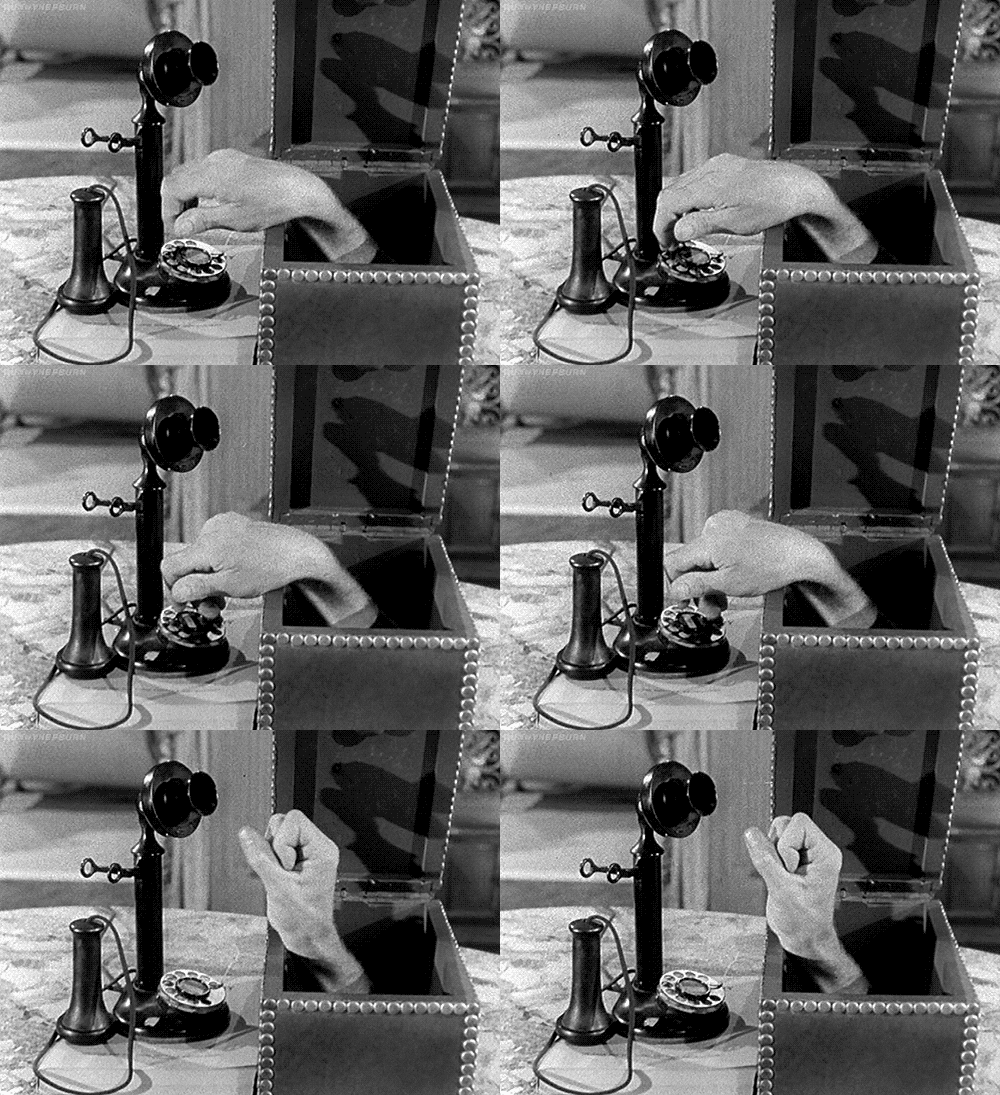
When the body parts are doing all the moving, what often happens is the character becomes passive. Writers can rely too heavily on these expressions and the reader is left trying to discern how these body parts all became autonomous. Reminds me of Thing from The Addams Family. *body shiver*
Make sure the character has agency, not their body parts. If deep POV is your goal, remember to avoid drawing conclusions for the reader with the author/narrator voice. Often, these expressions are “telling” instead of showing.
Show Don’t Tell
Don’t roll your eyes at this advice, it’s valuable. (See what I did there? *grin*) In deep POV, the goal is to remove the author/narrator voice. These phrases aren’t the POV character observing/describing this about themselves, it’s the observation of an outside entity filtering what they see and stepping into the story to share that with the reader.
By drawing conclusions for the reader, the emotions and the WHY are garbled.
Steve’s fingers flew across the keyboard.
What emotion is being conveyed there? Could be nervous, anxious, hurried/rushed, concentrating, angry… We don’t know. To the writer, their intent is obvious. Steve is <insert emotion>. But in reality, the emotion (the WHY behind the quick typing) is unclear.
Steve tapped out the email, checking his watch every two minutes, before hitting send and heading for the door.
Steve banged on each key, typing as fast as he could think, each stroke more pronounced and sharper than the last.
There’s lots of things you could do with that, but the rewrites (hopefully) convey more emotion through subtext and connotation than “his fingers flew.” The emotion that’s powering the action (the quick typing) is much clearer.
Metaphorical Use vs Literal Use
Janice Hardy makes a really great point on her blog that you likely don’t want to eliminate every moving body part. She writes:
“My heart reached farther than my hands ever could.
“I think the difference between this sentence and say, "My eyes darted over the fruit stand," is the intention of the sentence. If you're trying to be metaphorical, or lyrical, or poetic, then a disembodied body part can work. It's clear you don't mean it literally.” (source here)
Deep POV still makes room for metaphor and poetic language, if it suits the character you’re writing. Remember, in deep POV, you are not telling the story, the character is living out the story and the reader is a fly on the wall inside their heads. That’s why the specificity and particularity is so important in conveying the character’s emotions and the WHY behind their thoughts and decisions.
If your POV character is observing another character, for instance, it may be appropriate for them to describe what they see as “fingers flying across the keyboard” but when describing their own actions, you’re better to show and not tell.
How would your character describing an elevated heart rate? Would they feel their heart is pounding? Is it trying to escape their chest? Does it beat against their ribs like a wrongly convicted man? Maybe they check their smart watch and note their heartrate is up over 100. It’s more about how your character would observe and absorb the information they take in, than about you being poetic in deep POV.
Do you find yourself writing disembodied body parts? Do you think there’s a place for them in deep POV?
* * * * * *
About Lisa
Lisa Hall-Wilson is a writing teacher and award-winning writer and author. She’s the author of Method Acting For Writers: Learn Deep Point Of View Using Emotional Layers. Her blog Beyond Basics For Writers explores all facets of the popular writing style deep point of view and offers practical tips for writers.
She runs the free Facebook group Going Deeper With Emotions where she shares tips and videos on writing in deep point of view.
Imagine, for each of the below statements, receiving each of the above reactions:
“Could you take the trash out?”
“I got you a puppy!”
“I have something to tell you.”
“I love you.”
Actions, so the cliché goes, speak louder than words. Most experts agree that nonverbals make up the bulk of communication, and yet so often authors write scenes that rely mostly on dialogue to convey the dynamics between characters.
Words are a writer’s stock in trade, and what people say matters--but how they react arguably matters even more, as the above exercise indicates. Nonverbals can radically change the effect, meaning, or impact of dialogue.
They’re also key to revealing character--both POV characters as well as every other character in the story. Beyond the words they say and think, readers come to know characters through how they act, react, and interact.
Nonverbals are a powerful tool in your writer’s toolbox for bringing characters and scenes vividly to life on the page. But what are they, exactly, and how can you use them effectively?
What Are Nonverbals and What Do They Do?
Notice in the above photos how much is conveyed--far more than simply each person’s expression. In the top left, for instance, the forward lean might suggest interest or threat or slumping disrespect; the character’s shirtlessness could suggest casualness or provocation (either good or bad); the hand concealing one eye might indicate deception, shyness, skepticism. Every nonverbal this man is evincing could suggest any number of reactions, moods, traits--and even his tattoos convey something about his personality traits or preferences. That’s a lot of information from a single frozen pose, as in each of the other photos as well.
Nonverbals are basically just what they sound like--everything characters do and every behavior they elicit that isn’t the main action or dialogue: body language and posture, demeanor and affect, expressions, eye contact, gestures, level of attentiveness, etc.
They also include contextual details like how they dress, how they’re groomed, their comportment, choices and preferences, what they notice and don’t notice, and countless other under-the-radar elements of what makes up a three-dimensional human being.
Even nuances of dialogue like volume, tone, vocalized reactions, and silence are considered nonverbals.
Let’s look at an example to see what nonverbals can add to a scene--this is an excerpt from Kiley Reid’s wonderful book Such a Fun Age:
Seconds later, Zara’s phone exploded with sound. She flinched, said, “Whoops,” and turned the volume down. Synth filled the aisle, and as Whitney Houston began to sing, Zara began to twist her hips. Briar started to hop, holding her soft white elbows in her hands, and Emira leaned back on a freezer door, boxes of frozen breakfast sausages and waffles shining in waxy cardboard behind her.
Emira joined them as Zara sang the chorus, that she wanted to feel the heat with somebody. She spun Briar around and crisscrossed her chest as another body began to come down the aisle. Emira felt relieved to see a middle-aged woman with short gray hair in sporty leggings and a T-shirt reading St. Paul’s Pumpkinfest 5K. She looked like she had definitely danced with a child or two at some point in her life, so Emira kept going. The woman put a pint of ice cream into her basket and grinned at the dancing trio. Briar screamed, “You dance like Mama!”
There are five words of dialogue in these two paragraphs; much of the impression readers have of this scene lies in the nonverbals:
Zara’s flinch indicates she’s self-conscious about the loud ringtone in the tony grocery store the group is in.
The women’s respective reactions reveal character/mood/affect: Zara immediately launches into dancing; Briar’s cute body language and hops suggest she’s a child (and an unself-conscious one) even without our knowing already, and Emira’s hanging back at first tells us something about her too.
But Emira quickly joins right in with abandon--showing us another facet of her personality--till her relief at seeing the woman who comes into the aisle indicates that part of her is worried about propriety or is self-conscious or embarrassed, etc.
The woman’s appearance, casual attire, and affect (“like she had danced with a child or two at some point in her life”) suggest to Emira that she isn’t offended or annoyed by their antics, along with her carrying on with her shopping and grinning at their group, and thus Emira is comfortable continuing.
Briar’s scream indicates joy or perhaps that she’s a very unfettered, outgoing child.
That’s a lot of character info in two short grafs, none of which would have been conveyed by just a description of the action and dialogue:
Zara’s phone rang loudly. “Whoops.” She turned the volume down and started dancing with Briar, and after a moment Emira joined in. A woman coming into the aisle for ice cream smiled at them as Briar said, “You dance like Mama!”
Nonverbals help you paint your protagonists and their interactions with texture and depth. What is conveyed, for example, if your protagonist pulls the lapels of her jacket closed when her male boss walks in? If she sits up tall behind her desk, or leans back? If she grips the edges of her seat below his sightline? If she knocks over her coffee mug in a flurry of frenetic hand gestures? Each of these nonverbal cues tells readers something very different--and very distinct--about what’s going on inside her, and that’s what plunges us directly into your characters and scenes.
But they’re also invaluable for adding context and depth to other characters and their interactions with your protagonist. What do your POV characters observe in the people around them that informs the dynamics of the scene? How do other characters act and react, what is their affect or demeanor or mood?
Let’s say in our hypothetical scene above the boss knocks on her doorjamb with a single knuckle, grins, and leans one shoulder in the open doorway. Or he lets himself in the closed door without preamble, walking behind her desk and sitting on the edge so close his knees brush hers. Or fidgets in the chair across from her, or manspreads in it and leans forward leering, or stands looming over her, arms crossed.
In each instance, readers not only have a clear picture of the scene, but we’re forming impressions of the characters and what’s happening between them--just as your protagonist is. Which is an excellent way of plunging us directly into the scene and bringing it to life: We “see” it too, so we feel we’re part of it. It’s vivid, immediate, and real.
How to Use Nonverbals to Strengthen Your Story
The best way to learn how to effectively use nonverbals in your own scenes--as with so many other aspects of craft--is to learn to pay attention to them in others.
Try this exercise: Turn on a scene in a movie or TV show, but close your eyes and only listen. What do you know or infer about what’s going on from just the dialogue? Now back up that same scene and watch it--but this time with the sound off. How do the nonverbals change your impressions and the dynamics?
At night my husband watches TV in bed with headphones on (so I can read, of course), and I like to look up and see how much I can pick up on what a scene is about by watching something I’ve never seen before with no sound. Try this and you may be astonished how clearly the true dynamics of a scene come through without your hearing a single word of dialogue.
You can also do this with whatever you’re reading. Pick out especially vivid passages and dissect the prose as we did with Such a Fun Age Above to see what you glean about the characters and their dynamics from nonverbals, how much of the nuance of a scene is conveyed beneath the surface of simply what’s being said.
Become a student of human nature--others’ and your own. Tune into your own behavior, reactions, expressions in moments of emotion, for instance. (This is also a great cognitive behavioral psychology/Buddhist method of gaining some objectivity in these moments, as an added bonus.) When I’m nervous I talk much faster, for instance; I gesture a lot; I smile and laugh so much my face aches.
In conversations with others, notice how much of what you’re reacting to lies beyond the other person’s words: their facial expressions from which you infer their reactions, how they sit or stand, how close they are to you, nonverbal vocalizations of agreement or encouragement or skepticism or scorn.
And of course, we’re writers, so sit in a coffeeshop or bookstore (thank you, vaccines!) and watch other people interact. How much of their conversations can you glean simply from watching their body language, gestures, expressions?
Final Thoughts
Writers are sociologists of the human condition, avocational animal behaviorists whose subject is the endlessly faceted, fascinating Homo sapiens. Bring all that depth and color to your characters, scenes, and stories by digging into the rich vein of communication that lies under the surface of simply what is said.
Do you take care to add nonverbals to your stories as you write, or do you add them in later? How do you decide which ones to add and which ones to leave out? Share your process with us down in the comments!
* * * * * *
About Tiffany
Tiffany Yates Martin has spent nearly thirty years as an editor in the publishing industry, working with major publishers and New York Times, Washington Post, Wall Street Journal, and USA Today bestselling and award-winning authors as well as indie and newer writers, and is the founder of FoxPrint Editorial and author of the bestsellerIntuitiveEditing: A Creative and Practical Guide to Revising Your Writing. Check out her free “Self-editing Checklist” on the Resources page of her website, www.foxprinteditorial.com. Under the pen name Phoebe Fox, she's also the author of six novels, including the upcoming The Way We Weren't (Berkley).
To dig deeper into bringing characters to life, join me and Jane Friedman Wed., June 2 for our webinar Craft Believable and Compelling Characters, 1-2:15 EST. $25. (Recording available for attendees afterward.)