Plotting for pantsers … The plotters out there are laughing, the pantsers are gasping in horror.
Trust me … it can be done!
I’m a pantser with suspenders. No matter how many times I try to plot before starting a project, I freeze, can’t do it! My writing process is to tighten the suspenders and jump in feet first.
I’m cursed blessed with a critique partner whose first drafts are pretty darn brilliant. She’s a pantser but a pantser-with-a-plan.
I, on the other hand, have a vague “somewhere in that direction” idea and don’t let the lack of breadcrumbs on my path deter me. So by the time I squeal “ta da” (how many of you still actually type “the end” at the end?), I have a happy helping of a holy-wow-what-was-I-thinking first draft.
Why? Because I don’t have those helpful breadcrumbs to guide me. I start writing, then part way in, realize something needs to change and off I march. I don’t go back and fix anything in the first draft.
This, my writing friends, is when the suspenders come off and I veer down the plotting path. Here’s how:
1) Read the first draft.
Start with a beta read. I do all beta reads on my iPad—I’ll save the manuscript as a pdf and read in iBooks, that way I can see the page numbers and it looks and feels like a “real book.” I’m also not tempted to edit as I read.
Take notes. I always have a notepad handy when I’m doing a beta read and jot down notes. For example, on page 32 I zoned out and start wondering if I’m back to full lives in Free Fall? On page 179 the dialogue turned cheesy. On page 225, I had a sudden “whhhuuuutttt?” moment. Jot down if a certain phrase or action starts becoming obvious. Did you just stumble over a detour in the plot?
2) Read it again, and this time, pull it apart.
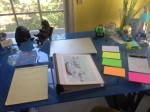
For the second—dissecting—read, I prefer hard copy. It provides yet another perspective and, for me at least, a more hands-on one. For this read I keep a stack of index cards and a notepad next to me.
Notepad: I write the name of each character on individual pages, the names of key locations in the story, a page for “timeline,” and any other key things that I need to keep organized. As I’m reading, I jot down key words/phrases for each. This becomes very helpful as I get deeper into the Harry Potter world staircase of my first draft—things shift; the notepad helps me stay true to the characters, locations, and timing.
Index cards: I use different colors for different plot threads. As I’m reading, I’ll pull the appropriate color card and jot down scene notes. For example: at the top of each card, I’ll write the plot thread, the chapter and the scene within the chapter, who’s in the scene, when does it take place, where is it happening, what’s happening.
During this second read is when I also refer back to any feedback I’ve received—critiques, contest feedback, even comments on previous manuscripts that may translate to the current work.
3) It’s puzzle time.
I take my fancy colored index cards and lay them out in chapter and scene order. This gives me a quick visual of what my story looks like. Armed with the notes I’ve taken and any feedback from other readers, I can see what’s missing, what scenes are redundant, which ones do nothing to move the story forward, and which ones are in the wrong spot.
Now I arrange the cards as necessary, mark ‘delete’ on some, mark ‘moved’ on others, and add new ones (note: use a different color pen and/or write “new” or whatever else works for you on these addition cards so you can easily tell what will be fresh copy versus editing existing).
At the end of the process I’ve—are you ready? Seatbelts buckled?—plotted. Seriously! Me … plotting. So there you have it—I may pants my way through a first draft but I’m a plotter with revisions.
What’s your process? Are you a pantser or a plotter? Or are you equal opportunity depending on the draft?
About Orly
After years of pushing the creativity boundary in corporate communications, Orly decided it was time for a new challenge. Three women’s fiction manuscripts later (plus a handful of picture books), it’s safe to say she’s found her creative outlet. When she’s not talking to her imaginary friends, she’s reading or at least trying to ignore everyone around her long enough to finish “just one more paragraph.” Orly is the founding president of the Women’s Fiction Writers Association.
I’ve been thinking a lot about story endings, probably because I’m getting close to one in the book I’m working on. But also we watched 2 Guns the other day and it has a fabulous mirror from the beginning to ending—that mirror technique where the last scene echoes the opening scene, but everything is now different, is a great technique. And to pull it off I think you really have to know where you’re going—it’s all about structure.
In 2 Guns, we open with the heroes coming into a diner opposite a bank. They seem to be planning a bank robbery. But nothing is as it seems—these guys are playing each other and aren’t really who you think they are. I won’t offer up spoilers (rent the movie—it’s a good one and Denzel Washington and Mark Walberg make it all work). But the end scene is our heroes going into a diner opposite a bank. They’re planning a bank robbery—but everything is different due to what you (the viewer) now know and due to what our good guys have gone through.
To make this work, the movie has to do a small jump back in time at the opening. But it does work. And so I’ve been thinking how any story works best when you can mirror the ending to the opening. But this means you need to know where you’re going (or you have to go back to the opening once you get to the ending to see how you make the story come full circle).
But this also leads me to thinking about what you really want in a great ending.
What to Write Toward:
1. Great endings always feel inevitable.
There’s a sense that the story HAS to come to this. This takes some work and thinking on the writer’s part because you have to build up to this point. Now, there is such a thing as writer’s instinct and some writers know how to structure without being able to tell you they do this. I’m not one of those writers. I have to work it out and think it over and revise—but I know I want this feeling of the story building to an inevitable point. This means I either need to know up front the scene that I want at the end or when I get to the end I want to look back and make sure I’ve set up this inevitable ending.
2. Great endings always surprise.
What I’ve learned is that surprise is not shock. I learned this early on when I had what I thought a great twist in a story—a real game changer. I took it to my readers and got back disappointment. I found out that a twist is just that—but if you make it into too tight a twist or turn, readers aren’t going to be happy. Shock comes from something too unexpected—it suddenly feels as if the writer is cheating the reader. And that’s not fun for the reader. So I’ve learned I don’t want to be too clever. I want a surprise at the end that seems inevitable—so one that gives the reader plenty of hints about what’s coming. Again, this comes from looking at the ending to make sure I foreshadow events.
I had this happen with both Burn Baby Burn and Riding in on a Burning Tire—both books are Urban Fantasy, and when I got to the end, I had one character make a major change and another one show up unexpectedly. The changes to the end scene were good ones—they added to the conflict and tension. But I couldn’t leave them hanging there. I had to go back to the earlier parts of the book and structure in enough scenes so that I could lead the reader up to the ending and make it a surprise, not a shock that comes from left field.
3. Great endings bring emotions full circle.
I think this is as important as the mirroring—in fact, it’s part of that mirroring. When any story opens, the main character’s life is out of balance and the main character is pushed into action. In the ending, the main character has to be shown to have come to some resolution that relates back to the opening—things have changed. The main character has changed. (Even in 2 Guns, a buddy film, you can easily see that Denzel Washington’s character is the main character—he’s at the emotional core of the film.)
What I’ve found is that books with an emotional resonance at the end provide a lot more satisfaction to the reader—these are the books that resonate. When an ending seems a little flat or just not right, I look to the emotion. What am I setting up as the main character’s arc? Does the main character go on an emotional journey? What does the main character learn in the dark moment? What does the main character demonstrate as being learned in the end of the book? Those are key questions for me to answer to make sure the book comes full circle.
4. Great endings give the reader enough but not too much.
There’s a story that Fred Astaire said he always got a dance routine perfect and then cut ten minutes. The idea is the old Vaudeville adage to leave ‘em wanting more. This is always a fine balancing act. If you end a story too abruptly the reader is left unhappy and the ending seems unsatisfying. If you linger too long the story can drift into being boring—meaning the reader is left wondering why this story is going on and on.
What I’ve learned is that you want enough end-story to balance what the character has emotionally endured. In other words, a very intense, emotional story needs a little bit of time to wind down and bring the reader some closer from all that emotion. That’s where an epilogue can be really useful to balance the story. Also, if a character makes a huge change, the reader needs to see the character has really changed—this needs to be demonstrated in a scene. This is why so many stories with bad-boy heroes have epilogues to show that he really has reformed. And this is a place where early readers can really help you to say if you’re lingering too long with your characters, or if you need a little bit more closure.
I had this withProper Conduct. I ended the story where I thought it should end, but it really needed a touch more closure on the story. So I added a little bit more to make the ending more satisfying to the reader.
5. Great endings tie up all loose ends.
This is also a tough one. I’m sure we’ve all been swept away by a movie or a book, and then we’ve realized later that the story never did sort out what happened to character X. The worst ones for me are the ones that pull in a dog or a horse—and you never know what happened to that dog or horse. That, to me, is just careless laziness. If you put in a character and give that character a subplot arc, make sure you hit the end beat. And, in general, you want to do this before you wrap up the main story. For me, this means I need to know all my subplots so I can make sure I’ve given them twists and an ending.
Imagine if, in Casa Blanca, you didn’t find out what happened to Claude Rains’ character, Captain Renault. That would have left the movie a little annoying—you might not have known why you walked out unhappy, but you would be less than satisfied. The fact that the movie ties up all the subplots in a terrific ending is one of the things that makes that movie great. That’s what we want to make sure we do with our stories, too.
Look at all your characters. Did you give everyone a little “star turn” moment in the story? Does everyone have a resolution? If not, go back and put it in somewhere. Remember to check every character’s arc. I do this with an edit that just looks at each character—it really helps the entire story become more satisfying.
Now, if you’re writing a series you often have to set up stuff for the next book. That’s fine. The question to ask then is, did you resolve enough to leave the reader satisfied? I’ve actually bailed on some series books just because the book was a great setup—but didn’t satisfy. That meant I didn’t trust the writer not to give me a good read in the next book, and the next after that. Remember that a story is something of a promise between you and readers—you are taking some of their time in exchange for a good read. If you deliver on this, you’ll have readers coming back for more.
6. Great endings sell your next book.
This is a saying that’s been around forever, and there’s more than a little truth in it. The sale comes because the reader does want more. If you give the reader a terrific read, with a satisfying ending that has an inevitable ending and just enough twist to keep the reader surprised but not shocked, you’ll have a reader who wants your next book, too. This means you don’t have to resort to tricks of cliff-hanging a book, or using obvious manipulation. In fact, you don’t want to use tricks at all—look to craft strong characters that have strong goals, clear reasons for those goals and put it all together with an end that mirrors your opening.
Don’t be satisfied when you finish a book—your work is just starting there. Go back and check every character arc. Look to see if you really mirror the opening and ending. Look to see if your character really did face a terrible dilemma at the dark moment—yes, even a comedy needs that.
Once you finish a story, that’s the time you can go back and make sure you have all the pieces in place to really give readers a great read. And use a few early readers to get their feedback. They’ll help you know if you really did pull off the feat of a story that hooks the reader and keeps them hooked from page one until the very end.
So what do you think? Have you ever used these techniques to craft a satisfying ending? Any other tips for us?
Shannon Donnelly’s writing has won numerous awards, including a RITA nomination for Best Regency, the Grand Prize in the "Minute Maid Sensational Romance Writer" contest, judged by Nora Roberts, RWA's Golden Heart, and others. Her writing has repeatedly earned 4½ Star Top Pick reviews from Romantic Times magazine, as well as praise from Booklist and other reviewers, who note: "simply superb"..."wonderfully uplifting"....and "beautifully written." She is also the author of the Mackenzie Solomon, Demon/Warders Urban Fantasy series, Burn Baby Burn and Riding in on a Burning Tire. She is currently working on her next Regency romance, Lady Chance.
Today I'm shaking my Cowbell about social media, with an emphasis on your profiles. Those header graphics and text are one of the biggest tools in your arsenal to catch people's eyes.
I know, I know. I’ve got writing pals who are worried their heads might explode. I’m already on Facebook, they whine. I just want to stay home and write in my pajamas. Why do I have to talk to people?
Because you do.
We all need to build a writing team to survive in this crazy business. The process of getting a book published requires a massive amount of teamwork.
The easiest place to find those team members is online. Programs like LinkedIn can be a big part of your team-building success once you understand how it works and how to navigate it like a rockstar.
The most important thing to remember?
You get two inches, or six seconds, to make your first impression.
(Get your mind out of the gutter! You’ve gotta hang out at More Cowbell for thoughts like that.)
Seriously, it’s a common saying in the business world. Get your most important point into the subject line and the first paragraph of an email because that’s all most people will read. Even as an author, we’re aware that we have anywhere from two paragraphs to two pages to engage an editor, agent or reader.
Hook people quick, or they’re moving on.
The average resume or LinkedIn profile gets no more than 6 seconds to engage someone. The same goes for a tweet or a Facebook author page header. To be fair, the average person is looking for different things than the recruiters I mention in the link above, but 6 seconds is still the average browse time.
What makes people scroll past your "top two inches?"
1. Your pictures and graphics.
Whether it's a profile, a blog header, or a newsletter, the very top needs to capture the essence of your brand.
On Facebook, this might include a photo of you and your book cover.
Any photos should be a clear, close, front-facing shot.
If you're included, it's best for you to look friendly and attentive.
Unless you work with kids or animals, there shouldn't be anyone else in the picture with you. No spouses, no kids, and on LinkedIn no hats and sunglasses in that profile picture.
Here is an example of a great header graphic. Below is the blog header for August McLaughlin's blog. She is a thriller writer, a health writer and is building an amazing platform on sexuality called GirlBoner. August has been doing some really smart branding.
Before you read a single word, you can see what August looks like, that she's written a book, and that you can find her online using the #GirlBoner hashtag. You can also see from that flirty heart on the left that she equates GirlBoner with love and sexuality.
2. Professional Summary
What are you doing now? What have you done in the past? Many authors build a profile in a program like LinkedIn and then let it moulder. They don't update it as their career develops, even though these updates are usually quick. By adding current and past positions to your profiles, space allowing, you get a quick summary of this in your top profile block on LinkedIn (I'll show this below) or at least a more updated profile in a program like Twitter.
For example, my pal, Marcy Kennedy, is a Twitter expert, but she is also an amazing freelance editor. By adding those two little words to her Twitter profile, she gives a much more comprehensive 140 character portrait.
Thriller writer and pet expert, Amy Shojai, joined LinkedIn about a year ago and she has been rocking the platform. Below you can see how important it is that she keeps up her work experience. It's a mini-resume in a two-inch space.
One I can type from memory and share easily. And the other...I can't, and won't.
When we started the Writers In The Storm Facebook page, one of the first things we did was customize our URL. It started as some ridiculous sequence of numbers that no one was going to remember. The same thing was true for my Jenny Hansen personal profile. All you have to do is go to your Settings and edit your "username" under General Account Settings.
4. Multiple points of contact
If you don't want to be called, you don't need to put out your phone number. But you should have an email, blog, website or a social media account like Twitter listed in your About page on your website/blog or in your contact info on LinkedIn.
An added bonus: Changing your profile picture on Facebook or updating your contact settings sends out an update, which puts you at the top of your connections' feeds. That is always a win.
Here's Amy Shojai's contact page on LinkedIn, a platform where you can have LOTS of data showing:
What about a program like Twitter where you don't get a lot of space?
Note how Marcy's in-page Twitter profile to the right shows only her website. You only get room to list a single site on Twitter, unless you want to take space from your 140 characters.
This is why it's so important to have an updated website, or if you live at your blog, to have an updated About page that allows people to find you.
Facebook expert, Lisa Hall-Wilson, recommends that your header graphic include your website for this exact reason. You don't want to make people scroll down for your information, because they won't.
I chose the graphics above as great examples because:
They give a complete impression of the person, including picture, blog, and other social media info.
They clearly list what that person is up to.
They’re friendly and engaging, yet professional.
Where possible, they include contact information.
Most give a very clear sense of the person's brand.
Remember, if you don't put "the good stuff" at the beginning, there is a fine chance people will miss it.
Do you think of these issues when setting up your social media? Do you have any how-to questions? What elements do you think are missing from your own profiles? Feel free to list your social media links in the comments so we can all follow you!
About Jenny Hansen
By day, Jenny provides training and social media marketing for an accounting firm. By night she writes news articles, humor, memoir, women’s fiction and short stories. After 18+ years as a corporate software trainer, she’s delighted to sit down while she works.