
Writing Without Following the Rules Too Closely
by Ellen Buikema
Sometimes taking a walk on the wild side, stepping outside the writing norms, can lead to great results. Here’s why ignoring writing rules can lead to interesting works.
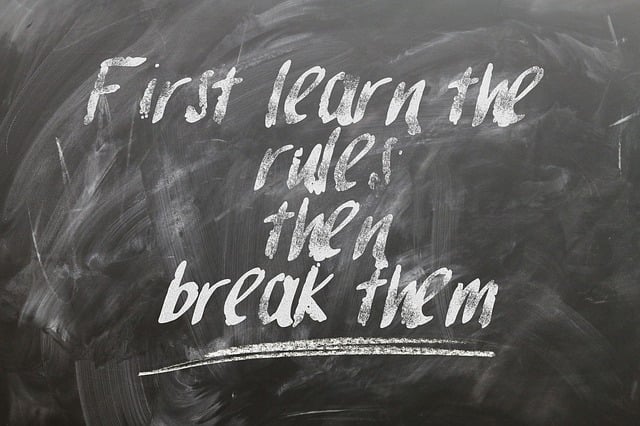
First, Know the Rules Before You Break Them
The main elements are:
- Clarity and Coherence: Ideas are easy to understand and flow logically.
- Grammar and Syntax: Sentences and punctuation are used correctly.
- Structure: Have a clear introduction, body, and conclusion.
- Tone: Use a tone that your readers expect based upon the story’s purpose.
Reasons to Break Those Rules
Breaking the Norms for Effect
Breaking writing norms is best done as a deliberate choice to strengthen the power of your writing. Consider a personal narrative. Using unusual sentence structures can mirror an experience, especially for chaotic exploits.
How to Break the Rules
Very short sentences give a feeling of urgency. “I said stop!” So does using an action verb before the subject instead of the more common Subject, verb, object. “Watch out for those buzzy, candy-filled kids!”
Think about the reason you’re writing and what you want to get across. If straying from norms serves a purpose, it’s worth trying.
Engaging and Distinctive Voice
A unique voice can make your writing shine. When you stick to the norms, your writing won’t stand out. Breaking the rules to create a distinctive style that allows your readers to relate on a personal level. For example, blog posts can benefit from a conversational, more personal tone that doesn’t strictly follow formal writing rules.
How to Break the Rules
Write as if you are having a conversation with a friend. Use colloquialisms, contractions, and a relaxed voice to make your writing feel real and keep your readers engaged.
“For years, I’ve kept my two worlds separate.
There’s Jenny, the fiction writer, lover of craft, believer in the power of story. And there’s Jen, the Storyselling Sherpa, who helps businesses articulate their difference so they can build trust and increase revenue.
I’ve never really blended the two.
But in 2023, while spending long hours in a chemo chair, wondering whether I’d get through to the other side, something became very clear: Life is too short to do work you don’t believe in.” — Jenny Hansen
Enhanced Emotional Impact
Now and then, breaking the rules can boost the emotional impact of your writing. You can create a sense of urgency by using unconventional formats or grammar. For instance, using sentence fragments or varied punctuation can control rhythm, understanding of the sentences, heighten emotions, and add tension more effectively than following traditional rules for writing.
How to Break the Rules
Use short, impactful sentences for suspense and a sense of urgency. Play with punctuation to create drama or rhythm. “For sale: Baby shoes. Never worn.” — Earnest Hemingway
Genre Shifts
Readers have different expectations, depending on the genre. For instance, a reader of romance novels expects a happy ending.
What’s considered a norm in one genre might be uncommon in another. Fantasy and science fiction genres often alter the rules with the creation of imaginative worlds and invented languages.
How to Break the Rules
As part of research, read several genre-specific stories to get a feel for what the authors composed. See if their methods/ideas are a good fit for your narrative, regardless of traditional writing rules.
J.R.R. Tolkien, who’s Elvish is my favorite invented language, is said to have developed languages for fun. This interesting article is about the topic of inventing fictional languages.
Innovative Perspectives
Rule breaking can change your paradigm, leading to new perspectives and fresh ideas. Nontraditional approaches might unlock creative problem-solving.
How to Break the Rules
Challenge existing perspectives. Experiment with different viewpoints, even if they are very different from established norms.
The Improbability of Love, by Hannah Rothschild, is told from the viewpoint of a painting.
Reader Engagement
Writing outside of the norm can make readers curious. Readers may be more interested in a story that invites them to engage in new ways, making the reading experience memorable.
How to Break the Rules
Weave interactive elements into your writing. Create a narrative that encourages readers to think and engage with the story’s content. Try interactive narratives in your story. Have alternate endings.
Here are 20 classic novels that almost had different endings.
An interesting story with many possible alternatives is Pretty Little Mistakes by Heather McElhatton, with more than 150 possible endings.
Unleash Creativity
Letting go of rigid rules allows for more creativity. For example, Naked Lunch by William S. Burroughs, with a nonlinear and disjointed narrative, reflecting the protagonist's addiction and fragmented consciousness. And Mark Z. Danielson's House of Leaves by Michael Seidlinger who’s novel is known for its unusual layout.
Varied:
- Words per page
- Text direction, sometimes sideways
- Pages filled with footnotes
All reflecting the confusing, labyrinth-like nature of the house.
How to Break the Rules
Try experimenting with non-linear storytelling. Let thoughts and ideas flow in a stream-of-consciousness fashion even if it means ignoring standard grammar rules.
Final Thoughts
Writing norms and conventions have their place, however breaking the rules can lead to great results. Defying traditional rules can set up new and different possibilities for your writing.
Get feedback from your Beta readers on how the broken rule sounds. That can help determine if you’ve found your writing voice.
* * * * * *
About Ellen

Author, speaker, and former teacher, Ellen L. Buikema has written Parenting ... A Work in Progress, non-fiction for parents, and The Adventures of Charlie Chameleon chapter book series with stories encouraging the development of empathy—sprinkling humor wherever possible. Her Works in Progress are The Hobo Code, YA historical fiction and The Crystal Key, MG Magical Realism/ Sci-Fi, a glaze of time travel.
Find her at https://ellenbuikema.com or on Amazon.
Top Image by Gerd Altmann from Pixabay
Leave a Reply
14 comments on “Writing Without Following the Rules Too Closely”
Tagged as:
Subscribe to WITS



Recent Posts
- Could Your Novel Become a Microdrama?
- The Best PR Bait Is NOT Your Book
- Make Your Setting Work Harder
- Why Does My Story Feel Broken?
- The Mirror Is Not Your Friend
Great post, Ellen. There is a world of difference between innovation and ignorance. Most readers love the former but get really turned off by the latter.
Thank you, ac! I'm sure your readers appreciate the results of all the research you do to have your worlds make sense. I suspect many sense your efforts rather than know how much time you put in. Clarity is important!
Great post! Writing is more art than science, which is one reason I don't worry about AI replacing good writing. I like bending the rules on occasion (doesn't everyone?). My particular pet peeve is having to fit my writing and my characters to the concept of genre. Stories, like people, don't belong in neat little boxes.
Ooh! I totally understand that.
Many a great story cover multiple genres and we're supposed to decide which one fits best. That's a poser to be sure.
Thanks, Diana!
Hi Ellen,
These are great ways to get unstuck as a writer as well. Thanks for the ideas to inspire my writing. Creating alternative endings is always a fun exercise!
Kris
Thanks, Kris!
I'm also a fan of creating alternative endings.
I was in college getting my degree in writing. I'd worked so hard to learn ALL the rules. Finally got to an advanced fiction writing class. I remember: we were sitting in the hallowed halls of academia, in a room that had literally been built AROUND the long antique table that we all shared for the class. The teacher explained that breaking the rules was a stylistic choice and a sign of advanced writing. I remember slamming my pencil on the desk in frustration. (Yes, it was that long ago...) I'd worked for years to learn the rules... only to be told that it was good to break them.
Of course, now I understand how stylistic that is and how critical it is to break them appropriately. LOL
Oh, Lisa!
I'll bet that was super annoying. All that hard work wasn't for nothing though. Best to know the rules before ya bend or break 'em. Cheers!
This is well said. I agree- know the rules before you break them. But break them when you need! In The Grim Reader, I broke some sentence structure rules for effect. In my current fantasy WIP, I’m breaking with several traditional structures to create my MC’s voice and to add tension to scenes.
Thanks for this post!
Hi Miffie,
You bring up an important point. Breaking rules for effect. There should be a reason to break those writing rules.
I'm glad that you enjoyed the post!
I too, am enthralled by J.R.R.Tolkien's linguistic genius, but I feel compelled to point out that the correct word choice for the above sentence should be "J.R.R. Tolkien, whose Elvish is my favorite invented language, is said to have developed languages for fun." (rather than "who's")
Apologies for nitpicking...lol.
LOL
Nothing wrong with picking a few nits.
Tolkien was a wonder!
When I began writing my debut novel in 2013, I had zero formal training in creative writing. Since winning my first award for a short story in the 4th grade, I'd always just kind of winged it. Now, my little Irish grandmother had taught Spelling & Grammar in the 1930's, so I knew how not to get my mouth washed out with her lye soap...again.
"Yes, Grannie, I understand that 'You should be eating, children.' is not the same as 'You should be eating children'."
For that first novel, my main character was far in the future, telling the story of how he came to be, and all that transpired, and how an artificial person could become a father.
I needed a prologue and an epilogue for that.
And EVERYONE told me, No no no, do NOT. That nobody uses prologues and epilogues anymore. That was old-school. Just tell the story.
Well...as it turns out, the prologue worked perfectly as the hook, while maintaining that 'second to last chapter' placement at the start of the story. The epilogue delivered the Big Surprise Ending, while transporting the reader far into the future again, and preparing the way for the sequel.
The folks at IPPY liked it, awarding it for Excellence in Independent Publishing, SciFi, in 2015.
By the time I started writing my third, I had formally learned The Rules.
The writing is better, yes. But, the road to freedom now has curbs.
Great reminder that the rules are there to be understood first. One small craft rule I always appreciated is the Chicago approach to numbers in prose — spelling out one through one hundred and using figures above that. It sounds fussy until you notice how jarring it is when a ransom note reads “one million dollars” in one scene and “$1,000,000” in the next, and suddenly your suspense hinges on credibility. For anything financial or legal in-story, writing amounts in words is what the real world does anyway — banks honor the words when figures and words disagree.