
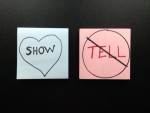
Most writers know Show Don’t Tell, but sometimes they think they’re showing when they are telling.
Here’s my oh-so-easy check.
Read the sentence that you think SHOWS the reader something.
Ask yourself ---- What’s the Visual?
You may be surprised that the sentence doesn’t provide a visual.
Wondering why I care?
Wondering why I think you should care?
Most readers have a video playing in their mind of the scene they are reading.
If a writer TELLS instead of SHOWS, the reader’s screen goes blank. No imagery. No power.
When the writer TELLS, they’re sharing what the POV character is thinking. They’re intellectualizing for the POV character.
The writer is not putting the emotional power on the page.
TELLING:
He looked angry.
She seemed agreeable to the plan.
He made a face.
She didn’t say anything, but he could tell she was pleased.
He knew she was nervous.
She looked like she wanted to go with him.
Jake seemed out of sorts.
If you’ve read one of my blogs before, or taken one of my online courses, or consumed one of my lecture packets, you know I always provide examples that support my teaching points.
Here comes the fun!
Example 1:
“Someone got hurt.”
She studied Susan’s face. “Are you okay?”
Whoops. What’s the visual?
We’re missing the subtext. We need to know Susan’s facial expression.
Example 2:
The POV character is watching Sam.
Sam moved around in an agitated manner.
What’s the visual?
Both parts of that short sentence are TELLING.
How did Sam move?
How does the POV character know Sam is agitated?
What’s his facial expression?
Example 3:
Mike is the POV character.
Traci seemed upset. “I need to leave.”
Mike touched Traci’s arm. “Don’t leave. We need to talk.”
What’s the Visual? Mike touched Traci’s arm, but the reader doesn’t know how Mike can tell Traci is upset.
The writer could SHOW, and share subtext, with Traci’s actions or face or voice.
Writers don’t need to add SHOWING to every sentence or paragraph. But many sentences need those visuals. They share the emotion, hook the reader.
Now we’ll dig deeper into some complex examples.
The Ones We Trust, Kimberly Belle, 4-time Immersion-Grad
First Example from Kimberly Belle
Kimberly Belle could have written:
Dad nodded, but I knew he was still upset.
But this is what she wrote:
Dad nods at me over the top of his menu, but his forehead doesn’t clear. His eyes don’t unsquint. The general is a man who misses nothing, including, according to his scowl, the reason behind my non-reply.
Deep Editing Analysis:
Slipped in a hint of setting:
- over the top of the menu
Showing What’s Not Happening:
- his forehead doesn’t clear
- his eyes don’t unsquint
Power Internalizations:
- the general is a man who misses nothing
- the reason behind my non-reply
Compelling Cadence
Everything shares subtext and deepens characterization.
Second Example from Kimberly Belle
Kimberly Belle could have written:
Dad let go of his anger.
But this is what she wrote:
Dad leans in, and everything about him softens. His posture, his expression, his ten-hut tone.
Deep Editing Analysis:
Shows Dad softening: his posture, his face, his voice
Second sentence is a frag. Works well.
Rhetorical Device: Anaphora – Triple Beginnings
- His posture, his expression, his ten-hut tone
Rhetorical Device: Asyndeton – No and after last comma
- His posture, his expression, his ten-hut tone
Character-Themed – Her Dad was a General
- his ten-hut tone
Compelling Cadence
Third Example from Kimberly Belle
Kimberly Belle could have written:
“Things you don’t want to understand.”
But this is what she wrote:
His expression is like a sluice, locked down tighter than the White House during a terrorist threat. “Things you don’t want to understand.”
Deep Editing Analysis:
She gave the reader a facial expression, amplified.
Rhetorical Device: Simile
- like a sluice
Character-Themed -- Her Dad was a General.
- locked down tighter than the White House during a terrorist threat.
Power Words: Words that carry psychological power.
- sluice, locked down, tighter, terrorist, threat
The Curse of Tenth Grave, Darynda Jones, NYT Bestseller, 2-time Immersion-Grad
Empowered Example from Darynda Jones
Darynda Jones could have just written one sentence:
He gave me his full attention.
But this is what she wrote:
He finally gave me his full attention. He put down the pen he’d been holding and sat back in his chair. The movement was so small, so every day, and yet it sent a tiny rush of excitement spiraling over my skin.
He’d rolled up his sleeves, exposing his corded forearms. His strong hands. His long, capable fingers.
He noticed me noticing for sure that time, but instead of reaching out to me, instead of inviting me into his personal space, he waited. He simply waited. For me to speak? For me to act? I had no idea which, so I went with the former.
“Yeah, so, for this plan to work, we are going to need a dozen syringes, a case of nitrous oxide, a serial killer, and a tank.”
I included more paragraphs than needed, but I wanted to share Darynda’s awesome line of dialogue. :-)
Deep Editing Analysis:
Showing, Amplified, many times.
First Paragraph:
Telling:
- Gave full attention
Showing:
- Put down pen
- Sat back in chair
Telling – Carried psychological power
- small movement
- so everyday
Stimulus/Response:
- Stimulus – all the Telling and Showing above
- Response – Visceral -- a tiny rush of excitement spiraling over my skin
Second Paragraph:
- Action -- rolling up sleeves
- Clear Visual – forearms, hands, fingers
Third Paragraph:
- Showing What’s Not Happening
- Power Internalizations
Fourth Paragraph – Power-packed dialogue – lots of power words, backloaded with tank.
Days Made of Glass, Laura Drake, RITA Winner, 2-time Immersion-Grad, Cruising Writers Grad
SHOWING example from Laura Drake.
This Expanded Time scene is one of my all time favorites, by any author.
Harlie, a closet thrill-seeker, runs into an arena to save a Pomeranian from a stampeding bull.
The sweet rush of adrenaline hit her like a heroin-mainlining junkie. It sang through her veins, lifting her, making her impervious—superhuman. She sped up, heart thundering in her ears—or maybe that was bull’s hooves.
Everything seemed to slow. Details stood out in perfect focus: the shine of spit on the dog’s bared teeth, the whorl of hair at the center of the bull’s forehead, a small scar next to its white-filled eye.
In full stride, Harlie reached the center of the arena, snatched the now cowering fur ball by the nape and kept moving. The ground shook with pounding hooves. She tensed her muscles for impact, but felt only a sliding rub of horn on her butt and the rush of air at her back as the bull passed. Clutching the suicidal mutt in a death grip, Harlie sprinted for the fence.
She’d taken only a couple of steps when the panicked yells of the onlookers penetrated the swelling adrenaline chorus in her head. Harlie didn’t have to look. She knew bulls. The animal had wheeled, and from the vibrations in the soles of her fancy cowgirl boots, was bearing down to gore her.
No time. She heaved the dog toward the red-faced men on the opposite side of the fence. Her brain registered a stop-action photo of the little dog flying through the air, hair blown back, mouth open.
She hadn’t known dogs had an expression for terrified but this one sure did. It hit the ground running and streaked for the line of boots at the fence.
Harlie spun on her heel. The bull was farther away than she’d guessed, but closing fast. She shot a glance to the fence. It seemed as if she were seeing it through the wrong end of a telescope. A bull will beat a human in a race, every time. She’d never make it.
No choice.
Tension zinged through her. The timing had to be just right. Failure would come in the form of lunging horns and bone-snapping hooves. Head down, the bull came on.
Decision made, the fear in Harlie’s chest lay down before a rising exaltation of knowing. Crouched in a marathon runner’s stance, she shook the jitters out of her hands and gauged the bull’s closing speed.
One more step –
Harlie exploded, launching herself straight at the bull.
She took two long-jumper strides.
The bull charged in, lowering its head to hook her.
On the third stride, perfectly timed, her foot came down in the center of the bull’s broad forehead. He threw his head up and she was launched, flying over the beast’s back.
It seemed she rose forever, her stomach dropping, shooting the sparkly fireworks of a roller coaster’s first hill. A quiet, high-pitched sound escaped her lips. It might have been a giggle.
When the arc finally began its downward tail, Harlie looked for a place to land.
Awesome example of showing visuals, and how to write a powerful expanded time scene.
Thank you for dropping by WITS blog today.
Please chime in and share your thoughts on What’s the Visual?
Or just click in and say Hi. Let me know you’re here.
Post a comment, and you have TWO CHANCES to WIN!
1. Lecture Packet from Margie Lawson
2. An online course from Lawson Writer’s Academy – worth up to $75!
My WITS blog for April had over 200 posts!
I doubled the drawings and we had four winners.
If the avalanche of comments on this blog WOW me, I’ll double the winners again.
The drawings will be Sunday, 9:00 p.m. Mountain Time.
Check out the courses offered by Lawson Writer's Academy.
1. Revision Boot Camp – May 16 – June 15, registration is still open!
http://bit.ly/RevisionBootCamp
2. Create Compelling Characters – Starts June 1
3. Writing Compelling Scenes -- Starts June 1
http://bit.ly/JuneCompellingScenes
4. How to Write Dialogue with a Psychological Punch -- Starts June 1 http://bit.ly/PowerDialogue
5. Pinterest for Authors -- Starts June 1
6. Virtues, Vices, and Plots -- Starts June 1

Margie Lawson—editor, international presenter—teaches writers how to use her psychologically-based editing systems and deep editing techniques to create page turners. Margie has presented over ninety full day master classes for writers in the U.S., Canada, Australia, New Zealand, and on cruises in the Caribbean.
To learn about Lawson Writer’s Academy, Margie’s 4-day Immersion Master Classes (in Denver, Washington, D.C., Phoenix, Canyon Lake, Dallas, San Jose, Albuquerque, Australia, and more), her full day Master Class presentations, on-line courses, lecture packets, and newsletter, please visit www.margielawson.com.
I love WITS! A big THANK YOU to the uber-fun and uber-talented WITS bloggers!




