
World Anvil: Make Readers Fall in Love With Your World
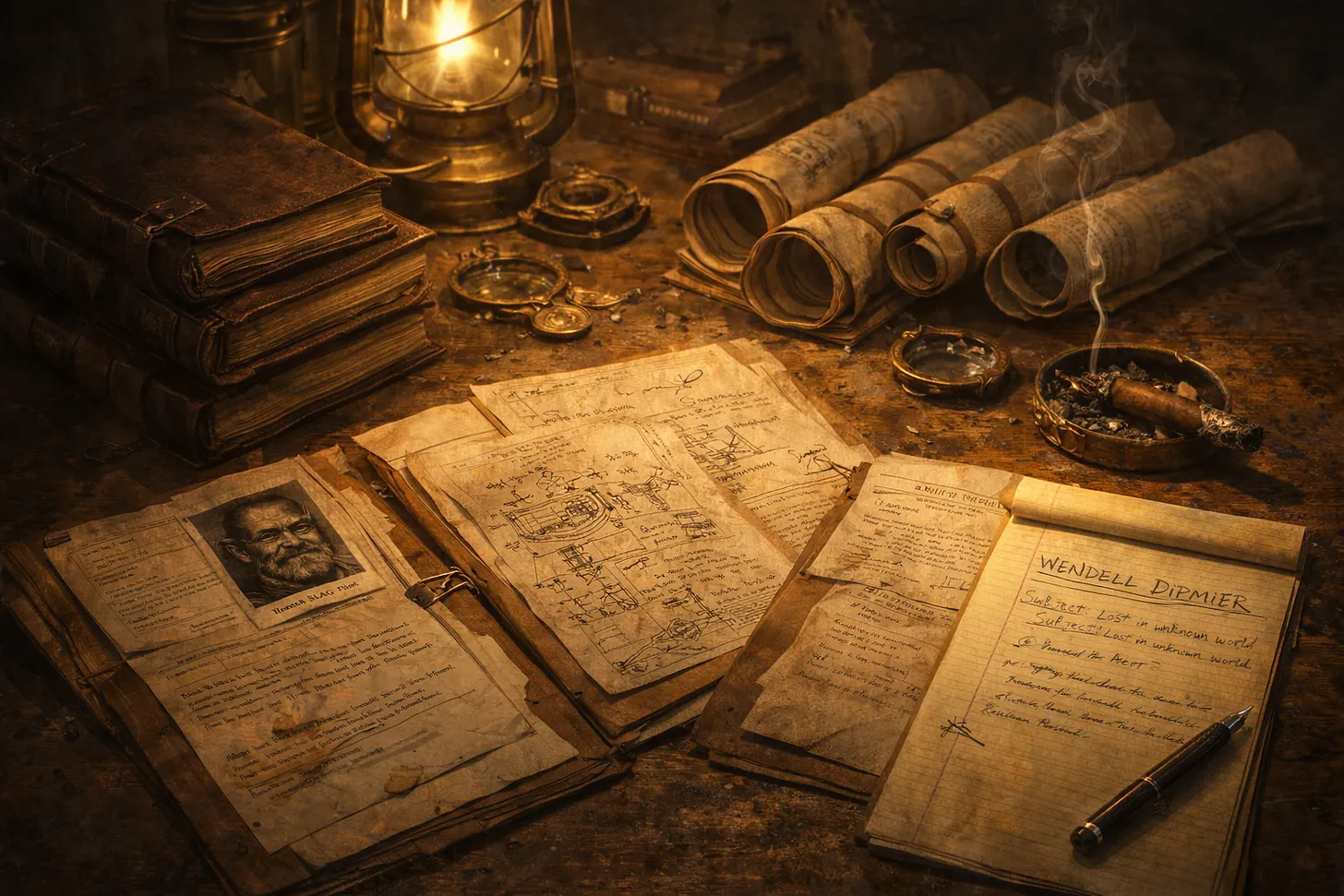
By Jaime Buckley
There is a difference between someone enjoying your story...and someone falling in love with your world.
That difference matters.
A reader can finish a good book, smile, put it down and move on with their life.
But when they fall in love with the WORLD?
Oh, that's different.
Now they want to know where the characters came from.
They want maps. History. Languages. Weapons. Legends. Old wars. Family connections. That weird tavern mentioned for three sentences in chapter fourteen. They want to know what happened to the guy standing behind the king during the coronation. They want to know whether that symbol carved into the doorway actually MEANS something. And if you're clever...
...it does.
This is one of the reasons I've used World Anvil since 2019.
World Anvil currently reports more than 7.35 MILLION fictional worlds on its platform.
That's an absurd amount of imagination in one place.
And somehow, among those millions of worlds, my own Wanted Hero universe at WantedHero.com has grown to receive more traffic than any other world on the platform.
I don't say that to brag.
Okay.
Maybe 4%.
But the other 96% is because I want writers to understand something important:
I don't use World Anvil the way most writers think they're supposed to use World Anvil, and that matters. Just FYI, I'm not an affiliate, I don't gain anything from telling you this…I have just benefited in HUGE ways by using the platform.
If you've read any of my articles here, you know writers are my PEOPLE.
…and I want MY people to WIN.
So listen up, cupcake…cause I'm gonna give you the secret sauce of my online success right here, right now.
My World Bible Isn't Really for Me
World Anvil is usually introduced as a worldbuilding platform.
And it absolutely is.
You can build character profiles, cultures, nations, organizations, histories, timelines, family trees, maps, locations, religions, technologies, magic systems and just about anything else your wonderfully overactive writer brain can invent.
That's useful.
World Anvil itself describes the platform as a way to build an interactive world bible and showcase that material to readers through things like articles, maps, timelines and character profiles.
But that's not the part that excites me most.
I don't primarily look at World Anvil as a place to store information. I see it as a place to create experiences.
That's a very different mindset.
I already have notes. Lots of notes. Probably enough notes to make an archaeologist question my mental stability.
What I want is somewhere my READERS can go.
Somewhere they can wander. Explore. Click on things. Follow characters. Discover connections. Find things they weren't necessarily looking for.
In other words...
I want a candy store.
Life of Fiction Is My Flagship. World Anvil Is My Candy Store.
My flagship online is Life of Fiction, through Substack (my SECOND favorite platform).
That's where the relationship happens. Substack is where I write to readers, publish stories, share ideas, release chapters, talk about creativity and invite people into the larger experience I'm building.
Life of Fiction is the center.
But WantedHero.com, built on World Anvil, serves a completely different purpose.
When readers become curious about something inside one of my stories, I want them to have somewhere to GO with that curiosity.
Maybe they love Dax.
Wonderful.
Go learn about Dax.
Read about his history. Follow his relationships. Discover the places he's been. See artwork. Find quotes. Read comments from other characters. Stumble across a piece of information that suddenly changes the meaning of something you read three chapters ago.
And perhaps, if I've done my job correctly, notice something that makes you think:
"Wait...what does THAT mean?"
Now I've got you.
And it's not because I tricked you. It's because curiosity is one of the most powerful forces in storytelling.
World Anvil is the candy store.
Don't Build an Encyclopedia. Build Rabbit Holes.
This is where I think writers can get World Anvil so very wrong.
They create encyclopedia entries.
Name.
Birthplace.
Height.
Weight.
Occupation.
History.
Relatives.
Favorite breakfast cereal.
Done.
Okay, fine. Technically, that's worldbuilding. Nothing wrong with that. But nobody falls in love with a fictional universe because your character database is extremely organized.
Readers fall in love because the information makes them FEEL something.
So give them rabbit holes.
One article should lead naturally into another. A character leads to an organization. The organization leads to an ancient war. The war leads to a legendary weapon. The weapon leads to the person who created it. That person leads to a civilization everyone believes vanished 800 years ago.
Except...
...there's another article suggesting they didn't.
See what just happened?
You're telling stories between the stories.
That's what makes this powerful, AND crazy fun for you.
Let Your Characters Into the Room
Another thing I do differently on Wanted Hero is avoid making everything sound like it came from a sterile reference manual.
My characters participate.
'The boys' comment.
They argue.
They contradict the historian.
They get offended.
Sometimes they reveal things they probably shouldn't.
…they've even showed up on WITS in force to cause a bit of mayhem.
Höbin Luckyfeller, one of my best friends and award-winning gnome historian, is particularly useful for this. He gives me an in-world reason for why so much information exists in the first place.
Then Chuck can (and often does) interrupt him.
Dax can disagree with him.
Other characters can add observations.
Suddenly you're not reading a database entry anymore. You're spending another few minutes with characters you already love.
That's powerful.
The reader came looking for information.
I gave them personality.
And personality creates attachment.
You can see this approach right on the Wanted Hero introduction, where characters such as Chuck and Dax intrude into what should otherwise be straightforward world information.
That's intentional.
My characters don't know they're supposed to behave inside an encyclopedia.
Apparently nobody told them.
(Not like they'd listen anyway.)
Easter Eggs Are Reader Rewards
I LOVE hiding things.
Seriously.
Give me an opportunity to hide a clue six years before someone understands what it means and I become ridiculously happy.
World Anvil is perfect for this.
A strange reference. A symbol. An apparently meaningless quote. Perhaps a contradiction between two historical accounts, or a character saying something they shouldn't know. Maybe a line buried halfway down an article that suddenly becomes important two books later.
These aren't meaningless gimmicks. They're rewards for paying attention.
Readers who casually enjoy the story aren't penalized because they missed them.
But your dedicated readers?
Your superfans?
They get MORE.
That's exactly how it should work.
The deeper they travel into your world, the more the world rewards them for exploring it.
World Anvil even supports secrets, spoiler controls, private material and subscriber-restricted content, allowing creators to decide exactly how much different readers can see.
Now you've turned passive reading into exploration.
This Also Happens to Be Good Business
We writers occasionally have to discuss that horrible four-letter word…
[Jaime casually locks the door…]
SELL.
You good? We good? No freaking out?
Writers need to make money. If we want the time and resources required to keep creating stories, worlds, art, games, podcasts and whatever else we're building, readers eventually have to be able to purchase something.
World Anvil helps me do that without making the whole experience feel like a sales page.
Someone might arrive because they're fascinated with a character. That character appears in a novel. Guess what they can find, often in the sidebar of the page, casually sitting in the readers peripheral vision?
The novel.
Another reader discovers a location.
There's a story connected to it.
Another discovers one of my books, guides or other products while exploring the world.
World Anvil explicitly supports monetizing worldbuilding, linking to storefronts and giving customers or supporters access to additional material.
That's the way I prefer selling.
Don't interrupt people. Give them something worth wanting.
Then make it ridiculously easy to obtain.
And Now There's Another Reason This Matters: AI
This is becoming increasingly important to me. AI is changing how people discover information online. Like it or hate it, that's happening.
So as a creator, I have a choice.
I can leave machines to figure out who Jaime Buckley is, what Wanted Hero is and what my stories are about from random scraps scattered across the internet...
...or I can create a massive, organized, interconnected body of canonical information myself.
Guess which one I prefer?
World Anvil gives me the greatest degree of control I currently have over what the AI Librarian can use when representing and promoting my work to potential new readers on the web.
That's enormously valuable to me.
Because this isn't random content scraped from somebody else's description of Wanted Hero.
It's MY material.
My character descriptions. My history. My terminology. My lore. My explanations. My links. My books. My universe.
The best part of all of this?
I decide what gets published.
I decide what stays secret.
I decide what information represents the world.
This isn't just worldbuilding anymore.
It's positioning your intellectual property for discovery.
And I believe writers should start thinking seriously about that.
PLEASE start thinking seriously about that.
But There's One Rule You Cannot Ignore
World Anvil will not make readers care about a world they don't already have a reason to care about.
Don't spend four years documenting the monetary policies of seventeen imaginary kingdoms because you think readers are going to stumble across your wiki and demand a seven-book publishing contract.
Story comes first.
Characters come first.
Emotion comes first.
Always.
The story creates hunger.
World Anvil feeds it.
That's the relationship.
My novels introduce you to Wendell, Dax, Chuck and the world they're struggling through.
Life of Fiction lets you experience those stories with me.
Then WantedHero.com says:
"Oh...you liked that?"
Come over here.
I've got something else to show you.
That's the candy store.
Build for the Reader, Not Just the Writer
If you're going to use World Anvil as an author, start changing the questions you ask.
Don't simply ask:
"What information should I document?"
Ask:
"What would someone who LOVES this character desperately want to know?"
Ask:
"Where could I send them next?"
Ask:
"What could they discover here that makes the novel more meaningful?"
Ask:
"What could I hide today that will make a reader scream three years from now?"
THOSE are interesting questions.
You don't need 4,000 articles either.
Start with the characters readers love most.
Build the locations central to your stories.
Document the conflicts, cultures, artifacts and mysteries people encounter in the books.
Connect them.
Then leave doors open.
Never answer everything.
Mystery is oxygen for fictional worlds.
Your Book Is the Invitation
I've been building Wanted Hero for decades.
I've published comics, novels, short stories, artwork, podcasts and more, and I'm still expanding the universe.
But I've learned that a fictional universe becomes something very different when readers have somewhere to explore it on their own.
A novel says:
- Come with me.
A platform like World Anvil lets you say:
- Stay as long as you like.
- Explore.
- Meet people.
- Look around.
- Open doors you're probably not supposed to open.
- Read the old books.
- Study the maps.
- Argue with the historian.
- Find the hidden clues.
- And when you're ready...
- there's another story waiting for you.
That is where World Anvil becomes more than a worldbuilding tool.
It becomes part of the storytelling.
And when you're surrounded more than 7 million other fictional worlds, that's the opportunity I think matters most.
Don't merely create a world readers can read about.
Create one they don't want to leave.
Want to see what I mean? Wander through mine at WantedHero.com.
Just don't blame me when you find a rabbit hole.
I put those there on purpose.
What is your favorite way to pull readers deeper into your story world?
* * * * * *
About Jaime

Jaime Buckley is the author of the Chronicles of a Hero series and the founder of LifeofFiction.com on Substack. He teaches writers how to build a sustainable publishing practice at JaimeBuckley.com and through the online course Substack for Authors.
Featured image by Jaime Buckley.
Leave a Reply
14 comments on “World Anvil: Make Readers Fall in Love With Your World”
Tagged as:
Subscribe to WITS



Recent Posts
- Struggling with Character Voice? Check Your Point of View
- Conflict in Fiction Writing, 7 Main Types
- Author Blind Spots: The Gaps You Can't See
- When Is It Okay to Quit a Story?
- Living at the Corner of FEAR and FINE
Jaime, this is one of the most exciting posts I've read for a long time. I' not heard of World Anville, but I'm going there ASAP. First to see what it's about, then to look at your part.
Thanks so much. I'm excited to get started.
Vivienne, you just made my morning. Thank you!
And your reaction is actually the whole point I was trying to make in the article.
You read about a world, something caught your imagination, and now you want to GO THERE.
That is exactly what we want readers to feel.
Worldbuilding is not just about creating more information. It is about creating curiosity. Giving readers enough to make them lean forward and think, “Wait...what else is there?”
World Anvil gives us a way to answer that question without cramming everything into the book itself.
So yes, go explore! Poke around World Anvil, then come wander through WantedHero.com and see how I’ve used it. Don’t worry about learning everything at once. Just pay attention to what makes YOU want to click deeper.
That feeling you have right now?
That’s the feeling we’re trying to create for our readers.
Jaime,
I love your take on World Anvil. It is an incredible platform. My difficulty in using it in the past has been the coding, the markdown language, I guess. It was tedious for an old dog like me. But, yikes, you have me once again mesmerized with the possibilities. Thanks for tossing me into the danger zone! LOL
Lisa Norman introduced me World Anvil a few years ago, and I imagined it was the perfect way to deliver my world(s) to readers. But it was overwhelming and difficult to use. I wonder if it has become more user-friendly recently.
I would certainly love your thoughts on where to begin, and which subscription levels might be most worthwhile for the writer-creator. (I'm thinking early Santa Claus delivery - Ho! Ho! Ho!)
Jennifer
P.S. GREAT article!
Jennifer...HA!
Welcome back to the danger zone. 😂
And YES, I completely understand what you're talking about. World Anvil used to feel considerably more technical, especially if you wanted things to LOOK the way you imagined them. The language you're remembering is primarily BBCode, and I spent more time than I care to admit staring at brackets wondering what tiny character I'd managed to offend.
The good news is that World Anvil has gotten much friendlier.
They now have a Visual Editor, so you can do the basic writing, formatting, linking, images, etc. without needing to learn all that coding first. The more advanced stuff is still there when you want to get fancy, but you don't have to START there.
And that's actually my biggest advice to you:
DON'T start by building your world.
Start by building one doorway INTO your world.
Pick the book or series you most want readers to fall in love with. Then create ONE location, ONE important character, ONE piece of lore, and maybe ONE mystery or unanswered question.
Connect those four things.
Then stop and look at what you've made.
That's enough to understand the real power of World Anvil without waking up three weeks later surrounded by 347 unfinished articles and wondering where your family went.
As for subscriptions, I'd actually start free and play with it first. If you decide, “Oh yes...I can USE this,” then I think Master is a perfectly sensible place for most writers to begin.
Grandmaster starts becoming interesting when you're thinking less like “I need somewhere to organize my world” and more like “I want to DESIGN an experience for my readers.”
And Sage is really the professional/business level.
That's where things like stronger branding, custom domains, white labeling, larger reader-access options, and the professional tools start mattering.
That's closer to how I use World Anvil today, but I absolutely would NOT tell someone just getting started to run out and buy the biggest package.
...unless they're like me and don't mind juming in with both feet and learning at a master level from day one.
Learn what you need first.
THEN spend money.
Santa will appreciate the fiscal restraint. Ho! Ho! Ho! 😂
Actually, your question has me thinking I should do a follow-up article specifically on “Okay, I Joined World Anvil...Now What?” because THAT may be the missing bridge between seeing the possibilities and actually using the thing effectively.
Thanks, Jennifer.
And thank you for the wonderful compliment.
Jaime, thanks for such a well-rounded and thoughtful response. You didn't have to do that, but you did. 🙂
The link to wanted hero led to a host error. I was really curious as to how you set up your world. I've been wanting to create a map of my fictional town and Chat isn't giving me what I'm looking for. I have two series set in the same world and this sounded like an interesting way to keep track and share.
Sylvie, thank you for telling me about that!
The Wanted Hero link problem is actually a security/certificate issue connected to some of the changes World Anvil has been making around security and AI, and I’ve been working with their support team all weekend to get it resolved.
They literally just told me they’re generating and installing a new certificate for the site, and that once it’s in place, some people may need to clear their browser cache or try another browser/device before the old error disappears.
So...you managed to arrive at precisely the moment I had the hood up and tools scattered all over the driveway.
Honestly I forgot the article was going live today and not next week.
UPDATE (already): It's fixed.
Please try WantedHero.com again shortly. I really WOULD like you to see it, because what you’re describing is exactly where World Anvil becomes useful.
Two series sharing the same world is a perfect example.
You can have the town exist ONCE, with its map, locations, history, businesses, families, secrets, important events, and whatever else matters...then both series can connect back into that same living body of information.
And that’s where I think the idea changes from “keeping track of my notes” into something much bigger.
Your readers can eventually explore the same town YOU have been carrying around in your head.
The map doesn’t even have to be perfect on day one. Start with the places that matter to the stories. Where does someone live? Where do they eat? Where did something terrible happen twenty years ago? Where do the teenagers go when they don’t want adults finding them?
Suddenly it isn’t just a map.
It’s a place.
And if you can make readers feel that the town continues existing even when the book is closed...you’ve done something very powerful.
Thank you for letting me know about the error, Sylvie.
And please do try again (remember to clear your browser cache first).
I’d love to know what you think once you can actually get through the front door.
I tested and wantedhero.com is working. So is mine: [Link deleted]
Curiosity is absolutely key to pull readers deeper into stories. I try to develop memorable characters that stay with readers after the story is over.
This is awesome, Jaime! Fantastic information. I'm pumped to learn more about World Anvil.
Ellen, thank you!
I love that you’re already thinking about this in terms of the characters.
That’s where my heart is too.
When a reader finishes one of my stories, I don’t want those characters to simply vanish because they reached the last page. If I’ve done my job, the reader still cares about them. They’re still wondering about their lives, their relationships, where they came from, and what happens next.
And THAT curiosity is such a gift.
World Anvil gave me a place to do something with it.
Instead of trying to squeeze every interesting detail into the novel, I can leave some doors unopened...and give the curious reader a way to walk through them later.
That’s been one of my favorite discoveries in building Wanted Hero.
And knowing how much you care about creating memorable characters, Ellen, I have a feeling you’re going to start seeing possibilities everywhere once you get inside World Anvil.
Just remember: you don’t have to build EVERYTHING.
Give readers one more reason to care...then one more place to explore.
Thanks for the kind words, my friend. I’m really glad this one got you pumped.
I love everything about World Anvil. Thanks for sharing it with our readers!
Lisa, you KNOW how dangerous it is to give EITHER of us an opportunity to talk about World Anvil.
LOL
I could have written three times as much and still had things left to say.
What I love most is that it gives us somewhere for all that imagination to LIVE. Especially after the book is finished. It's not just notes for us as writers, but places our readers can actually explore and become part of.
Thanks for letting me share this with everyone, Lisa.
I really hope a few writers walk away from this article realizing their fictional worlds can become MUCH bigger than the pages they started on.
- Jaime
Sounds like self, author constructed, fan fiction.
Hmmmm.
That’s actually a really interesting way to look at it, Matthew.
And in one sense...sure. You COULD call some of it self-authored fan fiction.
Except I think that definition becomes too small almost immediately.
What happens when the author creates stories that never belonged in the novels?
What if I write the childhood adventure of a side character readers love, or the legend behind a ruined castle, or the journal of an explorer who lived 400 years before the main story begins?
Is that fan fiction?
Maybe.
But what if the “extra” material is a living bestiary filled with creatures readers can discover?
Or an interactive world encyclopedia?
Or maps where readers can click on towns, ruins, taverns, battlefields, kingdoms, and hidden locations?
Or family trees, ancient languages, religious beliefs, political factions, recipes, songs, artifacts, historical documents, timelines, newspapers, wanted posters, field journals, letters between characters, puzzles, mysteries, and Easter eggs?
At some point, we’re not really talking about bonus fiction anymore.
We’re talking about expanding the STORY EXPERIENCE beyond the book.
And THAT is what fascinates me.
For most of publishing history, the book was the container. You had 300 pages, maybe 500, and whatever didn’t fit stayed in the author’s notebook.
That restriction doesn’t really exist anymore.
The novel can remain the MAIN event, and I think it should. I never want readers to need a website to understand the book.
But for the reader who finishes the story and says, “I don’t want to leave yet”...
Why make them?
Let them explore the world.
Give them the bestiary.
Let them read the history of the kingdom.
Show them the map.
Let them discover what happened to that minor character five years later.
Maybe hide something that changes the way they interpret a scene they already read.
That’s where I think things get REALLY interesting.
Authors have spent decades trying to build audiences around books.
I think we have an opportunity now to build experiences around WORLDS.
And if we do that well, readers stop simply consuming stories.
They start belonging somewhere.
That’s a completely different relationship.