
The Burnt Butterscotch Latte: My AI Origin Story
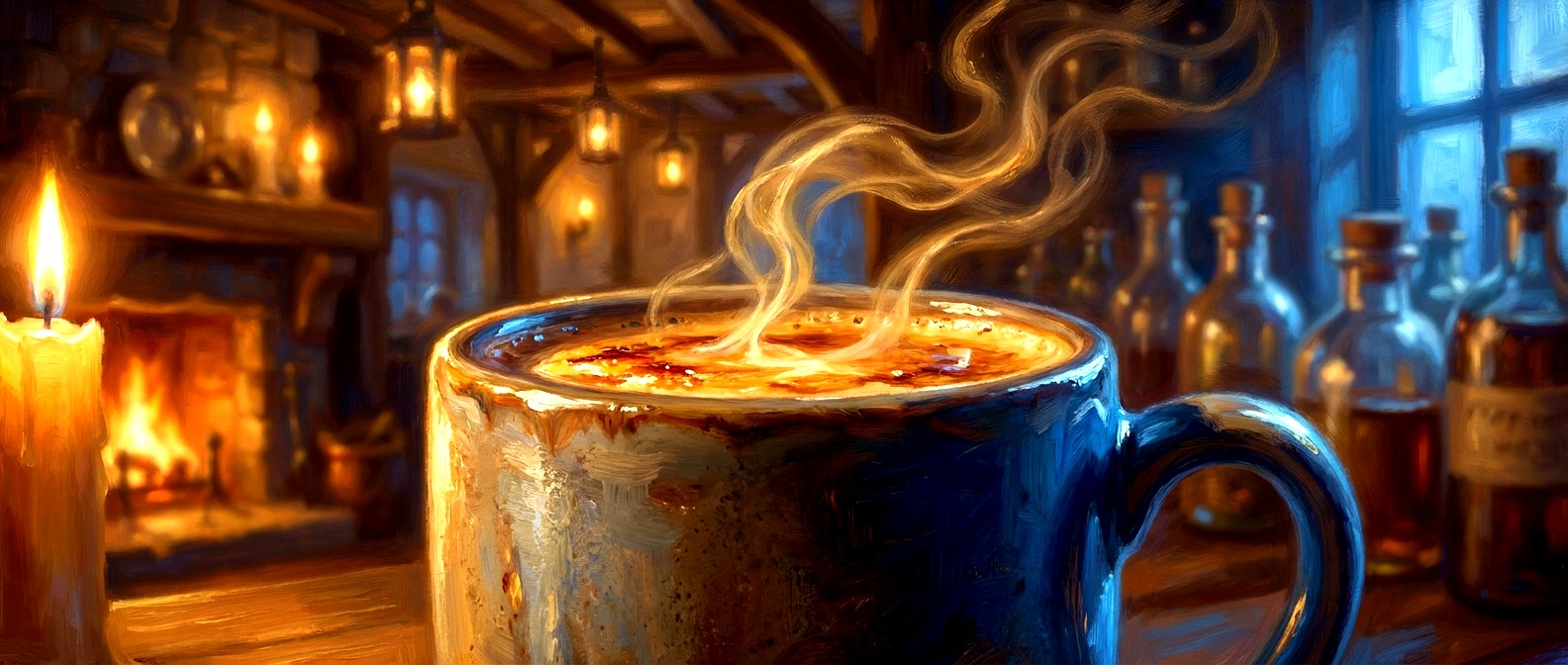
By RJ Redden
Spring 2022. I'm driving home, radio low, one hand hovering over the blinker before I've even consciously decided to turn, because my body knows this route better than my brain does.
I come up on my usual Starbucks, read the sign, and do the sigh. Because I already know how this is gonna go. I’ll walk in, ask for my coffee, get The Face from the barista (kind, but useless), and walk back out holding whatever's closest on the menu. A consolation prize dressed up as a decision.
My favorite coffee is burnt butterscotch latte. And I do mean burnt: the kind that tastes like caramel that almost escaped the pan but didn't, sweet with a smoky shadow trailing right behind it. Starbucks makes a great one, but only in the fall.
So I'm sitting at a red light doing math on exactly how disappointed I'm about to be. And a thought saunters in sideways, hips first, like it already knows it's about to rearrange my whole life.
You see, I'd just started poking around with this GPT thing.
What if, instead of settling for whatever's next, I skipped the counter and ask AI how to build the drink myself?
I drove straight home, and my answer came back: butterscotch extract and a little liquid smoke, just enough to smell like trouble. I poured it over a shot of espresso still ticking hot from the machine and took a sip standing at my own kitchen counter. No barista, no apologetic face anywhere in sight. Burnt-sugar smell curling up out of the mug like it had been waiting just for me.
It worked. It actually worked. The whole mug tasted like a campfire had fallen hard for a butterscotch sundae. And somewhere behind my eyes, my brain cracked open like a jar giving up its seal.
If I can build one recipe this way, I thought, I can build more. The coffee shop stuff is always so boring anyway.The same fourteen syrups just wearing a different trench coat depending on the season. Surely I can do better than that…
Then One Recipe Turns Into a Hundred
So I went hunting for extracts, and not politely. Picture the counter of a woman who has fully lost her sense of reality: little glass soldiers of extract lined up like a spice rack that had a breakdown, vanilla and toffee crowded next to one bottle that just says “smoke #3” in Sharpie because I'd run out of names. My whole kitchen started smelling like a bakery that couldn't decide what it was baking.
I was off to the races, writing recipe after recipe, and somewhere around recipe number two, still cradling that first burnt butterscotch latte like a trophy, a second thought sat down right behind the first one.
This drink needed a real name, something that belonged to my world, the fantasy tavern I'd been building in my head for years called the Come Write Inn. A harmless project, right?
So I had GPT pitch me titles. I picked one. I had it pitch descriptions, then did what I always do. I took what it gave me, and marked it up in red pen
Then I kept going. A whole slate of coffees, each one carrying a name and a sliver of story poured right into the cup.
A hundred coffees later, that is still exactly how it works.
The Loop, Explained Like a Barista Who Can’t Quit
This is the part I need you to actually get, because it's the entire point. I do not take what the AI gives me and call it finished, not on coffee one, not on coffee ninety-four.
Think of it the way a judge on Chopped sends a plate back for missing the mark, except the plate is actually a paragraph. I ask GPT to write the description for a coffee called the Widow's Toast. Round one comes back.
It's fine. It's technically words in a row, just not words that sound like they came out of my mouth. So I send it back. I tell it exactly what's off and what needs to go. Round two comes back closer, but still not quite it. I cut a line here, sharpen a phrase there. Out that description comes again.
Four rounds. Six. Sometimes ten, if that recipe's being stubborn. Every pass, the only question that matters is whether the words are finally right. The answer is no, right up until the second it isn’t.
That's the loop, spelled out plain: draft, critique, resubmit. Then again. And again, until it's something I'd actually put my name on. The AI hands me the first draft. I'm the one doing the shaping, and somewhere in the back of my head Ted Allen is already clearing his throat to ask what inspired this coffee.
The point isn't the material. It's refusing to stop shaping the draft until the page is right.
Then the Pictures Started Talking Back
Chapter two of this saga: I had roughly ten coffees fully written and wanted images to go with them. GPT couldn't generate images yet, so I grabbed stock photos that were close enough and called it good for now. Flat and generic, tasting of nothing much at all. Understudies standing in for stars who hadn't yet been cast.
Then the day came. The tool could suddenly generate images, and I was at the stage door before it had even finished opening. I took the description already written for a coffee, fed it to AI, and asked for an image. What came back was so much closer than I’d ever been. My world went from two dimensions to three in as many seconds.
I saw it. My world. Right there on the screen. It’s that moment when you’ve been carrying something around with you so long, something that no one else had ever seen.
Then, because apparently I don't know the meaning of leaving well enough alone, I pushed one step further. I took the finished image and fed that back in too, asking a different question this time, one layer deeper than the coffee itself: tell me the story of how this exact picture came to be.
Out came an extended backstory nobody had asked for, lore behind the lore. Same loop, just a bit larger.
A Hundred Coffees Later, I Still Can't Stop
That loop is still running right now, today, probably while you're reading this. Every coffee in my world has a title, ingredients, a description, a backstory, a character sheet, and in some cases a whole time-shifted history of how it came to sit on that tavern's menu.
We’re in over a hundred coffees deep. Forty-seven extracts currently live on my kitchen counter, lined up like a chorus line waiting for their cue, right next to a coffee machine that runs most of the day. A shrine nobody asked me to build and everybody who visits comments on anyway.
It isn't finished.
New flavors keep showing up. And somewhere along the way they stopped being just coffees. Characters started climbing out of them, and whole places came trailing right behind, magic items and all.
Start With Something That Doesn't Matter
This is the idea I actually want you to walk away with. I started with something fun and harmless.
Nothing was going to explode if a coffee description flopped. No client was waiting on the other end of a bad latte name. People write throwaway coffee shop copy every day of the week. It's about as low-stakes as language gets, and that's exactly why it made a safe door to walk through.
I fully expected the whole experiment to go nowhere. If that had happened, I'd have shrugged and gone on with my Tuesday.
Instead, one silly, doesn't-matter-if-it-flops drink order turned into the spine that holds up my entire fictional world. I'd tried building this world by hand before, with tea and notebooks and big brave stabs at a “series bible”. I stalled every time.
It just felt too big. I never knew which wall to start painting first. What actually cracked the world open was smaller than any plan I'd ever tried: one small idea nobody would miss if it flopped. Looped on with zero pressure to be brilliant. Then my whole world snuck in sideways while I was busy naming a latte.
So tell me. What's your burnt butterscotch latte? The one small, doesn't-matter-if-it-flops thing sitting in your writing life right now that you could hand to AI, just to see what loops back at you. Drop it in the comments. I read every one, and I will absolutely have thoughts.
CALL TO ACTION
If you want your own kitchen-counter moment, the kitchen's open. I'm hosting a Free Week of my NO BS AI class: seven days, two real things built by your own hands, no coding required, and I’m here to help you through. https://nobsai.now/free-week
About RJ

RJ Redden is your digital fairy godmother for audience engagement. Her wand wields AI, chatbots, and augmented reality to create experiences so engaging, your readers will forget Netflix exists. She also speaks fluent human in a world obsessed with algorithms. Find her at The Come Write Inn.com. This article was edited with AI assistance, because this fairy godmother believes in using every tool in the workshop — ethically and transparently.
Share this:
Facebook X Pinterest Reddit LinkedIn Threads Email Share
Pictures contributed by the author
Leave a Reply
16 comments on “The Burnt Butterscotch Latte: My AI Origin Story”
Tagged as:
Subscribe to WITS



Recent Posts
- Conflict in Fiction Writing, 7 Main Types
- Author Blind Spots: The Gaps You Can't See
- When Is It Okay to Quit a Story?
- Living at the Corner of FEAR and FINE
- Could Your Novel Become a Microdrama?
Lovely.
...as I knew it would be.
Hobin and I read that with huge grins, knowing our teacher was doing the rounds at WITS.
Love you tons 💗!
Jaime! You and Hobin grinning over your coffee is the exact picture I needed today — thank you both. Getting to do the rounds at WITS is a joy, but doing it knowing people I love are reading along? That's the good stuff. Love you tons coming right back atcha 💗
I love your enthusiasm, your brilliant creative mind, and your obvious joy, RJ. It's a great delight to hear your stories and realize I can follow the path you have opened for us. I am definitely going to join your class.
Thanks!!!!!
Sally
I have an AI story. I am working with a client on a growing up on a working cotton plantation in 1950s Louisiana semi-fictional memoir. He found a farmer with a small boy and a dog picture set against an amazingly beautiful sunset and asked me if we could use it for the book. I told him no, it's copyrighted, but I can see if I could generate something that we could present to our cover artist that would guide her in the right direction. I haven't used AI much yet for picture or images but I thought I'd give it a try. I tried to describe his dream picture with words like dog, farmer, boy, cotton bolls, flat Louisiana land, and sunsets. I am a writer, after all, and thought I did a good job. After two hours of discussion with CoPilot about the fact there are no mountains in Louisiana, that cotton bolls do not look like chrysanthemums, and that I wasn't being clear in my instructions, I got a beautiful picture my client loves that will go to the cover artist next week. AI is an amazing tool, just like a hammer or a screwdriver. Just have to use it for the right purpose.
Excellent story! Two hours negotiating with CoPilot over the geological impossibility of Louisiana mountains AND the botanical truth that cotton bolls are not chrysanthemums — and you walked out with a picture your client loves. That's the whole craft in one story: AI is the hammer, but you are still the carpenter. ☕
Sally, this made my whole morning — thank you. That joy is real and it turns out it's contagious. I promise the path is far more walkable than it looks from the outside, and I'm thrilled you're joining the class. Come ready to play. 💛
Delightful! So these are actual extracts rather than coffee syrups? I need to try some of your recipes, because they're all amazing looking. Marketing is one thing I'm currently working on turning over to AI. There's a level of research that AI is good at but that bores me. It has already surfaced areas that I hadn't thought to consider before, and I'm having fun experimenting. Disclosure: I have taken your class, and it is phenomenal. It's about expanding the ways authors can use AI to handle all of the drudgery, leaning into tools we'd never thought we could control.
Affirmative, the flavors are all extracts. you can also use syrups, just lighten the amount of sugar you put in so it doesn't end up tasting like candy. 🙂
You found the coffee nerd in me; I will never turn down a chance to talk recipes, so ping me any time. And thank you for the disclosure — it means the world coming from someone who's actually been in the room. "Leaning into tools we never thought we could control" is exactly the reframe I want every author to carry. Now go have fun making the marketing do the boring parts. 💛
A word of caution. Your idea is yours, but you can't copyright an idea. You can only copyright the text. The text may well belong to the AI even though you are editing it, unless you have a contract that says you own whatever is produced from your idea. This is the way work-for-hire is done. They give me the idea. I write it. They edit it. Because there is a contract, they own all rights to the text I produce. As far as I know, there is no case law on who owns what AI produces. I am not a lawyer, but I have heard agents/editors discuss this as the reason no publisher will take work produced with AI in this way. They can't be sure of who owns it. It's worth looking into before asking AI to produce text or art for use in a published work.
Debbie, thank you — genuinely. This is exactly the kind of caution authors need, and you've laid it out more clearly than most people manage to. You're right that the ownership question around AI-generated text and art is still unsettled, and it's absolutely worth every author looking into before putting anything into a published work. I appreciate you bringing the work-for-hire lens to the table; it's a valuable one to sit with.
One imagage from an overseas trip. One folktale or superstition from a foreign country. One new food. One dream. One freaky moment of one day. One funny sentence overheard. And I have many of each of these. This was a fun post! Thanks!
Karen, do you realize you just wrote a poem in the comments? One image, one folktale, one new food, one dream, one freaky moment — that's not a list, that's a year of story seeds. Go plant a few. So glad you had fun. ☕
Congratulations on your coffees and your world! Thanks for sharing the fun brainstorm with us.
Thank you, Jenny! Getting to share the messy, joyful brainstorm out loud is my favorite part — I'm so glad you came along for it. 💛
I cannot decide if this is really about coffee or a metaphor for something else? Nice essay either way
Matthew, I'm going to let you sit in that delicious uncertainty, because honestly? It's both. It was always both. Thank you for reading it either way. ☕