

By Piper Bayard
of Bayard & Holmes
Writing espionage is a balancing act between being authentic and being so accurate that we embarrass political leaders, get people killed, and/or end up with some angry FBI Special Agents on our doorstep. As a general rule, while the non-violent embarrassment of political leaders who are asking for it can be rewarding, writers, like all smart and decent people, want to avoid harming any of our own people or having uncomfortable conversations with the FBI. My writing partner, “Jay Holmes,” is a 45-year veteran of intelligence field operations, and we are committed to helping writers walk that line of authenticity.
Recently, Holmes and I had the opportunity to entertain some excellent questions during an online RWA workshop, and we want to share a few of the questions and answers with you.
1. What is the American television show that comes closest to accurately portraying spies?
2. Which movies most accurately represent the CIA? Which are less accurate?

Since Holmes and I are not familiar with all of the shows and movies out there, I threw this to the Intelligence Community ("IC") on Twitter for a broader response. Many of the shows recommended are not specifically American, but so many things cut across the entire profession, such as bureaucratic interactions, tradecraft, and the challenges personnel face, that Holmes and I did not limit ourselves to American shows in our answers.
As for accurate representation of the CIA, the CIA has an extensive and diligent review board that is very careful to make sure that no movies made by employees or former employees accurately represent it, so with the help of the IC on Twitter, I pulled in movies from other services, as well.
It was a joy to see the response from the Intelligence Community on Twitter. It stirred a rousing conversation that lasted two days, producing answers we never would have thought of on our own.
TV SHOWS
THE AMERICANS is accurate in much of its tradecraft and the realities of the Cold War. Three things are distinctly fiction about it, though. First, no country would use deep cover agents for such mundane things as thefts, honeypots, or assassinations. Second, there is no fast, fake facial hair that is good enough to stand up to a marriage. Disguises that detailed take more time and effort. Third, not even the Soviets would have recruited Paige like that. The children of real Soviet sleeper agents most likely do not know to this day that their parents were not born Americans.
LIBERTY CROSSING, one of my personal favorites, is a comedy about the National Counterterrorism Center (“NCTC”). It is pure genius for showing the personalities and inter-agency dynamics. Pay particular attention to the gap between the reality of what is actually happening, what is reported by the media, and the impact of the media on politics and, therefore, the NCTC assignments. Spot. On.
THE SANDBAGGERS is an older British series that is brilliant in its portrayal of what goes on behind operations as well as in the field. Though it’s older, the international and inter-agency dynamics haven’t changed. Often, many conversations and bargains occur between organizations and between allies to accomplish intelligence operations. The series is now only legally available on DVD, and it can be found at networkonair.com.
For more military-type personalities and espionage operations, THE BRAVE is excellent. In fact, it was good enough to upset some people.
THE NIGHT MANAGER is a BBC series based on the book by John le Carré, and you can never go wrong with John le Carré.
TURN is a portrayal of the Culpepper Spy Ring from the Revolutionary War. Excellent period piece to watch for the aspects of intelligence work that never change—the danger, the uncertainty, the courage, the motives, dead drops, and the way people of all financial statuses and backgrounds can be united in a common cause.
Holmes and I are fans of the Israeli show FAUDA, which was developed by two former members of the Israeli Defense Forces and based on their personal experiences. Heavy on smart field action, it is also rich in social and cultural depth. Fast-paced and violent. Find it on Netflix, where it is available in Arabic and Hebrew with subtitles.
JACK RYAN is fun and well written, though certainly fictional in its premise of an analyst involved in dangerous field work. Jack is a financial analyst for the CIA, not an operations officer. Many people switch back and forth between operations and analysis, but while they are working as analysts, it is unlikely that they would go out on operations that have a high expectation of violence. If they are like Jack, with no prior operational training or operational experience, it is even more unlikely. The fact that Jack is a former Marine does not change that, as even former Marines need operational training. However, I would point out that the dating difficulties Jack experiences are very real for those in the IC, even the analysts.
The French show THE BUREAU is an intelligence community favorite, as well as the first season of KILLING EVE.

As for COVERT AFFAIRS, I watched the pilot. It’s fun, but literally the only realistic thing about this show is the reference to donuts. I have it on good authority that the halls of HQ abound with a copious amount of donuts, croissants, pastries, and sweet stuffed things, as well as the occasional cookies I send to friends to share at the office.
More TV favorites of the Intelligence Community:
Deutschland 83 and 86, The Spy (Israeli series), Chaos, Intelligence (CBC), Counterpart, The Assets, Smiley's People, The Bletchley Circle, A Perfect Spy, Patriot, and Restless.
MOVIES
John le Carré was a former member of the British intelligence services, and it’s generally agreed that his works are among the most accurate, with A MAN MOST WANTED, THE LITTLE DRUMMER GIRL (the movie), and THE SPY WHO CAME IN FROM THE COLD topping the list.
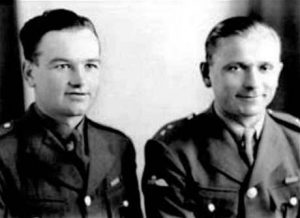
Image by UK Govt., public domain
ANTHROPOID is the historically accurate movie about the operation to assassinate Reinhard Heydrich in World War II. It is outstanding in showing how messy, imperfect humans can accomplish something “impossible” in the field, even when everything goes wrong. It is true to the story of Jan Kubiš and Jozef Gabčík.
CHARLIE WILSON’S WAR is a favorite of Holmes’s and an excellent movie about Texas congressman Charlie Wilson’s involvement in obtaining US support for Afghanistan against the Soviet Union during the Cold War. However, it is not an accurate portrayal of Milt Bearden, the man who ran the Afghan efforts. Milt Bearden is not a hard-drinking individual or in any way slobbish. He is a calm, level-headed, high-respected intelligence professional.
THE LIVES OF OTHERS is a German film about Stasi surveillance of citizens of East Berlin during the Cold War.
THE GOOD SHEPHERD includes an aspect of Intelligence Community history that is not frequently mentioned in popular culture—the influence of Yale’s Skull & Bones society. While Yale and other Ivy League schools are still well-represented at HQ, there are now also many private school alums and state college grads among the Intelligence Community ranks, and the CIA and other branches actively recruit at schools known for their diversity.
RED and GET SMART, though satirical comedies, are oddly accurate in the jokes, the attitudes, and, with RED, the personalities of those who are on the kinetic fringe of intelligence operations.
SUM OF ALL FEARS is recommended for the reality of the analyst scenes, though the movie itself is far-fetched.
The least accurate movies and TV shows are anything that show CIA operations inside US jurisdiction, which includes HOMELAND and more things out of Hollywood than I can name. Equally absurd are shows that have the CIA or any other US intelligence organization deliberately killing innocent people, killing off their own people, breaking serial killers out of jail to assassinate people, or brainwashing people to assassinate people. HANNA is fun, both the movie and the series, and it has some great action, but in no universe does the CIA sequester children from birth or perform biological experiments on them. The Soviets, however? They were another matter, and that is a different post.
More cinema favorites of the Intelligence Community:
Body of Lies, Munich, Spy, The Patriots, The Black Book, Spy Game, The Angel, Bridge of Spies, Ronin, Hidden Agenda, Hopscotch, The Quiet American, Ace of Spies, Our Man in Havana, Spies of Warsaw, The Tailor of Panama, Prisoners of War, the Johnny Worricker Trilogy, Office Space, Three Days of the Condor, The Falcon and the Snowman, The Tall Blond Man with One Black Shoe, In Bruges, and Tinker, Tailor, Soldier, Spy.
A big thanks to the Intelligence Community on Twitter for coming to our aid with this question. You folks rock!
It’s worth noting that after the first two hours or so of bandying about movie titles on Twitter, it was acknowledged that many of these movies recommended were not particularly accurate, but they are fun, and that is the point of fiction, after all.
What espionage questions would you like to see us address here at Writers in the Storm? Bayard and Holmes are also open for questions down in the comment section.
About Bayard and Holmes

SPYCRAFT: ESSENTIALS, takes the fiction out of spy fiction, covering the functions and jurisdictions of the main US intelligence organizations, the espionage personality and character, recruitment, tradecraft techniques, surveillance, firearms, the most common foibles of spy fiction, and much more. WIt is available in digital format and print. See Bayard & Holmes Nonfiction for links to your preferred bookseller.
Piper Bayard and Jay Holmes of Bayard & Holmes are the authors of espionage fiction and nonfiction. Please visit Piper and Jay at their site, BayardandHolmes.com. For notices of their upcoming releases, subscribe to the Bayard & Holmes Covert Briefing. You can also contact Bayard & Holmes at their Contact page, on Twitter at @piperbayard, on Facebook at Piper Bayard or Bayard & Holmes, or at their email, PiperBayard@BayardandHolmes.com.




